

Grafton Monster : The Headless Cryptid of West Virginia
| Description | |
|---|---|
| Origin | United States of America |
| Classification | Cryptid |
| Demeanour | Elusive |
| Habitat | Riversides |
| Status | Not Proven |
Mythlok Perspective
In Mythlok’s perspective, the Grafton Monster represents a uniquely modern myth, one born not from ancient ritual but from newspapers, headlights, and postwar uncertainty. Unlike older forest spirits or ancestral beasts, it reflects a society beginning to doubt the limits of what science could explain. When compared cross-culturally, the Grafton Monster mirrors headless guardian figures found in Celtic folklore and faceless yokai from Japanese tradition, all of which embody fear of the unknown landscape rather than direct hostility. Across cultures, headless beings often symbolize disruption of identity and order, suggesting that the Grafton Monster functions less as a creature and more as a warning born from liminal spaces.
Grafton Monster
Introduction
The Grafton Monster is one of the most unsettling cryptid legends to emerge from the United States, rooted firmly in the small Appalachian town of Grafton, West Virginia. The story entered public consciousness in the summer of 1964, when a respected local journalist reported a disturbing encounter with a massive, headless humanoid near the banks of the Tygart Valley River. Unlike older folklore passed down through generations, the Grafton Monster was born in the modern media age, documented in newspapers and debated openly by authorities, skeptics, and residents alike. This unique origin gives the legend a strange credibility, blurring the line between eyewitness experience, collective panic, and regional mythmaking. Decades later, the Grafton Monster remains a defining figure in West Virginia’s cryptid landscape, frequently compared to other American monsters yet retaining a personality and mystery entirely its own.
Physical Attributes
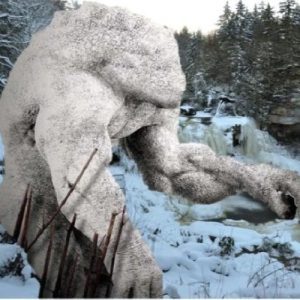
Descriptions of the Grafton Monster have remained remarkably consistent across accounts, which is one reason the legend has endured. Witnesses describe a towering humanoid standing between seven and nine feet tall, with an extremely broad upper body measuring nearly four feet across. The creature’s build was said to be thick, muscular, and disproportionately heavy in the torso, giving it a powerful, almost sculpted appearance. Its skin was smooth and reflective, often compared to rubber or the hide of a seal, and appeared pale white or dull gray under artificial light. The most disturbing feature was its apparent lack of a head, with no visible neck or facial structure. Observers believed the head may have been recessed into the chest or shoulders, creating a seamless, faceless silhouette. Its limbs were described as short but dense, with arms ending in large, three-fingered hands that suggested considerable strength despite the creature’s unusual proportions.
First Sighting/Reporting
The Grafton Monster legend began on the night of June 16, 1964, when newspaper reporter Robert Cockrell was driving home along Riverside Drive near the Tygart Valley River. At approximately 11 p.m., his headlights illuminated what he initially believed to be a large obstruction on the road. As he approached, the shape resolved into a massive, upright figure unlike any animal or person he had ever seen. Cockrell later described the creature as motionless but clearly alive, emitting a strange, high-pitched whistling sound. Startled and fearful, he fled the scene and later returned with companions, only to find the creature gone. What remained was a flattened area of grass and the lingering sound of whistling from the nearby riverbank. When Cockrell published his account in the local newspaper, the reaction was immediate and explosive, triggering multiple alleged sightings and transforming a quiet town into the center of a national cryptid story.
Other Names
While most commonly known as the Grafton Monster, the creature has acquired several alternative names over time as the story spread beyond local newspapers. The name “Beast of Grafton” was often used by residents to emphasize its size and menace, while “Headless Horror” became popular in paranormal literature due to its most defining feature. Some researchers and writers referred to it simply as “The Thing,” reflecting both uncertainty and fear surrounding its identity. In casual folklore, lighter nicknames emerged as a way to domesticate the fear, but formal cryptid records typically retain “Grafton Monster” or “Headless Monster of Grafton” to preserve the historical context of the original reports.
Modus Operandi
The reported behavior of the Grafton Monster adds another layer of mystery to the legend. Unlike many cryptids associated with direct aggression, the creature appeared cautious and evasive. Witnesses noted that it often froze when illuminated, then moved away with surprising speed despite its bulky frame. Its movement was described as sideways or gliding rather than forward running, an unnatural motion that unsettled observers. The whistling sound associated with the creature was heard repeatedly, though its purpose remains unknown. No physical attacks were ever documented, and no damage beyond disturbed vegetation was reported. Search parties found no footprints, hair, or physical traces, which led to speculation that the creature was either not fully physical or deliberately elusive. Some theories framed it as a guardian-type entity tied to the river or surrounding land, while others interpreted its behavior as that of a frightened, displaced being rather than a predator.
Pop Culture References
The Grafton Monster experienced a dramatic revival decades after the original sightings through modern media. The creature gained international recognition through the video game Fallout 76, where it appears as a powerful mutated enemy inspired directly by the original legend. This portrayal introduced the Grafton Monster to a global audience and renewed interest in its real-world origins. Paranormal television series such as Mountain Monsters further amplified the legend by framing it as an unsolved cryptid mystery worthy of investigation. Books on Appalachian folklore and West Virginia cryptids frequently include detailed sections on the Grafton Monster, often treating it as a bridge between classic folklore and contemporary urban legend. Through these appearances, the creature has evolved from a local scare into a symbol of Appalachian mystery.
Current Status
Today, the Grafton Monster is widely regarded as an unproven cryptid rather than an active threat. No confirmed sightings have been documented since the late 1960s, and no physical evidence has ever surfaced. Despite this, the legend remains very much alive. In 2024, Grafton hosted its first Grafton Monster Festival to mark the 60th anniversary of the original sighting, celebrating the creature’s place in local history. A dedicated museum space now preserves newspaper clippings, artwork, and research related to the legend. While skeptics attribute the entire episode to misidentification, suggestion, or mass hysteria, the consistency of the original account and the cultural impact it produced ensure that the Grafton Monster continues to occupy a respected place in American cryptid lore.


Source
Guiley, R. E. (2012). Monsters of West Virginia: Mysterious creatures in the Mountain State. Stackpole Books. https://www.goodreads.com/book/show/12767819-monsters-of-west-virginia
West Virginia Encyclopedia. (2024). The Grafton Monster. e-WV. https://www.wvencyclopedia.org/articles/2530
Wikipedia contributors. (2025). Grafton monster. Wikipedia. https://en.wikipedia.org/wiki/Grafton_monster
Fallout Wiki. (n.d.). Grafton Monster. Fandom. https://fallout.fandom.com/wiki/Grafton_Monster
The Clio. (n.d.). Grafton Monster Sighting. https://theclio.com/entry/85659
Believing the Bizarre. (2024). The Grafton Monster. https://believingthebizarre.com/the-grafton-monster/
Monster Creek. (2025). Grafton Monster. https://monstercreek.com/grafton-monster/
Sam Kalensky. (2023). Grafton Monster – [Cryptid]. https://samkalensky.com/en-us/products/graftonmonster
Frequently Asked Questions
What is the Grafton Monster?
The Grafton Monster is a cryptid reportedly sighted in 1964 in Grafton, West Virginia, described as a massive headless humanoid near the Tygart Valley River.
Is the Grafton Monster real?
There is no physical evidence proving the Grafton Monster exists, and it is classified as an unproven cryptid based on eyewitness reports.
Who first saw the Grafton Monster?
The first reported sighting came from newspaper reporter Robert Cockrell, whose account sparked widespread attention and additional reports.
Why does the Grafton Monster have no head?
Witnesses described its head as either absent or recessed into its chest, though no explanation has ever been confirmed.
Is the Grafton Monster connected to Fallout 76?
Yes, the creature appears in Fallout 76 as a monster inspired by the original West Virginia legend.