


Takhar : The Serer Deity of Justice and Moral Balance
Listen
At a glance
| Description | |
|---|---|
| Origin | Serer Mythology |
| Classification | Demigods |
| Family Members | N/A |
| Region | Senegal, The Gambia, Mauritania |
| Associated With | Justice, Retribution, Moral order, Protection against witchcraft |
Takhar
Introduction
Takhar, also rendered as Taahkarr in Serer and Cangin languages, occupies a distinctive position within the spiritual worldview of the Serer people of Senegal, The Gambia, and parts of Mauritania. Rather than functioning as a distant or abstract divinity, Takhar is understood as an active moral force—an intermediary power responsible for restoring balance when human actions disrupt social and cosmic order. Within Serer religion, the universe is governed by a supreme creator, Roog, who establishes existence but entrusts the regulation of human conduct to lesser divine agents. Takhar is one such authority, invoked specifically in moments of injustice, betrayal, and ethical collapse.
Unlike deities associated with abundance or fortune, Takhar represents consequence. His presence reinforces the Serer conviction that moral actions ripple outward into the natural and spiritual worlds. When harmony is broken—through theft, abuse of power, or harmful spiritual practices—Takhar becomes the channel through which retribution is delivered. This role makes him central not only to religious life but also to traditional systems of law, dispute resolution, and communal accountability.
Physical Traits
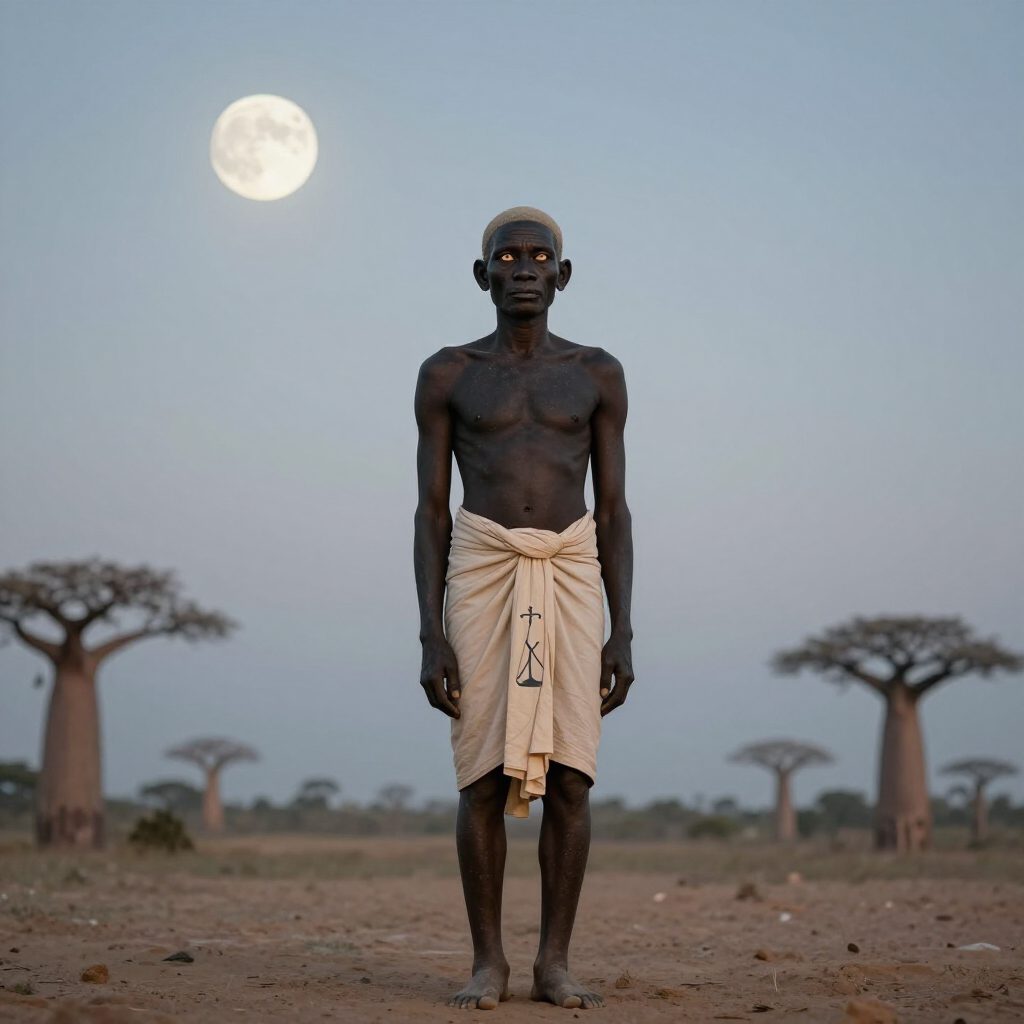
Serer tradition does not portray Takhar with a defined humanoid appearance, and this absence is deliberate rather than accidental. His power is conceptualized as inhabiting space rather than form. Takhar is believed to dwell within ancient trees and sacred groves, particularly in forested regions such as Sine-Saloum, where towering vegetation symbolizes endurance, vigilance, and judgment. These trees are not metaphors but living sanctuaries through which divine presence manifests.
This arboreal association reflects a broader Serer belief that nature is sentient and morally responsive. Takhar’s “body” is the environment itself, especially places untouched by human exploitation. Unlike certain Pangool spirits who may appear in animal or ancestral forms, Takhar remains unseen, reinforcing the idea that justice operates beyond human perception. His invisibility heightens his authority, as punishment or protection arrives without warning, reinforcing moral discipline through uncertainty rather than spectacle.
Family
Takhar’s place within the Serer pantheon is defined by function rather than lineage. He operates under the supreme authority of Roog, who creates but does not directly intervene in daily affairs. Takhar’s role is therefore delegated, making him an executor rather than a sovereign power. He does not possess a spouse, offspring, or sibling network in recorded oral traditions, which further emphasizes his purpose-driven identity.
His most significant relational dynamic is his opposition to Tiurakh, a deity associated with wealth, property, and material accumulation. This rivalry is not mythic conflict in the dramatic sense, but ideological tension. Where Tiurakh represents possession and prosperity, Takhar embodies restraint and accountability. Together, they form a moral counterbalance within Serer cosmology, ensuring that wealth does not eclipse justice. Takhar is also aligned with the Pangool, ancestral spirits who mediate between humans and higher divine forces, though he stands apart as an enforcer rather than a guide.
Other names
The name Takhar appears in slightly varied forms across Serer-speaking regions, most commonly as Taahkarr. These differences stem from linguistic patterns within Serer and Cangin dialects rather than theological divergence. Regardless of pronunciation, the identity and function of the deity remain consistent. He is always understood as the power that responds to wrongdoing and moral imbalance.
Unlike many deities whose names evolve into titles or epithets, Takhar’s naming remains stable, reflecting the seriousness of his role. He is not invoked casually, nor is his name embellished through poetic expansion. This linguistic restraint mirrors the cultural attitude toward justice itself—direct, uncompromising, and deeply respected.
Powers and Abilities
Takhar’s authority centers on retribution, protection, and moral enforcement. He does not reward devotion with prosperity or favor but instead responds when ethical boundaries are crossed. Individuals wronged by theft, deception, or spiritual harm may appeal to Takhar through ritual specialists known as Saltigues. These priests, drawn from respected hereditary lines, invoke him during judicial and divinatory ceremonies to reveal guilt or impose consequences.
Historically, Takhar’s justice manifested through fear of spiritual retaliation rather than physical punishment. Rituals conducted during the new moon, often involving offerings placed at the roots of sacred trees, were believed to summon his presence. Illness, misfortune, or social downfall following such invocations was interpreted as evidence of his judgment. Takhar is also regarded as a guardian against witchcraft and malicious spiritual acts, ensuring that unseen harm does not go unanswered.
His power operates indirectly, reinforcing the Serer belief that justice unfolds through natural and spiritual channels rather than overt divine intervention. This subtlety reinforces accountability, as wrongdoers may never know precisely when or how Takhar’s response will arrive.
Modern Day Influence
Despite centuries of religious change across West Africa, Takhar’s influence remains embedded within Serer ethical consciousness. While many Serer communities now practice Islam or Christianity, traditional beliefs continue to inform social norms, particularly regarding honesty, leadership, and environmental stewardship. Sacred forests associated with Takhar are still protected, functioning as ecological sanctuaries that resist deforestation and exploitation.
Takhar’s legacy also persists through cultural ceremonies such as the Xooy divination festival, where Saltigues interpret signs for the coming year and reinforce communal values. In contemporary discourse, Takhar is increasingly referenced as a symbol of indigenous justice systems—models rooted in moral responsibility rather than punitive excess. Among diaspora communities and scholars, his mythology is discussed in relation to modern conversations on corruption, abuse of power, and restorative justice.
Related Images


Source
Bérenger-Féraud, L.-J.-B. (1879). Les peuplades de la Sénégambie: Histoire, ethnographie, mœurs et coutumes, légendes, etc. E. Leroux.
Keane, A. H., Quiggin, A. H., & Haddon, A. C. (2011). Man: Past and present. Cambridge University Press.
Newland, H. O., & Lewin, E. (1922). West Africa: A handbook of practical information for the official, planter, miner, financier & trader. D. O’Connor.
TalkAfricana. (2021, December 14). The traditional religious beliefs of the Serer people of West Africa.
https://talkafricana.com/the-traditional-religious-beliefs-of-the-serer-people-of-west-africa/
Wikipedia contributors. (2023, March 16). Takhar. Wikipedia. https://en.wikipedia.org/wiki/Takhar
Wikipedia contributors. (2023). Serer religion. Wikipedia. https://en.wikipedia.org/wiki/Serer_religion
Mbiti, J. S. (1990). African religions and philosophy (2nd ed.). Oxford: Heinemann.
Faye, L. (2015). Religion and justice in Serer society. Journal of African Studies, 42(3), 215–230.
Sarr, A. (2009). Sacred trees and justice rituals in Senegambia. African Spirituality Review, 18(2), 145–162
Frequently Asked Questions
Who is Takhar in Serer belief?
Takhar is a demi-god in Serer religion who enforces justice and moral balance, responding to wrongdoing and spiritual harm.
Is Takhar a creator god?
No, Takhar operates under the supreme creator Roog and is responsible specifically for enforcing ethical order.
Where is Takhar believed to reside?
Takhar is associated with sacred forests and ancient trees, particularly in regions like Sine-Saloum.
How was Takhar traditionally worshipped?
He was invoked through Saltigue priests during rituals involving offerings and new moon ceremonies.
Does Takhar still influence modern Serer culture?
Yes, his principles continue to shape ethics, environmental protection, and cultural rituals among Serer communities.
