

Samebito : The Enigmatic Shark-Man of Japanese Lore
Listen
At a glance
| Description | |
|---|---|
| Origin | Japanese Mythology |
| Classification | Hybrids |
| Family Members | N/A |
| Region | Japan |
| Associated With | Weeping jewels |
Samebito
Introduction
Samebito, known in Japanese as 鮫人, is one of the most intriguing aquatic beings in Japanese folklore. Popularised internationally through Lafcadio Hearn’s 1904 story The Gratitude of the Samebito, this shark-like humanoid appears not as a violent sea monster but as a gentle exile whose fate is shaped by compassion. Earlier versions of the tale existed in Japanese literary tradition, including Kyokutei Bakin’s writings, but Hearn’s retelling brought Samebito firmly into modern cultural memory.
In the story, the creature’s chance encounter with a young man named Tōtarō leads to an unexpected friendship that reshapes both their destinies. Themes of exile, loyalty, forgiveness, and the hidden worth of the outcast run deeply through the narrative. Samebito’s jewel-weeping ability, turning sorrow into tangible treasure, reflects a cultural understanding of the ocean as both dangerous and generous—capable of producing beauty through hardship. Today, Samebito stands out among Japan’s sea-bound yōkai for its emotional depth and its rare portrayal as a being whose terrifying appearance hides a kind and noble spirit.
Physical Traits
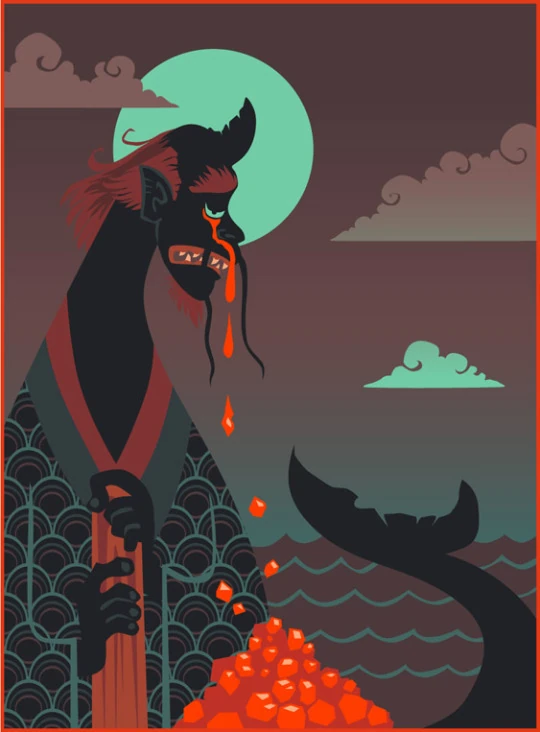
The Samebito is depicted as a striking hybrid of human and shark, evoking both the mystery of deep waters and the raw power of marine predators. It stands upright like a human but is entirely covered in slick, inky black scales reminiscent of a shark’s skin. Its robust frame suggests strength adapted to the pressures of underwater life, while its long limbs give it a somewhat uncanny, otherworldly silhouette.
Its face is one of its most distinctive features—often described as demonic, with sharp teeth lining a powerful jaw and a dragon-like beard that underscores its mythical origins. Despite this intimidating visage, its deep, glowing eyes convey a softness at odds with its outward ferocity. In many depictions, these eyes brim with tears, and those tears are unlike any other: when the Samebito cries from genuine sorrow, its tears of blood crystallise into flawless rubies or jewels. This combination of frightening appearance and extraordinary gentleness makes it one of the most complex figures in Japanese folklore.
Family
Samebito’s origins link it directly to the underwater kingdom of Ryūgū-jō, the palace ruled by Ryūjin, the Dragon King of the Sea. In the folklore, Samebito once served Ryūjin as an attendant or officer within his magnificent palace, placing him within the wider pantheon of aquatic spirits associated with dragons, sea rulers, and oceanic guardians.
There is no mention of biological relatives in traditional stories, highlighting that the creature’s true “family” is defined by duty and spiritual affiliation rather than bloodline. When Samebito is banished from Ryūjin’s service for a minor transgression, the loss of this divine household becomes the emotional core that drives its exile. On land, the friendship it forms with Tōtarō acts as a surrogate bond, allowing it to experience companionship that transcends the boundaries between human and yōkai. Through this, the legend subtly underscores that family can be chosen, forged through loyalty rather than inheritance.
Other names
The kanji 鮫人 can be read in two ways, giving the creature its primary names: Samebito and Kōjin. Both translate essentially to “shark person,” though “Samebito” became the more globally recognised name due to Hearn’s influence.
In older Japanese writings, particularly those referencing South China Sea merfolk or aquatic spirits, the reading “Kōjin” appears more frequently. While some regional folklore loosely connects Samebito to other shark-like yōkai, the two names remain the most consistent identifiers in literary and recorded tradition. Modern retellings and popular media overwhelmingly use “Samebito,” making it the dominant term in contemporary culture.
Powers and Abilities
The most famous ability of the Samebito is its capacity to shed tears that transform into precious jewels, typically rubies. These tears only appear when the creature experiences deep, genuine sorrow. In Hearn’s story, this power becomes the key to helping Tōtarō raise a fortune-required dowry, ultimately leading to the resolution of the tale.
Beyond this extraordinary emotional magic, the Samebito possesses natural aquatic abilities expected of a creature tied to Ryūjin’s palace. It can dwell in the sea or freshwater bodies with ease, exhibits shark-like resilience, and is implied to have considerable longevity. Some literary references also connect Samebito to underwater crafts such as weaving sea silk—reflecting a cultural motif of the ocean producing fine, otherworldly materials.
Unlike many yōkai, Samebito does not rely on aggression to display power. Its abilities are symbolic, tied to emotional truth, redemption, and the idea that beauty can emerge from vulnerability.
Modern Day Influence
Although not as widely represented as kappa or kitsune, the Samebito continues to inspire modern artists, folklorists, and storytellers. Hearn’s writings have cemented its place in Western understanding of Japanese folklore, and scholars frequently reference it when discussing benevolent yōkai.
In contemporary media, shark-humanoid characters in anime, manga, and games often draw visual or thematic inspiration from the Samebito, especially those that mix intimidating strength with emotional depth. Indie artists and digital creators frequently reinterpret the creature with stylised designs, emphasising its jewel-weeping motif.
Folklore blogs, YouTube channels, and educational platforms also retell the Samebito story as an example of compassion in yōkai narratives. Its central theme—that kindness can redeem even the most unlikely of beings—continues to resonate today, making the Samebito a compelling figure for modern mythological storytelling.
Related Images



Source
Bakin, K. (1814–1842). Kōjin [Original tale inspiring Samebito legend]. Japanese yomihon literature.
Davis, F. H. (1912). Myths & legends of Japan. T. Fairbairns & Co. https://archive.org/details/mythslegendsofja00davi
Hearn, L. (1900). Shadowings. Little, Brown, and Company. https://www.gutenberg.org/ebooks/34215
Kyokutei, B. (Early 19th century). Nansō Satomi Hakkenden [Epic influencing aquatic yokai tales]. Sanseido.
Meyer, M. (n.d.). Kōjin. Yokai.com. https://yokai.com/koujin/
Wikipedia contributors. (2025). Samebito. Wikipedia, The Free Encyclopedia. https://en.wikipedia.org/wiki/Samebito
Yokai.com. (n.d.). The legend of Samebito the Japanese shark-man. Nihowa Blogs. https://nihowa.com/blogs/japan/samebito
Foster, M. D. (2009). Pandemonium and parade: Japanese monsters in culture and folklore. Berkeley: University of California Press.
Komatsu, K. (1999). An introduction to yokai culture. Tokyo: Kadokawa Shoten.
Reider, N. T. (2010). Japanese demon lore: Oni from ancient times to the present. Logan: Utah State University Press.
Yoda, H., & Alt, M. (2013). Yokai attack! The Japanese monster survival guide. Tokyo: Tuttle Publishing.
Noraguchi, T. (2017). Sea deities and yokai in Japanese folklore. Journal of Asian Mythology, 12(3), 45–62
Frequently Asked Questions
What is a Samebito in Japanese folklore?
A Samebito is a shark-like humanoid spirit known for weeping tears that turn into jewels and for its gentle nature despite its fearsome appearance.
Where does the story of the Samebito come from?
The most famous version comes from Lafcadio Hearn’s story The Gratitude of the Samebito, though older Japanese sources also reference similar aquatic beings.
What powers does the Samebito have?
Its primary ability is shedding ruby-like jewel tears during deep sorrow, symbolising beauty born from hardship, along with natural aquatic resilience.
Is Samebito considered a dangerous yōkai?
No. Despite its shark-like appearance, Samebito is portrayed as kind-hearted, loyal, and harmless to humans.
Who did the Samebito serve before exile?
The Samebito served under Ryūjin, the Dragon King of the Sea, in the underwater palace Ryūgū-jō before being banished for a minor mistake.