


El Trauco : The Mysterious Forest Spirit of Chiloé
Listen
At a glance
| Description | |
|---|---|
| Origin | Chiloe Mythology |
| Classification | Spirits |
| Family Members | La Fiura (Wife) |
| Region | Chile |
| Associated With | Seduction, Forests, Illness |
The Mythlok Perspective
In Mythlok’s Perspective, El Trauco represents more than a frightening forest creature. He embodies the intersection between nature, sexuality, and social control within isolated communities. Like many folklore figures, his legend explains uncomfortable realities through supernatural storytelling. Comparable figures appear across cultures. The seductive forest spirits of Slavic folklore, such as the Leshy, and certain Japanese yokai associated with temptation reflect similar anxieties about wilderness and desire. El Trauco stands as Chile’s distinctive version of this global archetype: a mysterious spirit who reminds people that the forest is not only beautiful but also unpredictable and powerful.
El Trauco
Introduction
El Trauco is one of the most feared and widely discussed figures in the folklore of the Chiloé Archipelago in southern Chile. The legend belongs to Chilote mythology, a unique cultural tradition shaped by the interaction between Indigenous Huilliche beliefs and Spanish colonial storytelling. These stories evolved in a region known for its dense forests, fog-covered hills, and isolated fishing villages, where myths often blur the line between the supernatural and everyday life.
According to traditional accounts, El Trauco lives deep within the forests of Chiloé. He is described as a small, grotesque humanoid spirit who possesses unsettling supernatural powers. Despite his unattractive appearance, he is believed to have an irresistible influence over women. Folklore claims that he can seduce them through magical force, sometimes even appearing in dreams or drawing them into the forest.
Historically, the legend also served a social function in rural communities. When unexplained pregnancies occurred, particularly in isolated villages where social shame could be severe, the presence of El Trauco was sometimes invoked as the cause. In this way, the myth became intertwined with social customs, morality, and community storytelling.
Beyond its social symbolism, the story of El Trauco also reflects the mystical landscape of Chiloé itself. The archipelago has long been associated with mysterious creatures, sea spirits, and enchanted ships, making it one of the richest folklore regions in South America. Within this tradition, El Trauco stands as a dark and unsettling guardian of the forest, representing the hidden dangers and mysterious forces believed to dwell in the wilderness.
Physical Traits
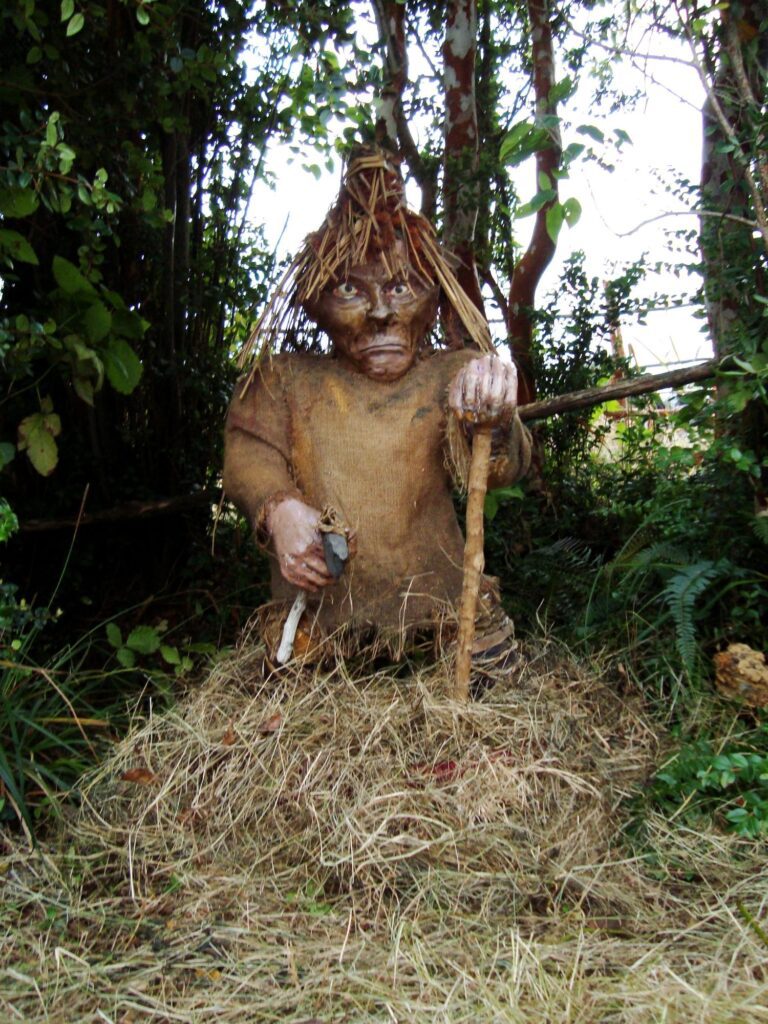
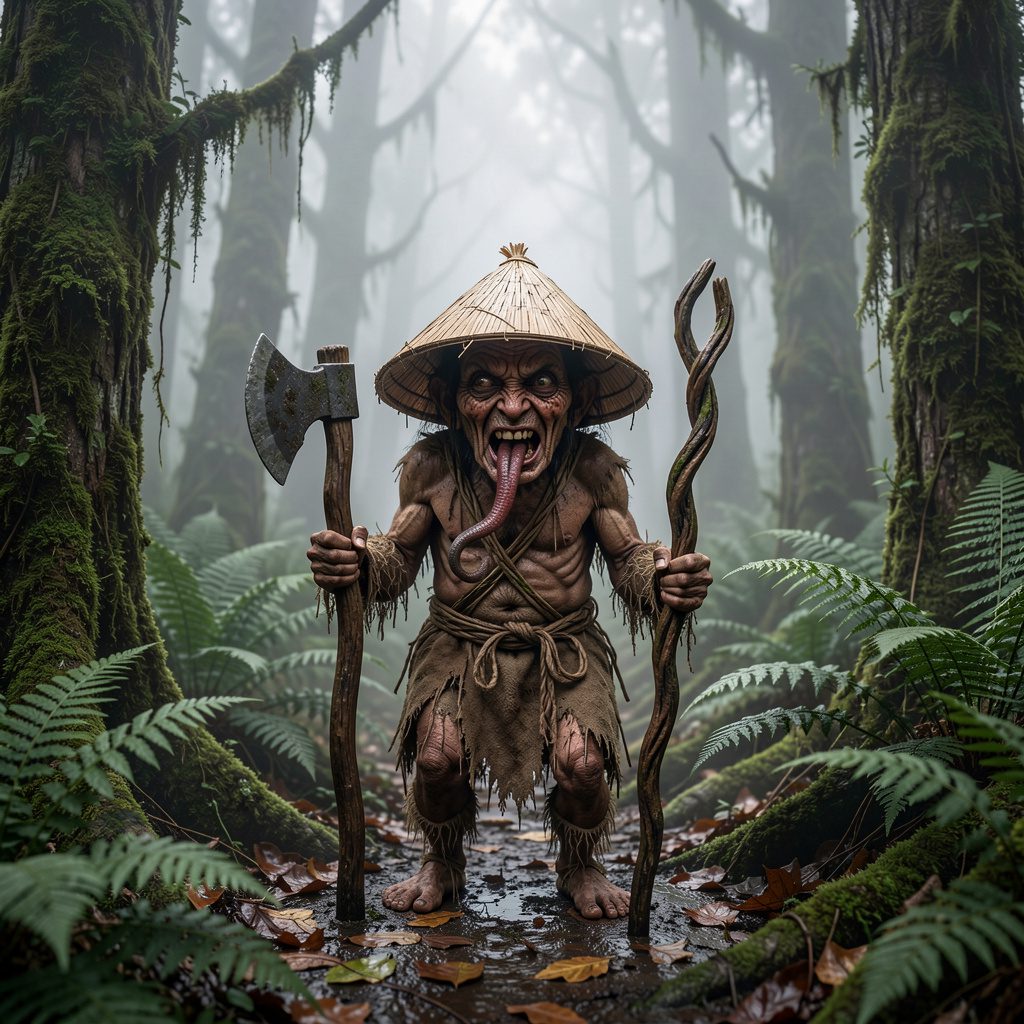
El Trauco is usually described as a small humanoid creature roughly 80 to 85 centimeters tall. His appearance is grotesque and unsettling. Stories portray him with a twisted face, rough skin, and distorted features that make him instantly recognizable in Chilote folklore. Despite his small size, he is said to possess remarkable physical strength.
One of the most unusual characteristics attributed to El Trauco is the absence of normal feet. Instead, his legs end in pointed stumps or hardened wooden-like extensions that allow him to move easily through dense forests and uneven terrain. These strange limbs reinforce his image as a creature belonging more to nature than to humanity.
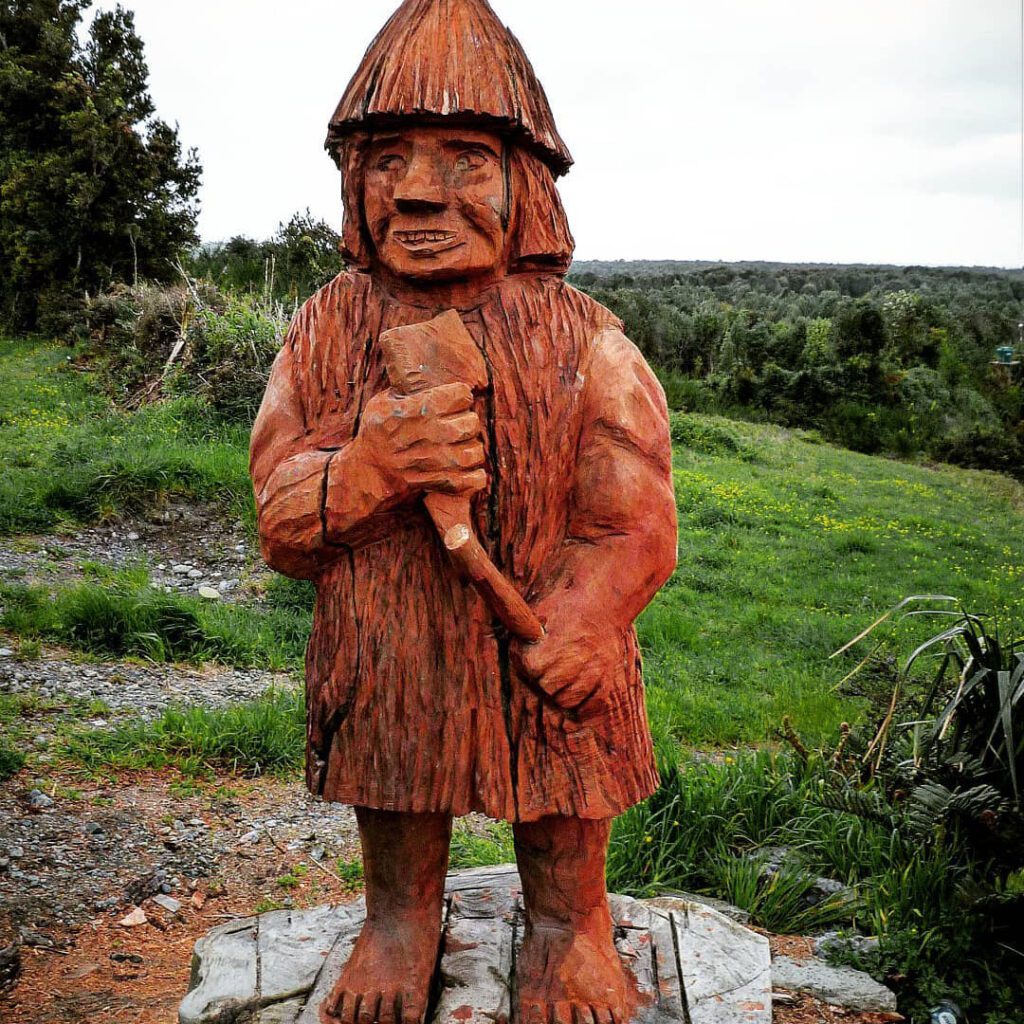
He traditionally wears clothing made from forest materials. His garments are described as woven from quilineja vines, a parasitic plant found in southern Chilean forests. On his head he often wears a small conical hat made from colihue bamboo, another plant common in the region.
El Trauco also carries two symbolic objects. The first is a stone-headed axe or hatchet, which he uses to strike tree trunks. This action is believed to announce his presence in the forest. The second object is a twisted wooden staff called the pahueldún, which is associated with his supernatural authority and control over the forest environment.
Family
In Chilote folklore, El Trauco is often connected to other supernatural beings from the region’s mythological tradition. His most commonly mentioned companion is La Fiura, a grotesque female spirit who lives in the forest.
La Fiura is described as equally frightening. She is said to be disfigured, foul-smelling, and covered in moss or vegetation. Like El Trauco, she possesses supernatural powers that allow her to seduce humans, particularly men who wander into the forest alone. Some versions of the legend portray the two as husband and wife, forming a symbolic pair representing dangerous forms of desire and temptation.
Some folkloric traditions also connect El Trauco to Coi Coi-Vilu, a powerful serpent deity associated with floods and natural forces in southern Chilean mythology. In these versions, El Trauco is sometimes described as a supernatural offspring of this serpent spirit, linking him to the broader cosmology of Chilote beliefs.
Other names
The name Trauco appears to originate from Indigenous languages of southern Chile, most likely influenced by Mapudungun or related regional dialects. Over time, the term became integrated into Spanish-language folklore as El Trauco, meaning “the Trauco.”
Unlike many mythological figures, the creature does not have numerous formal alternative names. However, in oral storytelling traditions across Chiloé, people sometimes refer to him more descriptively. Expressions such as “the forest dwarf,” “the little man of the woods,” or “the seducer of the forest” occasionally appear in local narratives.
Powers and Abilities
El Trauco’s most infamous power is his supernatural ability to attract and seduce women. According to traditional belief, his magical presence can cause intense attraction or desire, even when a woman has never seen him before. Some stories claim that he can appear in dreams, influencing women while they sleep and drawing them toward the forest.
In folklore, this power is described as irresistible. Women who fall under his influence are believed to lose control over their actions, explaining why communities historically viewed victims as blameless. For men, encountering El Trauco is said to be extremely dangerous. His gaze is believed to cause weakness, paralysis, or even death in certain tales. Other stories claim that his breath or magical influence can cause illness, deformity, or sudden physical ailments.
Despite his small stature, El Trauco is also believed to possess immense strength. Folklore suggests that he can fell trees with only a few strikes of his stone axe, demonstrating supernatural physical power. Another characteristic attributed to him is secrecy. He rarely allows humans to see him directly, often remaining hidden in the forest. The sound of his axe striking tree trunks is believed to signal that he is nearby.
Modern Day Influence
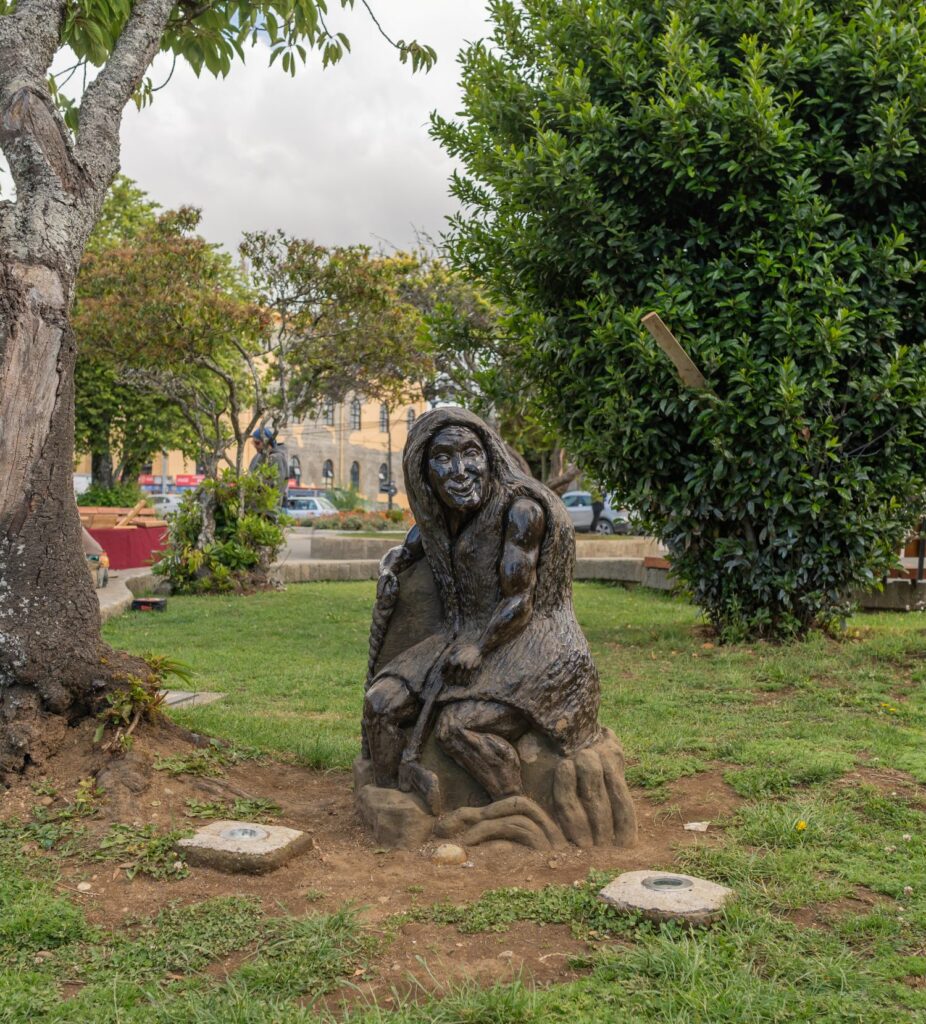
Although rooted in centuries-old folklore, the legend of El Trauco continues to shape the cultural identity of Chiloé. The figure appears frequently in local art, sculptures, literature, and tourism campaigns promoting the island’s rich mythological heritage.
Visitors to the region often encounter statues or artistic depictions of El Trauco alongside other famous Chilote creatures such as La Pincoya and El Caleuche. These figures form part of a broader folklore tradition that defines the cultural landscape of southern Chile.
Scholars studying Latin American folklore have also examined the legend from sociological and psychological perspectives. Many researchers view the story as a cultural explanation for social issues, particularly related to sexuality, gender expectations, and rural community life.
Despite these modern interpretations, the myth remains alive in everyday storytelling. In many parts of Chiloé, people still recount stories of mysterious sounds in the forest or strange encounters attributed to El Trauco. Whether believed literally or symbolically, the legend continues to be an important part of the island’s cultural identity.
Related Images

Source
Lenz, R. (1914). Chiloé y los chilotes: Estudios de folk-lore y lingüistica de la provincia de Chiloé. Imprenta universitaria.
Daughters, A. (2023). Memories of Earth and Sea: An Ethnographic History of the Islands of Chiloé. University of Arizona Press.
Wikipedia. (2024). Trauco. https://en.wikipedia.org/wiki/Trauco
Cryptid Wiki. (2024). El trauco. https://cryptidz.fandom.com/wiki/El_trauco
Curriculum Nacional. (2021). El trauco. https://www.curriculumnacional.cl/614/w3-winarticle-241388.html
Cascada Travel. (2017). The haunting mythology of Chile’s southern islands. https://www.cascada.travel/blog/the-haunting-mythology-of-chile-s-southern-islands
Revista Nothofagus. (2025). El canto del Trauco. https://revistanothofagus.ulagos.cl/index.php/nothofagus/article/view/77
Icarito. (2009). Mitos y leyendas, un legado cultural. https://www.icarito.cl/2009/12/46-2953-9-6-chiloe.shtml/
Frequently Asked Questions
Who is El Trauco in folklore?
El Trauco is a supernatural forest spirit from the Chiloé Archipelago in southern Chile, known for his ability to magically seduce women and harm men who encounter him.
Why is El Trauco associated with pregnancies in folklore?
In traditional Chilote communities, unexplained pregnancies were sometimes attributed to El Trauco, allowing women to avoid social stigma or blame.
What does El Trauco look like?
He is described as a short, deformed humanoid creature with a twisted face, moss-like clothing, and a stone axe used to strike trees.
Is El Trauco connected to other Chilean mythological beings?
Yes. He is often associated with La Fiura, a female forest spirit, and in some stories he is linked to the serpent deity Coi Coi-Vilu.
Is El Trauco still part of Chilean culture today?
Yes. The legend remains widely known in Chiloé and appears in tourism, art, storytelling traditions, and folklore studies.
