

Fleshgait : The Internet Monster That Mimics Its Victims
| Description | |
|---|---|
| Origin | United States of America |
| Classification | Digital |
| Demeanour | Hostile, Predatory |
| Habitat | Forests, Remote Wilderness |
| Status | Fictional |
Mythlok Perspective
In Mythlok’s View, the Fleshgait represents a new evolutionary stage of myth-making, where collective imagination replaces cultural tradition as the source of legend. It embodies the fear of imitation and identity loss, themes that are increasingly relevant in a digital world. Unlike ancient forest spirits that reflect nature’s unpredictability, the Fleshgait reflects human anxiety about deception and artificial replication. In this sense, it parallels entities like the European doppelgänger and the Japanese Noppera-bō, both of which challenge the stability of human identity. Where older myths warned against the unknown wilderness, the Fleshgait warns against the unknown within the familiar.
Fleshgait
Introduction
The Fleshgait is one of the most unsettling creations of modern internet folklore. Unlike ancient legends passed through generations, this entity emerged from digital storytelling spaces such as creepypasta forums, Reddit threads, and anonymous message boards. It represents a new kind of myth, one shaped not by geography or tradition, but by collective imagination.
First gaining attention around 2015–2016, the Fleshgait became widely known after a popular creepypasta story set in New Mexico’s Gila National Forest. From there, it evolved rapidly, absorbing traits from older mythic archetypes like the Wendigo and other mimic-based entities, while deliberately distancing itself from culturally rooted traditions.
At its core, the Fleshgait is described as a predator that hunts by imitation. It does not simply chase or overpower its prey. Instead, it studies, mimics, and deceives. This psychological dimension is what makes the legend particularly disturbing. It reflects a modern fear that something can look and sound exactly like a human, yet remain fundamentally inhuman.
Physical Attributes
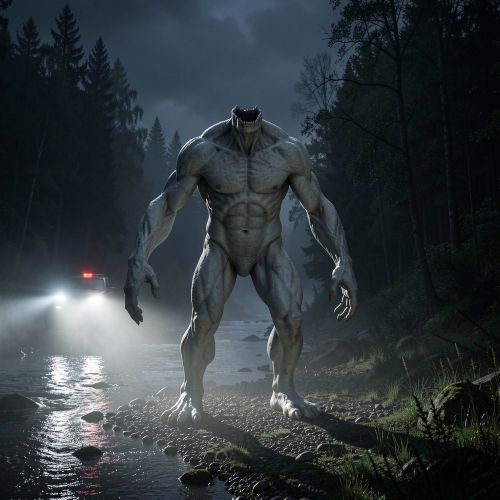
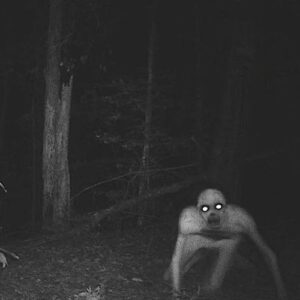
Descriptions of the Fleshgait vary across accounts, but several recurring traits give the creature a consistent identity. It is typically portrayed as an unnaturally tall humanoid, often estimated between 8 and 9 feet in height. Its body is extremely thin, with elongated limbs that hang awkwardly, giving it a skeletal and disproportionate appearance.
Its skin is usually described as pale grey or sickly white, stretched tightly over its frame. The lack of hair, combined with this unnatural complexion, contributes to its corpse-like aesthetic. Witnesses often emphasize its unsettling movement, which appears jerky, uneven, or animalistic when it is not actively mimicking a human.
The most disturbing descriptions emerge when its disguise fails. In these moments, its form is said to distort, with facial features shifting or rippling unnaturally. Some accounts mention dislocated jaws, exposing a wide, unnatural mouth filled with irregular teeth or an indistinct mass.
Sound also plays a critical role in its presence. Reports frequently describe high-pitched shrieks, chittering noises, or distorted attempts at human speech. These auditory elements reinforce the idea that the creature is constantly attempting to replicate human behavior but never achieves perfection.
First Sighting/Reporting
Unlike traditional cryptids, the Fleshgait has no verified historical sightings or cultural lineage. Its origin can be traced directly to internet fiction, making it a rare example of a fully digital-born legend.
The most influential early account is a creepypasta story written by a user known as EmpyrealInvective, published on the Creepypasta Wiki in late 2016. Set in the Gila National Forest, the story presented the creature in a realistic outdoor survival scenario, which helped ground the narrative and make it more believable.
Prior to this, fragmented mentions of similar entities appeared on anonymous forums, particularly on paranormal discussion boards. These early versions blended elements from existing folklore but lacked a clear identity. The 2016 story effectively consolidated these ideas into what is now recognized as the Fleshgait.
Claims of earlier “sightings” in real-world locations such as forests in North America exist, but they are entirely anecdotal and cannot be verified. These reports are best understood as retroactive additions to the myth rather than genuine historical evidence.
Other Names
The Fleshgait is occasionally referred to by alternative names, though none are as widely accepted as the original term. One of the more common variants is “Flesh Pedestrian,” a phrase that highlights its human-like movement while adding a layer of dark humor.
In online discussions, it is sometimes grouped with creatures like “Crawlers” or “Rakes,” due to similarities in physical appearance. However, enthusiasts typically distinguish the Fleshgait based on its advanced mimicry abilities rather than its movement or form alone.
Some discussions loosely associate it with terms like “Grey Mimic” or “Digital Wendigo,” but these are more descriptive labels than official names. Importantly, modern interpretations avoid directly linking it to culturally specific entities, positioning it instead as a distinct product of internet folklore.
Modus Operandi
The defining characteristic of the Fleshgait is its method of hunting, which relies heavily on deception and psychological manipulation rather than brute force. It is said to operate primarily in isolated environments such as forests, hiking trails, and remote campsites. Instead of attacking immediately, the creature observes its targets, learning their voices, behaviors, and interactions. This period of observation allows it to replicate individuals with unsettling accuracy.
Its most common tactic involves mimicry. It may call out using the voice of a friend or loved one, often repeating phrases that it has overheard. However, these repetitions are sometimes slightly off, creating an eerie sense of wrongness that serves as a warning sign in many stories.
The creature is also associated with creating unnatural silence in the environment, a phenomenon often described in wilderness folklore as a sudden absence of animal sounds. This silence is typically followed by disorienting experiences, such as misplaced objects or confusion among group members.
Some variations of the legend claim that the Fleshgait can infiltrate groups by taking on a human appearance after killing a victim. While this aspect is more speculative, it reinforces the core theme of identity distortion and mistrust. The ultimate goal of the creature is predation, but the process leading up to it is what defines the legend. It isolates, confuses, and manipulates before striking, leaving little to no trace.
Pop Culture References
The Fleshgait has become a prominent figure in internet horror culture. Its rise is closely tied to creepypasta storytelling, where it continues to appear in new narratives and reinterpretations. YouTube channels dedicated to horror narration have played a significant role in popularizing the legend, often dramatizing encounters and expanding its lore. Podcasts and online discussions further explore its origins, sometimes framing it as a case study in digital folklore evolution.
Reddit communities and niche forums remain active hubs for Fleshgait-related content, with users sharing fictional sightings, theories, and artwork. This continuous engagement ensures that the legend remains dynamic rather than static. Unlike traditional myths, which are preserved through repetition, the Fleshgait evolves through variation. Each retelling adds new elements, reflecting the collaborative nature of internet storytelling.
Current Status
As of 2026, the Fleshgait remains an unverified entity with no credible physical evidence supporting its existence. There are no authenticated photographs, scientific studies, or documented encounters that confirm it as a real-world cryptid.
Instead, it is widely recognized as a “digital folk monster,” a concept that highlights how myths can emerge and thrive in online environments. Its continued popularity is driven by storytelling communities rather than empirical observation.
Despite its fictional origin, the Fleshgait persists because it taps into deeply rooted fears. The idea that something can perfectly imitate a human challenges our ability to trust our senses, making it uniquely unsettling in a modern context.




Source
Paranormal Authority. (2021, May 30). What is a Fleshgait? https://paranormalauthority.com/fleshgait/
Vertigo Warrior. (2020, May). Mystery: Fleshgaits. https://www.vertigo22.com/2020/05/mystery-fleshgaits.html
The Ghost in My Machine. (2025, August 18). Creepypasta of the Week: “Fleshgait”. https://theghostinmymachine.com/2025/08/18/creepypasta-of-the-week-fleshgait/
EmpyrealInvective. (2016). Fleshgait [Creepypasta]. Creepypasta Wiki. https://creepypasta.fandom.com/wiki/Fleshgait
Vertigo Warrior. (n.d.). Urban legends – Page 6. The Haunting of Us. https://thehauntingofus.com/1773-2/6/
Paranormal Authority. (2021). What is a Fleshgait? (Snippet reference). https://paranormalauthority.com/fleshgait/
Frequently Asked Questions
What is a Fleshgait?
A Fleshgait is a fictional humanoid creature from internet folklore known for mimicking human voices and appearances to hunt victims.
Is the Fleshgait real or a hoax?
There is no scientific or physical evidence supporting its existence. It is widely considered a fictional entity created through online storytelling.
Where did the Fleshgait originate?
The Fleshgait originated from creepypasta and online forums around 2015–2016, particularly through a popular story set in New Mexico.
What makes the Fleshgait different from other cryptids?
Its defining feature is advanced mimicry, allowing it to imitate humans rather than relying purely on physical strength or speed.
Why is the Fleshgait so popular online?
It combines psychological horror with familiar environments, making it relatable and easily adaptable in modern storytelling.