Jack-in-Irons : The Chain-Bound Terror of Yorkshire
At a glance
| Description | |
|---|---|
| Origin | English Mythology |
| Classification | Hybrids |
| Family Members | N/A |
| Region | England |
| Associated With | Fear, Punishment, Road dangers, Supernatural strength |
The Mythlok Perspective
In Mythlok’s Perspective, Jack-in-Irons is not a ghost bound by death, but a manifestation of environmental fear given form. He represents the moment when the physical world itself becomes hostile, where roads, forests, and darkness turn into active threats. This concept appears across cultures. The Slavic Leshy misleads travelers in forests, while the Japanese Yamabiko echoes through mountains, disorienting those who wander. Like them, Jack-in-Irons is not defined by origin but by function. He exists to remind humans that nature, when crossed carelessly, does not forgive.
Jack-in-Irons
Introduction
Jack-in-Irons is a fearsome figure from Yorkshire folklore in northern England, known for haunting lonely roads and desolate moorlands after dark. Often called Jack o’ Chains, he is not a traditional ghost tied to a single death or location, but a roaming supernatural presence that embodies the dangers of isolation and travel.
Unlike classical spirits that linger due to unfinished business, Jack-in-Irons is better understood as a spectral giant or folkloric bogey entity, one that physically confronts and destroys those who cross his path. Early stories from the 17th and 18th centuries may have linked him loosely to executed criminals, but over time, he evolved into something far more symbolic and terrifying.
By the Victorian era, his legend had transformed into a cultural warning. He became the living embodiment of what could happen when one strayed too far from safety, turning the English countryside into a place of dread rather than comfort.
Physical Traits
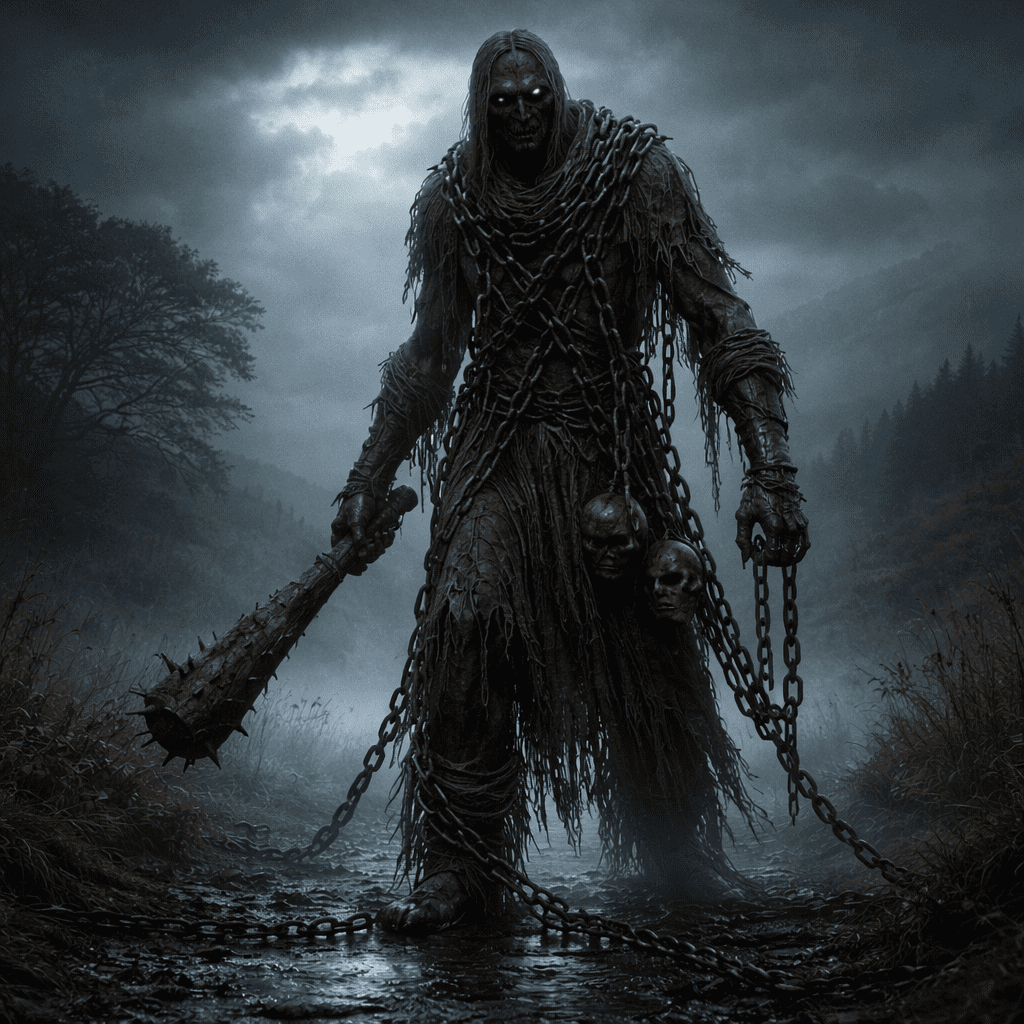
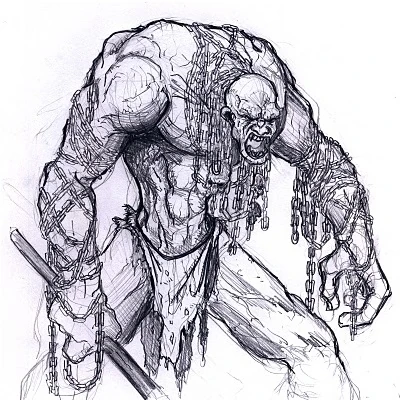
Jack-in-Irons is consistently described as a towering, unnatural giant, typically ranging between seven and fifteen feet in height, though some exaggerated accounts make him even larger. His body is often gaunt and skeletal, yet deceptively powerful, giving him an eerie presence that feels both lifeless and unstoppable.
His defining feature is the set of heavy iron chains wrapped around his torso and limbs. These chains drag along the ground as he moves, producing a chilling metallic sound that echoes through the night. Unlike a ghostly whisper, this is a physical noise, reinforcing his presence as something tangible and real.
Descriptions of his face vary across accounts. Some portray glowing eyes and a distorted, menacing expression, while others describe him as headless, carrying his own severed head. His clothing resembles burial cloth or prisoner rags, suggesting punishment and suffering rather than peaceful death.
In more grotesque depictions, Jack-in-Irons wears the severed heads of his victims as trophies. He is also frequently shown carrying a massive spiked club, a weapon that highlights his brute force and violent nature.
Family
There are no known familial connections associated with Jack-in-Irons in traditional folklore. He exists entirely alone, without lineage, origin story, or kinship ties. This lack of family reinforces his identity as a constructed fear figure rather than a character with a narrative genealogy. While some tales hint at a human origin, possibly as a punished criminal, these ideas are inconsistent and not central to his myth. Instead, he functions as an isolated presence, appearing without explanation and disappearing without trace, much like the dangers he represents.
Other names
Jack-in-Irons is also known as Jack o’ Chains, a name that directly references the iron restraints that define his appearance and sound. The use of “Jack” in English folklore is significant. It often acts as a placeholder name for an unknown or generalized male figure, similar to “John Doe.” This suggests that Jack-in-Irons is not meant to be a specific individual, but rather a universal symbol of fear given a familiar name.
Powers and Abilities
Jack-in-Irons possesses immense physical strength, far beyond that of any human. As a giant, he is capable of overpowering victims effortlessly, often appearing suddenly to block paths and prevent escape. His chains serve a dual purpose. They act as both a psychological warning and a deadly weapon. He is said to use them to ensnare and strangle his victims, while his spiked club delivers crushing blows.
Unlike incorporeal spirits, Jack-in-Irons interacts directly with the physical world. He emerges from behind trees, stone walls, or darkness itself, making him feel more like a living predator than a drifting spirit. One of his most disturbing traits is his tendency to decapitate victims and collect their heads. This behavior links him to broader European folklore traditions but also reinforces his role as a relentless enforcer of fear.
Encounters with Jack-in-Irons are almost always fatal in legend. There are no widely known methods of escape or defense, which strengthens his role as an unstoppable force rather than a negotiable supernatural being.
Modern Day Influence
Jack-in-Irons has continued to evolve in modern storytelling, often appearing in fantasy literature, horror fiction, and role-playing games. These adaptations tend to emphasize his physicality, portraying him as a massive chain-bound giant rather than a ghostly apparition. During the Victorian era, his legend became a narrative tool used to express the risks of travel and the unknown. Gothic literature further shaped his image, blending realism with supernatural dread.
In contemporary media, he appears in various forms, from towering enemies in tabletop games to inspiration for horror-themed television episodes. The sound of dragging chains, now a common horror trope, owes much to figures like Jack-in-Irons.
Some modern interpretations reinterpret him as a symbolic figure rather than a literal monster. In these versions, he represents guilt, punishment, or the psychological weight of isolation. Others depict him as a guardian of forgotten paths, shifting his role from predator to protector. Local tourism in Yorkshire has also embraced his legend. Ghost tours, folklore exhibits, and storytelling events continue to keep his presence alive, transforming a once-feared entity into a cultural icon.
Related Images
Blogs & Opinions

Mythical Events
Source
Ball, J. (1922). To the waters and the wild: Building a visual developmental portfolio
Boll, J. (2012). The sacred dragon in the woods: On Jez Butterworth’s Jerusalem.
Connect Paranormal. (2025, March 2). Jack-in-Irons: Myth, cultural significance, and evolution.
https://connectparanormal.net/2025/03/02/jack-in-irons-myth-cultural-significance-and-evolution/
Daimler, M. (2020). A new dictionary of fairies: A 21st century exploration of Celtic and related Western European fairies. John Hunt Publishing.
Hamilton, L. K. (n.d.). Merry Gentry series.
Novoseltseva, L. A. (2018). Folklore archetypes of evil and good spirits in British beliefs and literature. In Nauka v sovremennom informatsionnom obshchestve (pp. 67-71).
Wikipedia. (2006, June 12). Jack-in-Irons. https://en.wikipedia.org/wiki/Jack-in-Irons
Wikia. (n.d.). Jack-in-Irons (folklore). Villains Wiki. https://villains.fandom.com/wiki/Jack-in-Irons_(folklore)
Frequently Asked Questions
Is Jack-in-Irons a ghost?
No, Jack-in-Irons is not a traditional ghost. He is better understood as a spectral giant or bogey entity with physical presence.
What does Jack-in-Irons do in folklore?
He ambushes travelers on lonely roads, using chains and brute force to attack, often leaving no survivors.
Why is Jack-in-Irons associated with chains?
The chains symbolize punishment and suffering, possibly linking him to criminal folklore, while also serving as weapons.
Where does the legend of Jack-in-Irons come from?
The legend originates in Yorkshire, England, particularly tied to isolated moors and rural pathways.
What does Jack-in-Irons represent?
He represents fear of isolation, the dangers of travel, and the unknown threats that exist beyond safe environments.