


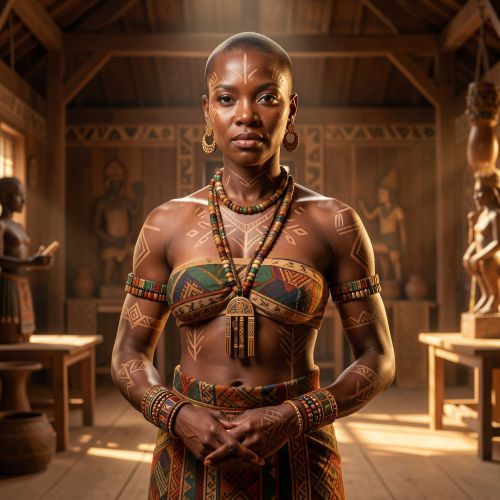
Queen Lueji : Legendary Queen of the Lunda Kingdom
Listen
At a glance
| Description | |
|---|---|
| Origin | Chokwe Mythology |
| Classification | Mortals |
| Family Members | Mwata Iyala Mwaku (Father), Chibinda Ilunga (Husband) |
| Region | Angola, Democratic Republic of Congo, Zambia |
| Associated With | Leadership, Royal authority |
The Mythlok Perspective
In Mythlok’s Perspective, Queen Lueji represents a powerful reminder that leadership in many ancient societies was not confined by gender. Her story reflects a political philosophy where authority flowed from lineage, wisdom, and communal trust rather than physical dominance. In this way, she resembles figures such as the Celtic queen Boudica or the Egyptian ruler Hatshepsut, who also embodied sovereign authority within patriarchal worlds. Across cultures, these narratives reveal a recurring archetype: the woman who becomes the stabilizing force of a kingdom.
Queen Lueji
Introduction
Queen Lueji is remembered in the oral traditions of Central Africa as one of the most influential female rulers connected with the Lunda and Chokwe cultural traditions. Her story blends historical memory, political mythology, and ancestral symbolism. Most narratives place her life sometime between the late sixteenth and mid-seventeenth centuries. She was the daughter of the Lunda ruler Mwata Iyala Mwaku, sometimes also referred to as Konde or Yala Muaku in oral traditions.
Unlike many royal successions of the time, Lueji was chosen as heir over her brothers. According to Lunda tradition, her father entrusted her with the lukano bracelet, a powerful symbol of royal authority and legitimacy. The transfer of this bracelet marked her as the rightful ruler of the Lunda federation. This moment in the story highlights the importance of matrilineal inheritance within certain Central African societies, where leadership could pass through female lines.
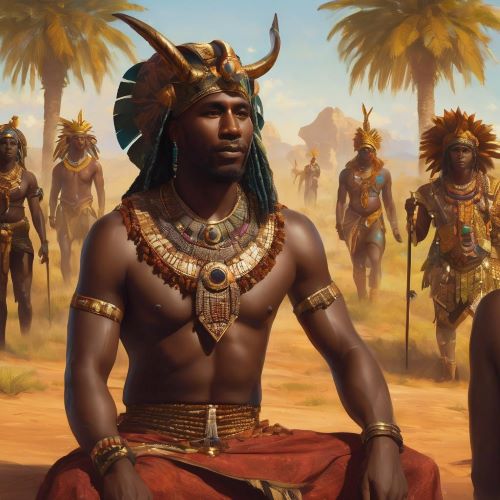
Lueji’s legacy is most strongly tied to her marriage to Chibinda Ilunga, a noble hunter from the Luba kingdom. Their union became one of the most famous legendary episodes in Central African tradition. It symbolized not only romance but also the merging of political cultures between the Lunda and Luba peoples. From this alliance emerged the ruling tradition associated with the Mwata Yamvo dynasty, which would influence regional governance and cultural practices for centuries.
The legend of Queen Lueji therefore serves multiple purposes. It explains the origin of political authority, the spread of cultural institutions, and the importance of female leadership within the Lunda world. Even today, her story remains a foundational narrative for communities in Angola, the Democratic Republic of Congo, and Zambia, where oral history continues to preserve her memory.
Physical Traits
Historical descriptions of Queen Lueji herself are limited because the stories about her were preserved primarily through oral traditions rather than written records. However, visual representations in Chokwe sculpture provide clues about how she was imagined and remembered.
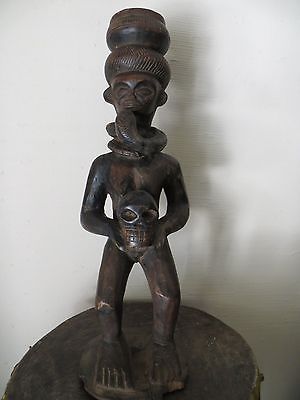
Statues associated with Queen Lueji typically portray a woman in the prime of life, with balanced proportions and a poised, dignified stance. The figure often stands upright with slightly bent knees and bent elbows, a posture that expresses vitality and readiness. In many carvings, the chest, head, and hands are emphasized, suggesting strength, presence, and authority.
One notable feature in these sculptures is the large, carefully carved hands and feet. In Chokwe artistic symbolism, enlarged hands often represent action and leadership. The idea is that a chief or ruler shapes the destiny of the community through decisive acts. Likewise, broad feet symbolize stability and connection to the land.
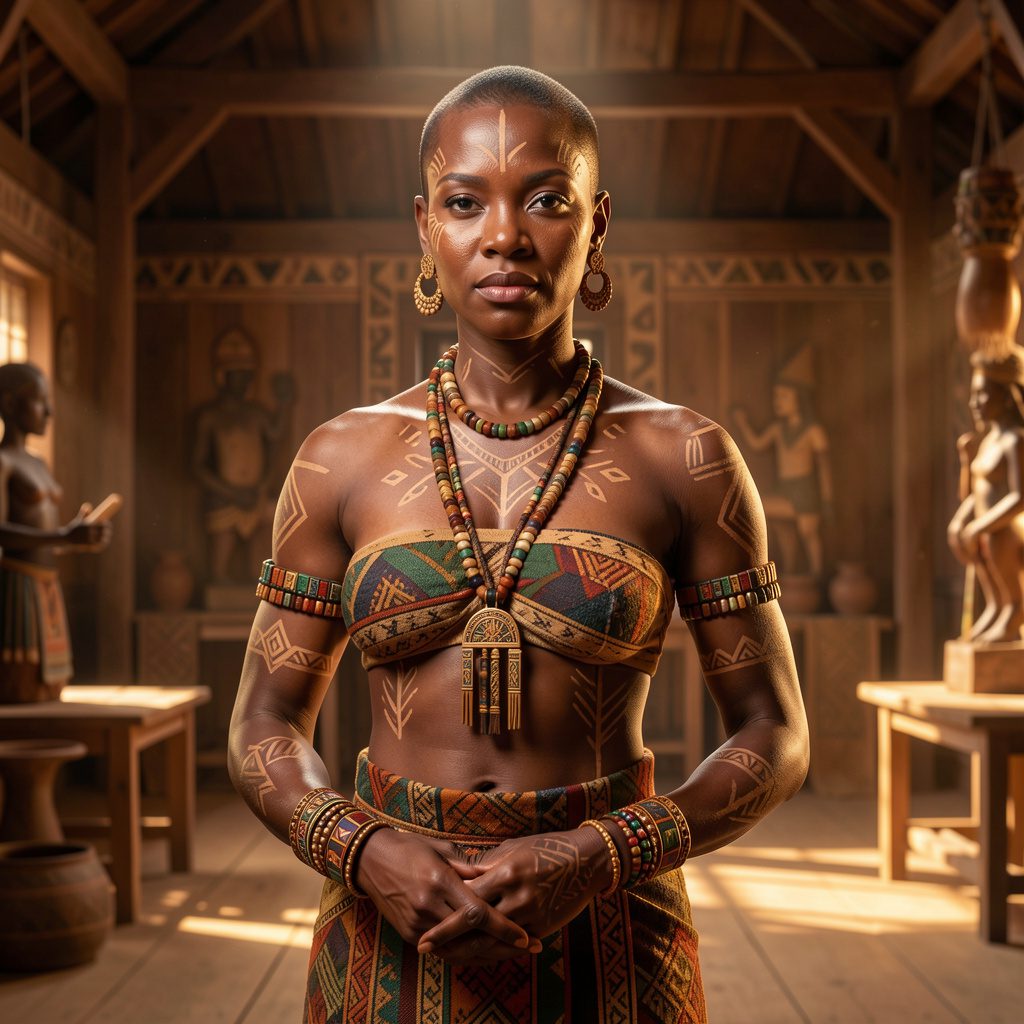
Another recurring detail is the high forehead and stylized hairstyle, which reflects the traditional grooming styles of Chokwe women. Scarification patterns sometimes appear across the abdomen or below the navel, representing both beauty and cultural identity. These marks also carry associations with fertility and womanhood.
Many statues include a carved cimba pendant, worn on the chest. This circular ornament symbolizes royal authority and sacred status within Chokwe tradition. The statues themselves were usually carved from wood and ranged between thirty and forty-five centimeters in height. They were once adorned with real hair or other materials, giving them a lifelike presence.
Family
Queen Lueji was born into the royal lineage of the Lunda people, one of the major cultural groups of Central Africa. Her father, Mwata Iyala Mwaku, ruled a federation of communities that would later become the foundation of the Lunda kingdom. Although Lueji had several brothers, tradition states that they fell out of favor with their father. Because of this, the ruler chose his daughter as his successor. The decision demonstrated that leadership in the Lunda system depended not simply on gender or birth order but on perceived wisdom, loyalty, and the ability to maintain unity.
Lueji’s marriage to Chibinda Ilunga, a prince from the Luba kingdom, is one of the most important aspects of her legend. Chibinda Ilunga was known as a skilled hunter and noble warrior. His arrival at the Lunda court represented a major cultural exchange between two powerful societies. Their union became the symbolic foundation of the Mwata Yamvo royal lineage, a ruling tradition that spread across large parts of Central Africa. The story of their marriage also explains the emergence of several related ethnic groups, including the Chokwe.
In some oral traditions, the marriage between Lueji and Chibinda Ilunga eventually ended due to political tensions. These narratives emphasize that Lueji placed the stability of her kingdom above personal relationships. Whether literal or symbolic, the story reinforces her image as a ruler committed to protecting her people.
Other names
Queen Lueji appears under several variations of her name across Central African oral traditions. These differences reflect linguistic diversity among the Lunda, Chokwe, and neighboring communities. Common variations include Lweji, Luweji, and Lweshi. Each version represents a phonetic adaptation of the same name within different regional languages.
In some historical references influenced by Portuguese colonial records, she is also referred to as Rainha Lueji or Rainha Lweji, meaning “Queen Lueji.” These titles highlight her status as a female sovereign and ancestral ruler. Another form sometimes mentioned in traditional narratives is Lueji wa Nkonde, which emphasizes her lineage and royal heritage. Despite these variations, all versions refer to the same foundational figure whose leadership shaped the cultural and political identity of the Lunda and Chokwe peoples.
Powers and Abilities
Unlike many mythological figures, Queen Lueji is not described as possessing magical abilities or supernatural powers. Instead, her strength lies in political wisdom, leadership, and symbolic authority. In Central African tradition, rulers were believed to possess a sacred connection to the well-being of their people. This belief meant that a chief or queen had a spiritual responsibility to maintain harmony between the community, the ancestors, and the land.
The lukano bracelet that Lueji inherited from her father represented this sacred authority. The bracelet was more than jewelry; it was a royal insignia that legitimized the ruler’s right to govern. Whoever possessed the lukano was recognized as the rightful leader of the Lunda federation.
Queen Lueji’s most important abilities were therefore diplomatic and administrative. She successfully unified different groups under a shared political structure and maintained stability within the kingdom. Oral traditions often portray her as a careful listener who valued advice and consultation before making decisions. Her story also emphasizes the idea of custodial leadership. Rather than ruling through fear or domination, she is remembered as someone who viewed power as a responsibility to protect the community.
Modern Day Influence
The legacy of Queen Lueji continues to shape cultural identity across Central Africa. Her story is preserved through oral traditions, historical research, and artistic expression among the Lunda, Chokwe, and related communities. Chokwe sculptures depicting Lueji remain some of the most admired examples of Central African art. These works can be found in major museum collections around the world, including institutions in Europe and North America. Through these artworks, Queen Lueji has become a global symbol of African heritage and leadership.
Her story also contributes to contemporary discussions about the role of women in African history. Many scholars highlight Lueji as an example of how female political authority existed long before colonial rule, challenging outdated assumptions about leadership in precolonial societies.
Within Central Africa, the traditions connected to the Lunda kingdom still influence cultural institutions. Titles, rituals, and ceremonial practices continue to reflect the historical structures that developed during the era associated with Queen Lueji. Even today, her legend remains an important reminder that leadership, identity, and cultural continuity often emerge from stories passed down through generations.
Related Images


Source
Bastin, M.-L. (1982). La Sculpture Tshokwe. Meudon.
Google Arts & Culture. (n.d.). Female ancestor figure, Chokwe culture. https://artsandculture.google.com/asset/female-ancestor-figure-chokwe-culture/vgEb5oXVPWbBiA?hl=en
Jordán, M. (1998). Engaging the ancestors: Makishi masquerades and the transmission of knowledge among Chokwe and related peoples. In Chokwe and the arts of Northern Angola (pp. 129-177). University of Wisconsin Libraries.
Kerchache, J., Paudrat, J.-L., & Stéphan, L. (1988). L’art africain. Paris.
Sotheby’s. (2017). Chokwe female statue, Angola. https://www.sothebys.com/en/auctions/ecatalogue/2017/african-oceanic-n09619/lot.20.html
Traditional Zambia. (2019). Chokwe. https://traditionalzambia.home.blog/2019/07/24/chokwe/
Wikipedia contributors. (2023). Chokwe people. https://en.wikipedia.org/wiki/Chokwe_people
Petridis, C. (2008). Art and power in the Central African Savanna: Luba, Songye, Chokwe, Luluwa. Cleveland Museum of Art.
Vansina, J. (1966). Kingdoms of the Savanna. University of Wisconsin Press.
Frequently Asked Questions
Who was Queen Lueji?
Queen Lueji was a legendary female ruler in Central African traditions associated with the Lunda kingdom and the Chokwe cultural heritage.
Where did Queen Lueji rule?
She ruled within the Lunda federation in Central Africa, influencing regions that today include Angola, the Democratic Republic of Congo, and Zambia.
What is the story of Lueji and Chibinda Ilunga?
Their marriage represents a symbolic union between the Lunda and Luba peoples, which helped shape the political and cultural development of the region.
What does the lukano bracelet represent?
The lukano bracelet is a royal insignia symbolizing legitimate authority and leadership within the Lunda political system.
Why is Queen Lueji important today?
She is remembered as a symbol of female leadership, cultural unity, and the historical foundations of Central African governance.
