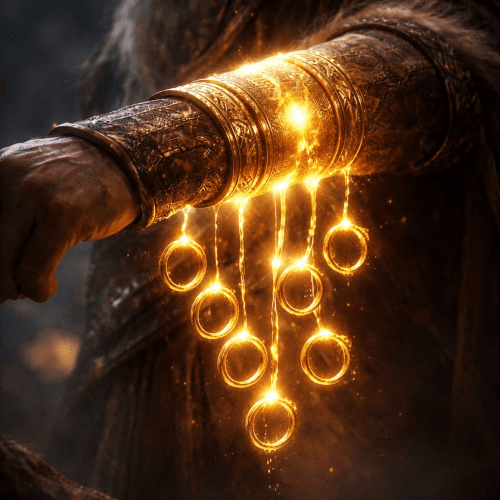


Mustika Ampal : The Mystical Ring of Ekalaya
| Description | |
|---|---|
| Origin | Indonesian Mythology |
| Classification | Heirloom ring fused to thumb, granting supernatural archery skill |
| Owners/Users | Raden Ekalaya |
| Symbolism | Loyalty, Empowerment, Martial skill, Divine favor |
| Source Texts | Mahabharata (Indonesian Variant) |
Mythlok Perspective
In Mythlok’s View, Mustika Ampal reflects a universal mythic theme where power is amplified through sacred objects that bond with their wielder. Its role in Javanese storytelling mirrors the symbolism of enchanted weapons found across world traditions. The ring’s fusion with Ekalaya resembles the inseparable bond between hero and artifact seen with Thor’s hammer in Norse lore or the divine weapons of Indian epics. Across cultures, such artifacts represent the idea that true strength emerges when personal skill and cosmic favor unite.
Mustika Ampal
Introduction
In the rich landscape of Indonesian folklore, Mustika Ampal is remembered as a mysterious and powerful artifact connected to spiritual power, martial skill, and divine destiny. Rooted in Javanese mythic tradition, the object appears in stories that blend indigenous animist beliefs with elements drawn from the Indian epics that influenced Southeast Asian storytelling. Among these tales, Mustika Ampal is most famously associated with the legendary archer Ekalaya, a character derived from the Mahabharata’s Ekalavya but transformed through local cultural interpretation.
In Javanese tradition, the word mustika refers to a mystical gem or talisman believed to contain spiritual power or supernatural energy. These objects are often considered living artifacts, imbued with invisible guardians or energies that influence their bearer’s abilities and destiny. Mustika Ampal is therefore not merely a jewel or ornament. It is portrayed as a divine artifact capable of magnifying a warrior’s inner strength and skill.
The stories surrounding Mustika Ampal are preserved mainly in wayang narratives, the traditional Javanese shadow-puppet theatre that adapts epic tales into local mythic cycles. Within these performances and related literature, the artifact becomes a symbol of talent, fate, and the complex relationship between divine blessing and human ambition.
Description
Mustika Ampal is most commonly described as a mystical ring, though some traditions refer to it as a sacred jewel embedded within a ring-like form. The artifact is believed to have been bestowed as a divine gift intended for the rightful ruler of the Nisada kingdom, a realm where martial skill, particularly archery, was deeply valued.
According to the story, the ring came into the possession of Ekalaya’s father during a period of intense meditation and spiritual devotion. The king had prayed for a worthy heir who would rule wisely and defend the kingdom. In response to this devotion, the supreme deity Sang Hyang Wenang, a primordial figure in Javanese cosmology, granted the Mustika Ampal as a sacred sign of destiny.
The artifact was placed on the young Ekalaya when he was still an infant. Over time, the ring did not remain a simple ornament. Instead, it fused with the prince’s thumb, becoming embedded beneath his skin. This fusion symbolized the inseparable bond between the warrior and the divine power contained within the artifact.
The ring’s position on the thumb carried special significance. In archery, the thumb plays a critical role in drawing and releasing a bowstring. By becoming part of Ekalaya’s body, Mustika Ampal ensured that every arrow he released carried supernatural precision and force.
Mythological Context
The mythology of Mustika Ampal is closely linked to the Javanese adaptation of the Mahabharata. In these versions of the epic, Ekalaya appears as a prince of the Nisada or Paranggelung kingdom, a skilled warrior whose ambition was to become the greatest archer of his time.
Unlike Arjuna, who trained under the renowned teacher Pandhita Durna (a Javanese adaptation of Drona), Ekalaya was largely self-taught. Despite this disadvantage, his natural talent and the power granted by Mustika Ampal allowed him to achieve extraordinary mastery of archery.
The artifact therefore plays an important narrative role. It explains how Ekalaya could rival the elite warriors trained by the greatest teachers of the age. The divine ring amplified his internal power, known in Southeast Asian martial traditions as tenaga dalam, allowing him to channel energy through his arrows.
In many wayang interpretations, the rivalry between Ekalaya and Arjuna becomes a symbolic clash between institutional privilege and natural talent. Mustika Ampal represents the idea that divine power may bless unexpected individuals rather than those favored by traditional authority.
Owners/Users
In mythological accounts, the primary and often sole wielder of Mustika Ampal is King Ekalaya himself. Although the artifact was originally granted to his father, it was intended for the future ruler of the kingdom and therefore belonged to Ekalaya from birth.
The fusion of the ring with his thumb made the connection between artifact and warrior permanent. Unlike ordinary weapons or talismans that could be passed between individuals, Mustika Ampal became physically inseparable from its owner.
This bond carried symbolic meaning. The artifact did not merely grant power to Ekalaya; it became an extension of his body and spirit. Because of this fusion, Ekalaya could not abandon his abilities or pretend weakness in battle. Whenever he prepared to draw a bow, the power of the ring would naturally manifest.
Instances of Use
The power of Mustika Ampal is most clearly demonstrated through Ekalaya’s extraordinary archery feats. With the ring embedded in his thumb, he could draw a bow with incredible strength and release arrows with near-perfect accuracy.
In Javanese mythic narratives, this supernatural skill allowed Ekalaya to challenge even the greatest warriors of the era. One of the most dramatic episodes involves a confrontation between Ekalaya and Arjuna. Arjuna wielded the sacred bow Gandewa, a powerful weapon associated with the god Indra in epic tradition.
During their clash, the power channeled through Mustika Ampal allowed Ekalaya’s arrows to overwhelm the sacred bow. Some versions of the story claim that Gandewa itself was shattered or rendered powerless by the force of Ekalaya’s attacks.
The artifact also enabled Ekalaya to perform the advanced archery technique known as Sapta Tunggal, a method involving the release of multiple arrows through the concentration of internal energy. The ring amplified this energy, allowing Ekalaya to strike with remarkable speed and precision.
Symbolism and Interpretations
Within Indonesian folklore, Mustika Ampal carries several layers of symbolic meaning. At the most immediate level, it represents divine empowerment. The artifact is granted by a cosmic authority and destined for a worthy ruler, reinforcing the idea that leadership and skill are guided by spiritual forces.
The fusion of the ring with Ekalaya’s thumb symbolizes an unbreakable bond between talent and destiny. Power, once granted, becomes inseparable from the individual who receives it. The artifact also reflects the cultural belief that mystical objects can amplify inner energy rather than replace it. Ekalaya’s success is not solely due to the ring; it arises from the combination of natural ability, discipline, and divine blessing.
In a broader sense, Mustika Ampal represents the tension between recognition and exclusion. Ekalaya possesses immense talent yet remains outside the traditional hierarchy of warriors. The artifact therefore becomes a narrative device that elevates a marginalized hero while highlighting the complexities of honor, competition, and loyalty.
Comparative Analysis
Magical artifacts that enhance a warrior’s abilities appear in many mythological traditions. Mustika Ampal fits within this broader global pattern while retaining uniquely Indonesian characteristics. In the Indian epic tradition, powerful weapons such as divine bows or celestial arrows grant heroes extraordinary strength. Similarly, Norse mythology features enchanted items like Thor’s hammer, which amplify the god’s power in battle.
However, Mustika Ampal differs in one key aspect. Instead of functioning as a separate weapon, it merges with the body of its wielder. This fusion reflects the Southeast Asian belief that spiritual energy flows through the human body and can be strengthened through sacred objects.
Other Indonesian mystical items, such as enchanted keris daggers or mustika stones believed to contain guardian spirits, share a similar concept. They are not simply tools but spiritual companions that interact with the bearer’s energy. Through this lens, Mustika Ampal represents the intimate relationship between human ability and supernatural influence found throughout Indonesian spiritual traditions.
Modern Influence
The legend of Mustika Ampal continues to survive primarily through wayang kulit performances, literature, and discussions of Javanese mysticism. These storytelling traditions remain an important cultural bridge between ancient mythology and contemporary Indonesian identity.
Within martial arts communities, particularly those connected to pencak silat, stories of mystical artifacts often serve as symbolic explanations for the development of extraordinary skill. Although the literal existence of such objects is debated, the idea of spiritual power enhancing martial discipline remains influential.
In modern popular culture, the concept of enchanted objects granting unique abilities appears frequently in fantasy films, novels, and games. Mustika Ampal fits easily into this broader narrative tradition, representing the timeless fascination with artifacts that unlock hidden potential.
Legacy
The enduring legacy of Mustika Ampal lies in its connection to the story of Ekalaya, a hero whose talent and determination allowed him to challenge the greatest warriors of his era. Through this narrative, the artifact becomes more than a magical object. It represents the power of inner strength supported by divine guidance.
Within Indonesian storytelling, the ring remains a symbol of destiny, perseverance, and the unpredictable nature of greatness. It reminds audiences that extraordinary ability may emerge from unexpected places and that true mastery often arises outside established hierarchies. As long as the tales of Ekalaya continue to be told, the legend of Mustika Ampal will remain an enduring part of Indonesia’s mythic heritage.

Sources
Bezoar Mustika Pearls. (n.d.). Wonderful, Magickal Mustika Pearls. http://www.bezoarmustikapearls.com/mustikapearls.html
Indotalisman. (n.d.). Magickal Mustika Pearls. http://www.indotalisman.com/mustika.html
Bezoar Mustika Pearls. (n.d.). Cloud Pearl. http://www.bezoarmustikapearls.com/cloud.html
Articles Factory. (2006). Wonderful, Magickal, Mustika-Pearls Part 1. https://www.articlesfactory.com/articles/metaphysical/wonderful-magickal-mustika-pearls-part-1.html
Indotalisman. (n.d.). Mustika–Magickal Pearls. http://www.indotalisman.com/pearls.html
Element Mustika. (2023). FAQ. https://elementmustika.sg/pages/faq
Ask Oracle. (2024). Mustika – Javanese Girl Name.
Frequently Asked Questions
What is Mustika Ampal in Indonesian folklore?
Mustika Ampal is a legendary mystical ring from Javanese tradition believed to amplify the archery abilities of the warrior Ekalaya.
Who used the Mustika Ampal?
The artifact is primarily associated with Ekalaya, a prince and skilled archer who appears in Javanese adaptations of the Mahabharata.
What powers does Mustika Ampal have?
The ring enhances precision, strength, and internal energy, allowing its wearer to perform extraordinary feats of archery.
Is Mustika Ampal connected to the Mahabharata?
Yes. The artifact appears in Southeast Asian interpretations of the Mahabharata, particularly within Javanese wayang storytelling traditions.
Why is Mustika Ampal fused with Ekalaya’s thumb?
The fusion symbolizes the inseparable bond between the warrior and the divine power granted by the artifact.