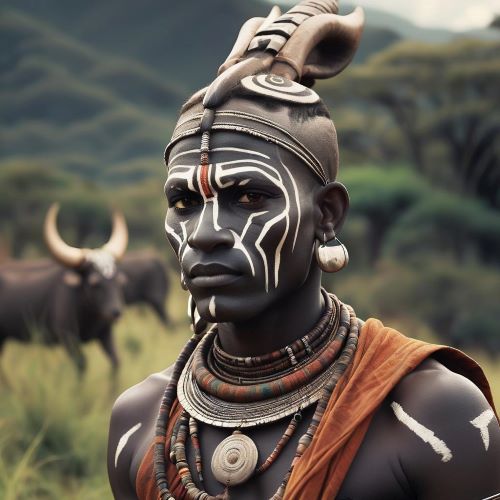


Tororut : The Supreme Sky Deity of the Kalenjin People
Listen
At a glance
| Description | |
|---|---|
| Origin | Kalenjin Mythology |
| Classification | Spirits |
| Family Members | Seta (Wife), Arawa, Ilat, Kokel, Topogh (Children) |
| Region | Kenya |
| Associated With | Creation, Sky, Weather, Lightning, Thunder |
Tororut
Introduction
Tororut occupies a commanding place in the spiritual worldview of the Kalenjin people of Kenya’s Rift Valley. Revered as the supreme creator and cosmic authority, Tororut is believed to have shaped the earth, brought humanity into existence, and set the natural order in motion. Unlike distant or abstract creator figures found in some traditions, Tororut remains deeply woven into daily life through weather, morality, and ancestral memory. His presence explains thunder, rain, abundance, and disaster, positioning him not only as a creator but also as an active overseer of human conduct.
Within Kalenjin belief systems, Tororut reflects an ancient Nilotic form of henotheism, where a single supreme deity governs a world inhabited by lesser divine forces. In some traditions, particularly among southern Kalenjin groups, Tororut is closely associated or even identified with Asis, the sun deity. This fluid identity does not dilute his authority but instead reinforces his role as the ultimate source from which all celestial and earthly forces originate.
Physical Traits
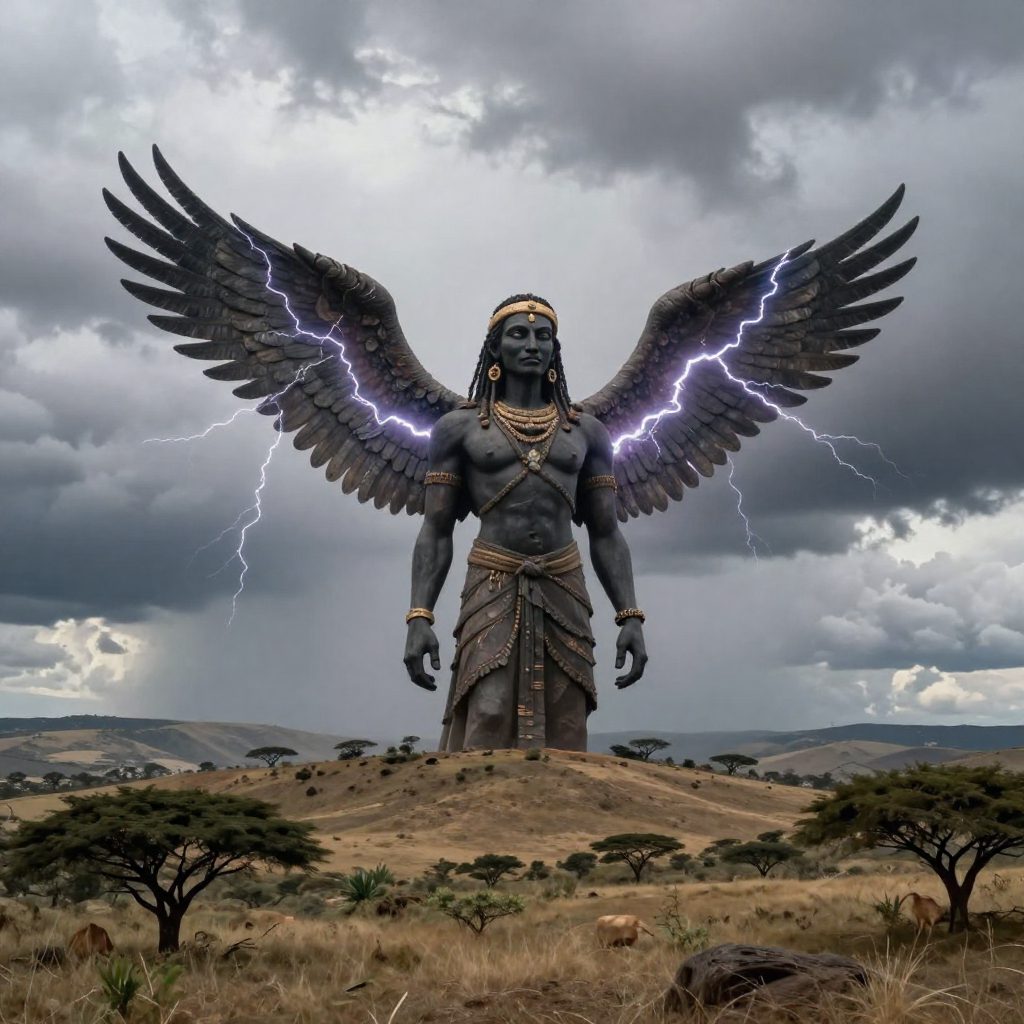
Tororut is described in oral tradition as a vast, humanoid being whose scale transcends the human world. His head is said to touch the sky while his feet rest upon the earth, a powerful image that symbolizes his dominion over both realms. He possesses enormous wings, and it is through these wings that natural phenomena are explained. When they flash, lightning is born. When they whirl through the air, thunder rolls across the land.
Unlike purely abstract sky gods, Tororut’s form retains a tangible quality. Elders recount that ancestors once glimpsed him dwelling “above,” in a realm filled with fertile land, livestock, ivory, and endless abundance. This upper world is not imagined as distant or unreachable but as a parallel domain reflecting an idealized version of earthly life. Through this imagery, Tororut becomes both awe-inspiring and familiar, embodying a divine presence that feels close to human experience.
Family
Tororut’s family structure mirrors the cosmos itself, transforming celestial bodies and natural forces into kin. His wife is Seta, identified with the Pleiades star cluster, whose seasonal appearance guides agricultural rhythms. Together they produce children who govern fundamental aspects of existence. Arawa, the moon, is described as Tororut’s firstborn son, while Ilat, associated with rain and thunder, plays a more volatile role, spilling water across the earth to bring rain or destruction.
Other offspring include Kokel, linked to the stars, and Topogh, the evening star and firstborn daughter. These divine relationships do not function merely as mythology but as explanatory frameworks for natural cycles. In some traditions, Ilat is viewed as Tororut’s servant, while in others he operates independently as a powerful and sometimes dangerous force. Regardless of variation, Tororut remains the patriarchal center, the unifying source from which all cosmic relationships flow.
Other names
Tororut’s identity shifts subtly across Kalenjin sub-groups, reflecting linguistic diversity and regional belief systems. Among northern Kalenjin communities such as the Pokot and Suk, Tororut is often equated with Asis, the sun deity. Asis is also known as Cheptalel, meaning “The One Who Shines,” or Chebet chebo Chemataw, “Daughter of the Day,” titles that emphasize radiance and life-giving warmth.
In Tugen traditions, Asis may appear as Tororut’s wife rather than an equivalent deity, highlighting a symbolic union between sky and sun. The name Netorror appears in ritual contexts, particularly in prayers and invocations. These variations do not contradict one another but instead reveal a flexible theological system where divine roles adapt to environment, history, and cultural exchange, especially following Cushitic influences in the region.
Powers and Abilities
As the supreme deity in Kalenjin belief, Tororut’s powers encompass creation, judgment, and cosmic balance. He is credited with forming the earth and bringing humans and animals into existence, establishing an ordered world from primordial unity. His omniscience allows him to observe human actions, rewarding moral behavior and punishing wrongdoing through calamities such as droughts, lightning strikes, and natural disasters.
Tororut’s control over weather is among his most significant attributes. Through his wings and his divine offspring, rain, thunder, and storms are unleashed upon the world. Creation myths describe his interaction with primordial beings, including Ilet and the ancestral elephant, to define the relationship between sky and earth. Through these acts, Tororut becomes not only a creator but a regulator, ensuring harmony between the natural world and human society.
Modern Day Influence
Although Christianity now dominates religious practice among the Kalenjin, Tororut’s influence has not disappeared. Instead, it has adapted. Traditional rituals such as kaapkoros, conducted on sacred hilltops and led by Tisiik priests, preserve elements of older sky worship. Blessings invoking warmth, home, and continuity often echo Tororut’s presence, even when framed within Christian language.
Folklore surrounding figures like Chemosit and Ilat continues to circulate through oral storytelling, reinforcing moral lessons rooted in Tororut’s authority. In recent years, cultural blogs, academic research, and social media platforms have revived interest in indigenous belief systems, presenting Tororut as a symbol of heritage rather than a rival to modern faith. Through these channels, Tororut endures as a foundational figure in Kalenjin identity, representing order, memory, and the enduring bond between humanity and the sky.
Related Images


Source
Eiselen, W. B. (1955). The Nandi and Kipsigis of Kenya. In Daryll Forde (Ed.), African worlds (pp. 57-72). Oxford University Press.
Ehret, C. (1998). An African classical age: Eastern and southern Africa in world history, 1000 B.C. to A.D. 400. University Press of Virginia.
Fisher, R. (1954). Twilight tales of the black bag. Nairobi: Eagle Press.
Huntingford, G. W. B. (1953). The Nandi of Kenya: Tribal control in a pastoral society. Routledge & Kegan Paul.
Kipkorir, B. E. M. (1980). People of the rift valley. Evans Brothers.
Peristiany, J. G. (1939). The Nandi of Kenya. In M. Fortes & E. E. Evans-Pritchard (Eds.), African political systems (pp. 209-237). Oxford University Press.
Wikipedia contributors. (2024). Kalenjin mythology. Wikipedia. https://en.wikipedia.org/wiki/Kalenjin_mythology
Lebarty. (n.d.). Kalenjin mythology. Retrieved December 18, 2025, from https://lebarty.bongchong.com/kalenjin-mythology/
Stronghold Nation. (n.d.). Tororut Ancient Gods. Retrieved December 18, 2025, from https://www.stronghold-nation.com/history/myth/tororut
Kipkorir, B. E. (1973). The Kalenjin heritage: Traditional religious beliefs and practices. Nairobi: East African Literature Bureau.
Frequently Asked Questions
Who is Tororut in Kalenjin belief?
Tororut is the supreme creator deity of the Kalenjin people, responsible for creating the earth, humanity, and natural order.
Is Tororut the same as Asis?
In some Kalenjin traditions, Tororut is identified with Asis, the sun deity, while in others they are distinct but closely related figures.
What natural forces are linked to Tororut?
Tororut is associated with lightning, thunder, rain, and storms, often explained through his wings and divine offspring.
Does Tororut have a family?
Yes, Tororut’s family includes celestial beings such as the moon, stars, and rain, represented as his children in myth.
Is Tororut still worshipped today?
While formal worship has declined, Tororut’s influence survives through rituals, folklore, cultural identity, and syncretic beliefs.