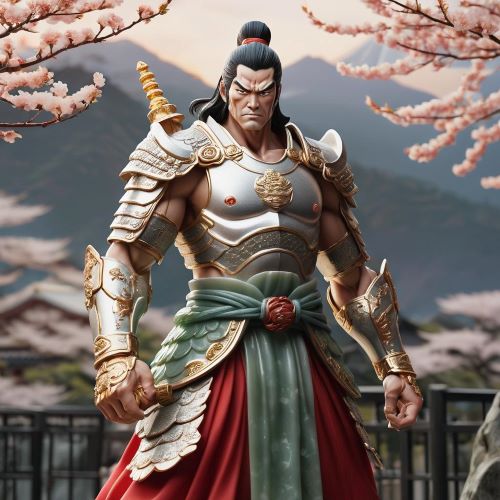


Gozu Tennō : The Japanese Ox-Headed Guardian of Disease
Listen
At a glance
| Description | |
|---|---|
| Origin | Japanese Mythology |
| Classification | Gods |
| Family Members | Harisaijo (Wife), Hachiōji (Sons) |
| Region | Japan |
| Associated With | Disease, Protection |
Gozu Tenno
Introduction
Gozu Tennō (牛頭天王), often rendered in older transliterations as Gozu Tennu, occupies a unique and complex position in Japanese religious history. Known as the “Ox-Headed Heavenly King,” he represents a powerful fusion of Buddhist, Shinto, and folk traditions that developed during Japan’s classical period. Rather than belonging neatly to a single pantheon, Gozu Tennō emerged through shinbutsu-shūgō, the long-standing blending of Buddhist deities with native kami. His cult was especially prominent from the Heian period onward, when epidemics were frequent and poorly understood, and spiritual explanations dominated public responses to disease.
Originally derived from continental Asian traditions linked to Bhaiṣajyaguru, the Medicine Buddha, Gozu Tennō was later identified with Susanoo-no-Mikoto, the Japanese storm god. This fusion transformed him into a paradoxical figure who embodied both calamity and protection. Feared as a divine source of pestilence, he was simultaneously revered as the very power capable of stopping it. Nowhere was this dual role more visible than at Yasaka Shrine in Kyoto, where Gozu Tennō stood at the center of rituals meant to safeguard the capital from epidemics. His mythology reflects how societies personified invisible threats and sought balance through ritual appeasement rather than simple worship.
Physical Traits
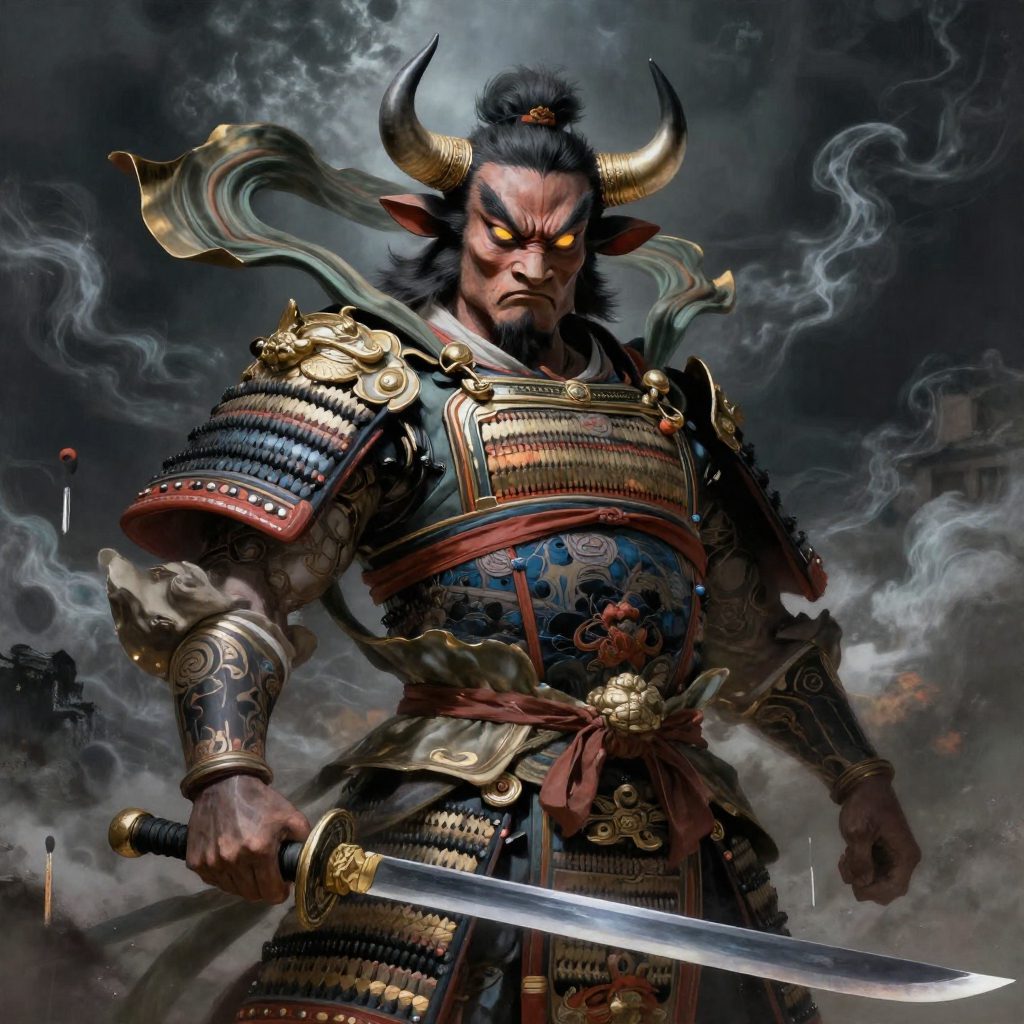
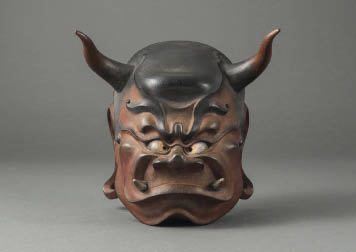
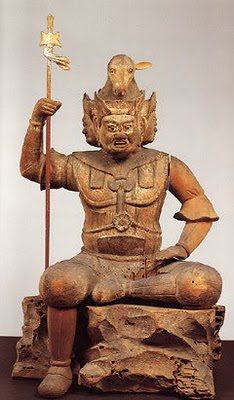
The visual identity of Gozu Tennō shifts across centuries, yet certain features remain constant. He is most recognizably depicted with the head of an ox, a symbol associated across Asia with brute strength, endurance, and unstoppable force. Unlike animal-headed demons of purely infernal realms, Gozu Tennō’s ox head does not reduce him to a monster; instead, it emphasizes his status as a divine enforcer whose appearance inspires fear as a protective mechanism.
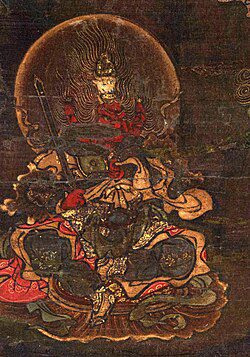
In painted scrolls and temple art, he often appears as a wrathful guardian figure, with bulging eyes, flared nostrils, and a commanding posture. Sculptural representations frequently portray him as a foreign general, clad in armor or Chinese-style robes, reflecting his continental origins. Some iconographic traditions give him multiple arms or faces, reinforcing his supernatural authority rather than literal physical form. His imagery visually connects him to other ox-headed beings in Buddhist cosmology, including the hell guardian Gozu, yet Gozu Tennō remains distinct in function, operating not in the afterlife but in the fragile boundary between human communities and divine punishment.
Family
Gozu Tennō’s mythological family structure mirrors Shinto patterns of divine lineage while retaining Buddhist influences. He is traditionally paired with a consort named Harisaijo, and together they are said to have produced eight sons, collectively known as the Hachiōji, or Eight Princes. These offspring were believed to act as extensions of their father’s authority, each protecting specific directions or localities, reinforcing Gozu Tennō’s role as a territorial guardian rather than a distant cosmic god.
This familial framework helped localize his worship, allowing communities to establish smaller shrines dedicated to individual princes while still acknowledging the overarching power of Gozu Tennō. His later identification with Susanoo-no-Mikoto further integrated him into the broader Shinto divine family, aligning him with storm, chaos, and purification. Rather than replacing Susanoo, Gozu Tennō became another lens through which the same divine force could be understood, demonstrating how Japanese mythology prioritizes function and presence over rigid genealogies.
Other names
Few deities illustrate the fluidity of Japanese religious identity as clearly as Gozu Tennō. Over time, he accumulated a wide range of names, each reflecting a different aspect of his worship. Among the most prominent are Gion Daimyōjin, Gion Tenjin, Mutō-no-Kami, and Mutō Tenjin. These titles connect him directly to the Gion district of Kyoto, where his cult flourished, and to the Buddhist Jetavana monastery, known in Japanese as Gion.
These shifting names do not represent separate beings but rather contextual identities shaped by ritual function, location, and audience. In Buddhist settings, his name emphasized his role as a divine protector linked to sacred space. In folk traditions, names like Mutō-no-Kami anchored him within local legends such as the Somin Shōrai tale, where he rewards hospitality by granting protection from disease. This multiplicity of names underscores how Gozu Tennō adapted seamlessly across religious boundaries without losing his core identity.
Powers and Abilities
Gozu Tennō’s power lies in contradiction. He is both the source of epidemics and the authority that restrains them. In pre-modern Japan, disease was not viewed as random but as a sign of spiritual imbalance or divine displeasure. Gozu Tennō personified this belief, acting as the divine agent who released illness upon communities that failed to maintain ritual harmony. Yet this same power made him indispensable, as only he could be petitioned to halt the suffering he caused.
His weapons, often depicted as swords, halberds, or binding cords, symbolize his ability to subdue malignant forces rather than indiscriminate violence. Through his association with Bhaiṣajyaguru, Gozu Tennō also absorbed the identity of a cosmic physician, reinforcing the idea that punishment and healing are inseparable aspects of divine justice. Protective charms linked to his myths, especially those derived from the Somin Shōrai legend, were widely used as talismans against disease, making his influence tangible in everyday life.
Modern Day Influence
Although direct worship of Gozu Tennō declined following the Meiji separation of Buddhism and Shinto, his legacy remains deeply embedded in Japanese culture. The Gion Matsuri, now celebrated primarily as a cultural festival, originated as a ritual to appease Gozu Tennō during a devastating epidemic in the ninth century. Even today, the festival’s emphasis on purification and communal protection echoes its original purpose.
In contemporary popular culture, ox-headed figures inspired by Gozu Tennō continue to appear in anime, manga, and video games, often reimagined as oni or underworld guardians. These portrayals preserve his fearsome visual language while detaching it from formal religious worship. For scholars, Gozu Tennō remains a crucial example of how imported deities were transformed within Japanese belief systems, illustrating the adaptability of mythology in responding to social crises. His story resonates strongly in modern discussions about collective fear, ritual response, and the human need to give form to invisible threats.
Related Images


Source
Ashkenazi, M. (2008). Handbook of Japanese mythology. ABC-CLIO.
Encyclopedia of Shinto. (n.d.). Gozu Tennō. Kokugakuin University. https://d-museum.kokugakuin.ac.jp/eos/detail/?id=9933
Japan Forward. (2022, September 3). The Gion Matsuri: The mysteries of Gozu Tenno. https://japan-forward.com/the-gion-matsuri-the-mysteries-of-gozu-tenno/
Occult World. (2023, January 8). GOZU-TENNO. https://occult-world.com/gozu-tenno/
Rods Shinto. (2020, June 12). Japan Shinto Kami Gods | Gozu-Tennō. https://www.rodsshinto.com/gozu-tenno
Wikipedia. (2021, January 5). Gozu Tennō. https://en.wikipedia.org/wiki/Gozu_Tenn%C5%8D
Yokai.com. (2023, January 8). Gozu. https://yokai.com/gozu/
Frequently Asked Questions
Who is Gozu Tennō in Japanese mythology?
Gozu Tennō is a syncretic Japanese deity associated with disease, epidemics, and healing, known for his ox-headed form and role as both destroyer and protector.
Is Gozu Tennō the same as Susanoo?
In many traditions, Gozu Tennō was identified with Susanoo-no-Mikoto through religious syncretism, especially in Kyoto’s Gion cult.
Why is Gozu Tennō linked to plagues?
He was believed to unleash epidemics as divine punishment while also possessing the power to stop them when properly appeased.
What is the connection between Gozu Tennō and Gion Matsuri?
The Gion Matsuri began as a ritual to calm Gozu Tennō and protect Kyoto from widespread disease during the Heian period.
Does Gozu Tennō appear in modern culture?
Yes, his ox-headed imagery influences modern depictions of demons and guardians in Japanese anime, manga, and games.