
Na Atibu : The Primordial Creator of the Kiribati Cosmos
Listen
At a glance
| Description | |
|---|---|
| Origin | Kiribati Mythology |
| Classification | Gods |
| Family Members | Nei Teukez (Wife), Nareau the Younger, Te Nao, Na Kika, Ruki (Children) |
| Region | Gilbert Islands |
| Associated With | Creation |
Na Atibu
Introduction
Na Atibu occupies a central place in the mythology of the Gilbert Islands—today’s Republic of Kiribati—where he is remembered as one of the earliest beings responsible for shaping the world and giving life to humankind. His story reflects the deep relationship the I-Kiribati people have with land, sea, ancestry, and the continuity of creation. According to oral tradition, Na Atibu was fashioned by Nareau the Elder, the cosmic spider deity credited with forming the universe. Alongside Nei Teukez, his female counterpart, Na Atibu becomes a pivotal figure whose body, actions, and lineage define the very structure of the physical and spiritual world. His myth is part of a broader Micronesian cosmogonic tradition in which the universe emerges through sacrifice and transformation, with Na Atibu’s body becoming the source of life, celestial order, and human origins.
Physical Traits
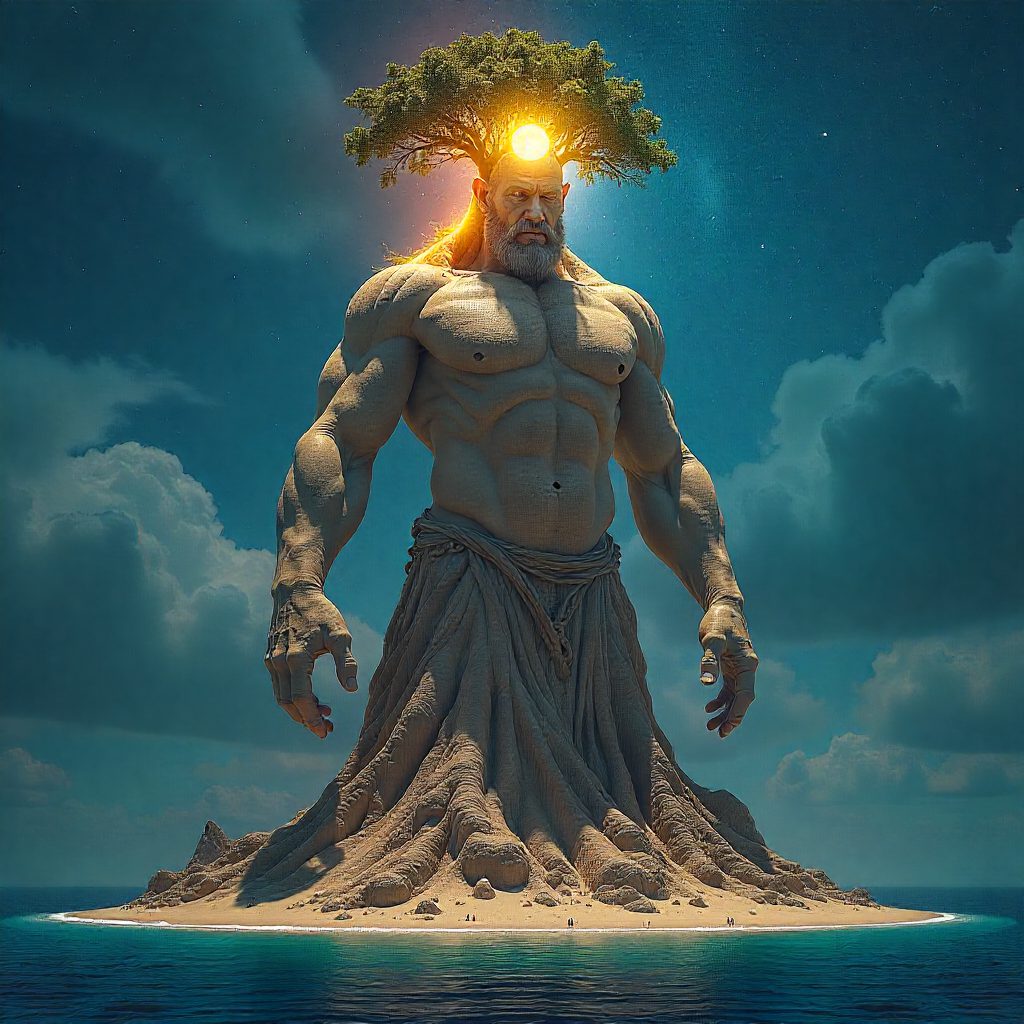
Descriptions of Na Atibu rarely focus on humanlike features; instead, they emphasize his symbolic and elemental form. Created from sand and water by Nareau, he embodies the substances that define the fragile yet enduring landscape of the Gilbert Islands—coral sands shaped by ocean currents. His most defining “physical trait” appears only after his death, when his spine becomes the root of the sacred kai-n-tiku-aba tree. This cosmic tree grows into a towering structure whose fruits eventually become human beings. His eyes transform into the sun and moon, his brain into the stars, and his bones and flesh into the islands and trees. These descriptions reveal Na Atibu not as an anthropomorphic deity but as a vast cosmic being whose very body becomes the architecture of the world, linking the natural environment directly to divine sacrifice.
Family
Na Atibu belongs to the first generation of beings brought into existence by Nareau the Elder. His union with Nei Teukez results in the birth of several important deities who inhabit and shape the newly forming universe. Among their children are Nareau the Younger, Te Nao (the wave), Na Kika (the octopus), and Ruki (the eel)—figures who later influence the ocean, the land, and the forces that govern everyday life in Kiribati. Through this lineage, Na Atibu helps establish the divine genealogy from which the world evolves. Even after his body becomes the cosmos itself, his descendants continue the work of creation, reflecting the Kiribati belief in generational responsibility and the continuity of ancestral power.
Other names
While Na Atibu remains the most commonly used name across the Gilbert Islands, variations appear in certain oral traditions. In some recitations, he is known as Na Abitu, a regional variation arising from dialectal differences. In stories tied to the kai-n-tiku-aba myth, he is occasionally associated with names linked to specific islands such as Tabiteuea, where the sacred tree plays an important role in local identity. Although not widely used, these alternate names highlight the fluid nature of oral storytelling, where pronunciation and emphasis shift from one clan or island to another. Despite these variations, all versions recognize him as the primordial being whose sacrifice enables creation.
Powers and Abilities
Na Atibu’s abilities differ from the active, interventionist power of warrior gods or trickster deities. His strength lies in his capacity to generate life and structure through his own transformation. His greatest power manifests in the moment he allows himself to be dismantled so the world may emerge. His spine becomes the source of humanity; his eyes, the celestial lights; his flesh, the islands; and his bones, the trees. Through his union with Nei Teukez, he also fathers the deities who regulate natural forces such as ocean tides, marine creatures, and environmental rhythms essential to Micronesian life. Na Atibu’s powers therefore center on cosmic creation, ancestral genesis, and the enduring influence of his essence throughout the natural world.
Modern Day Influence
Though Kiribati is now predominantly Christian, stories about Na Atibu continue to shape cultural memory and ecological identity. The kai-n-tiku-aba tree remains one of the most important symbols in Kiribati mythology, representing human origin, community lineage, and the profound connection between people and land. In a nation threatened by rising sea levels, Na Atibu’s narrative offers a reminder of ancestral resilience and the interdependence of environment and human life. His story appears in cultural revival projects, academic studies of Micronesian cosmology, and global discussions that draw parallels between Na Atibu and other cosmic progenitors like Ymir of Norse mythology. Digital storytelling platforms and diaspora communities increasingly share Na Atibu’s myth to preserve I-Kiribati identity, ensuring that his legacy continues to thrive in both traditional and contemporary contexts.
Related Images


Source
Banuck, G. (1986). We, the people of Kiribati: Originally known as I-Tungaru. Ministry of Cultural and Internal Communications. https://mcic.gov.ki/download/57/filed-copyrighted-work/4038/first-go-on-nareaus-canoe.pdf
Grimble, A. (1972). From island to island. John Murray.
Koch, G. (1986). Kiribati: Traditional and contemporary visual art. Institute of Pacific Studies.
Wikipedia contributors. (2021). Nareau. Wikipedia. https://en.wikipedia.org/wiki/Nareau
Wikipedia contributors. (2002). Kai-n-Tiku-Aba. Wikipedia. https://en.wikipedia.org/wiki/Kai-n-Tiku-Aba
Williams, T. R. (1971). Religious belief and social organization in the Gilbert Islands. Journal of the Polynesian Society, 80(2), 215-238.
Luomala, K. (1940). Polynesian mythology and its relation to Kiribati traditions. Bishop Museum Press.
Maude, H. E. (1968). Myths and legends from the Gilbert Islands. Pacific History Series.
Teiwaki, R. (1988). Kiribati: A changing atoll culture. Suva: Institute of Pacific Studies, University of the South Pacific.
Kaeppler, A. L. (1999). The Pacific arts of Kiribati: Myth, ritual, and identity. Journal of Pacific Studies, 22(2), 45–67
Frequently Asked Questions
Who is Na Atibu in Kiribati mythology?
Na Atibu is the primordial creator whose body becomes the foundation of the islands, the sky, and human life in Kiribati tradition.
What is the kai-n-tiku-aba tree associated with Na Atibu?
It is the sacred tree that grew from his spine, producing the first humans and symbolizing the origin of life.
How was Na Atibu created?
He was formed by Nareau the Elder from sand and water, representing the elemental origins of the Gilbert Islands.
What happened to Na Atibu after his death?
His body transformed into the cosmos—the sun, moon, stars, islands, and the sacred tree from which humanity emerged.
Does Na Atibu influence modern Kiribati culture?
Yes. His myth remains central to identity, ecological understanding, and cultural revival among the I-Kiribati people.