


Kuutkh : The Raven Creator of Chukchi Tradition
Listen
At a glance
| Description | |
|---|---|
| Origin | Chukchi Mythology |
| Classification | Gods |
| Family Members | N/A |
| Region | Russia |
| Associated With | Creation |
Kuutkh
Introduction
Kuutkh, also spelled Kutkh or Kutkha, is one of the most enduring figures in Chukchi mythology and a defining spirit of the Chukotko-Kamchatkan cultural world. Known primarily as the Raven creator, he shapes the cosmos with a blend of divine intention and mischievous impulse. His stories reveal the worldview of the Chukchi, Koryak, and Itelmen peoples, who share a close mythological heritage across northeastern Siberia. In these traditions, Kuutkh acts as both the architect of the natural world and a trickster who disrupts order to bring about transformation. His influence extends across land, sea, animals, and humanity, reflecting the challenges and mysteries of the Arctic landscape. Through his actions—purposeful or accidental—Kuutkh establishes the conditions of life, light, survival, and culture, making him an indispensable figure in Siberian cosmology.
Physical Traits
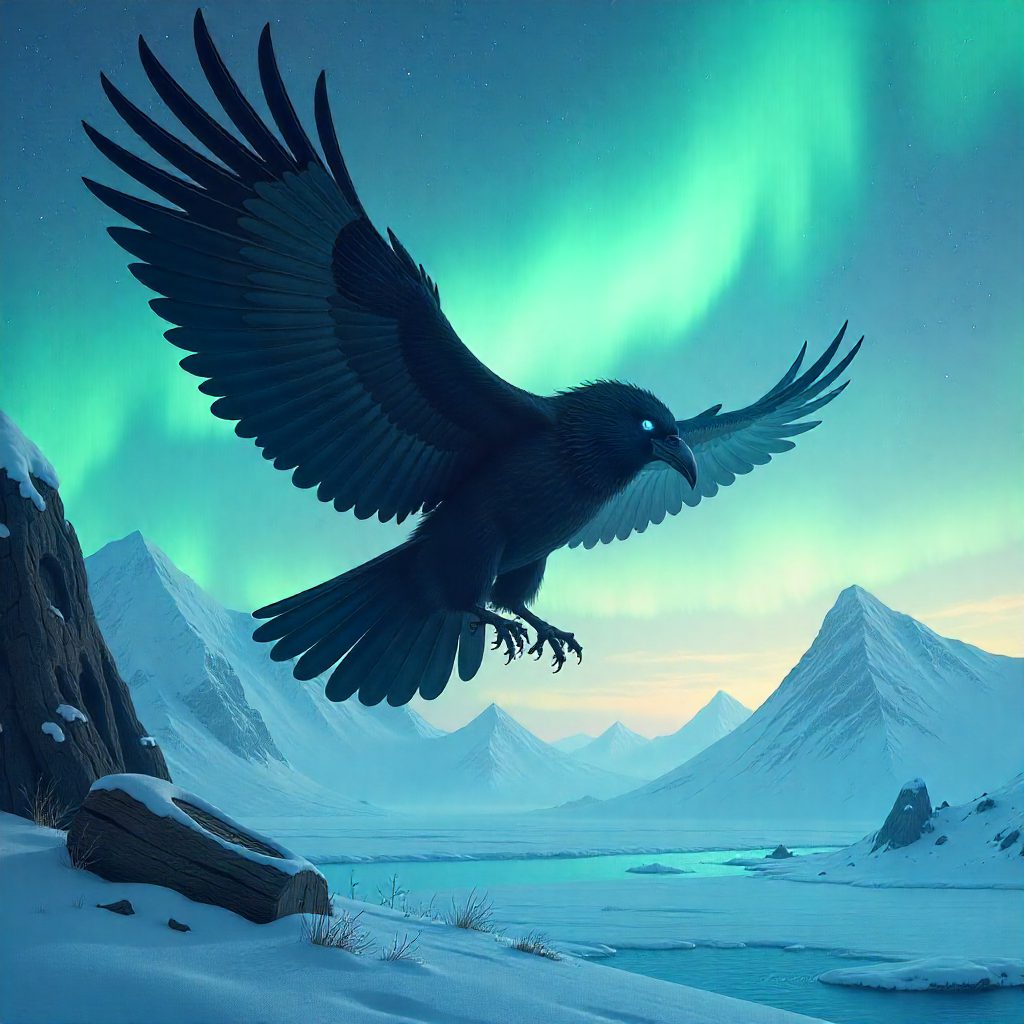
Kuutkh is most famously identified with the Raven, a creature that thrives in the harsh northern environment and is admired for its intelligence and adaptability. His primary form is that of a great black bird with gleaming feathers, sharp eyes, and a commanding presence, embodying his ability to travel freely between the human world and the realm of spirits. Within his stories, his raven body is not merely symbolic; his movements, flights, and even bodily actions mold elements of the landscape. At the same time, Kuutkh is capable of shifting into a human-like figure, especially when interacting directly with mortals. In these moments he appears as a tall, disheveled man whose wild hair and restless behaviour hint at his avian nature. This fluidity between forms reinforces his position as a liminal being—neither fully bird nor human, but something that transcends both.
Family
Kuutkh’s family relationships differ slightly among Chukchi, Koryak, and Itelmen traditions, yet all portray him as deeply embedded within a web of spiritual kinship. In many accounts, he is paired with a female spirit representing earth or fertility, a counterpart who helps stabilise the world he creates. Certain narratives mention his wife Miti, and others describe unnamed consorts through whom he fathers the first humans or other mythic beings. His children often become ancestors of specific peoples or animals, illustrating the belief that all life stems from divine lineage. These familial connections highlight his dual nature: he is simultaneously a lofty creator and a relatable figure whose experiences echo human concerns about kinship, responsibility, and conflict. His interactions with other spirits—whether sea deities, animal guardians, or elemental beings—reinforce the interconnectedness of natural forces in Arctic cosmology.
Other names
The many names associated with Kuutkh reflect both linguistic diversity and the wide reach of his myths across northeastern Siberia. Among the Chukchi he is typically called Kuutkh or Kutkh, while Koryak traditions use forms such as Kutkha, Kutq, or the descriptive title Big Raven (Quikinna’qu). The Itelmens of Kamchatka know him as Kutkhu, preserving his raven identity in their own oral traditions. These variations all point to the same powerful culture hero whose deeds shaped the world. The consistency of his identity across different peoples suggests an ancient shared mythological foundation, strengthened by centuries of cultural exchange. Although similar to the Raven figures of Alaska and the Pacific Northwest, Kuutkh remains firmly rooted in Siberian landscapes, values, and cosmology.
Powers and Abilities
Kuutkh’s powers encompass creation, transformation, and cunning—traits that define his role in Chukchi mythology. He is responsible for bringing the world out of chaos, forming landmasses, carving valleys, and shaping oceans through deliberate actions or comedic mishaps. Several tales describe him stealing or releasing light to illuminate the world, placing him among the great creator figures of circumpolar myth. His ability to shift forms allows him to interact with animals, deceive rival spirits, or teach humans essential skills. Kuutkh bestows knowledge such as fire, hunting techniques, or the craft of weaving nets, though his lessons often come indirectly through trickery. He can command weather patterns, influence migrations, and traverse spiritual dimensions, embodying the shamanic ideal of movement between realms. Despite his immense power, he remains vulnerable to his own impulses, creating a dynamic figure whose unpredictability mirrors the volatility of the Arctic environment.
Modern Day Influence
In the modern era, Kuutkh continues to play an important role in the cultural identity of the Chukchi, Koryak, and Kamchatkan communities. His stories are preserved through folklore collections, museum exhibits, and contemporary adaptations in literature and film. Artists frequently depict him in wood carvings, beadwork, and traditional clothing designs, ensuring that his raven image endures in both ceremonial and commercial contexts. As global interest in Arctic cultures grows, Kuutkh’s myths serve as valuable insights into Indigenous relationships with nature, survival, and spirituality. Comparative mythologists draw parallels between Kuutkh and other Raven creators across the circumpolar world, highlighting ancient connections shaped by migration and shared ecological challenges. In discussions on environmental preservation, Kuutkh often symbolises a reminder of balance between human communities and the fragile Arctic ecosystem. His presence in modern storytelling, both academic and popular, underscores his lasting relevance as a cultural symbol of resilience and transformation.
Related Images


Source
Bogoras, W. (1909). Chukchee mythology. E. J. Brill. https://www.scribd.com/document/47429463/Bogoras-Waldemar-Chukchee-Mythology
Godchecker. (2023). KUTKH – the Siberian Trickster God. https://www.godchecker.com/siberian-mythology/KUTKH/
Kutkh. (2007). Wikipedia. https://en.wikipedia.org/wiki/Kutkh
Living wisdom of the Far North: Tales and legends from Chukotka and Alaska. (n.d.). Arctic Institute of the U.S. https://www.arlis.org/docs/vol1/P/760199228.pdf
Tenhunen, U. (2011). A critical review of the traditional narratives of Chukotka and Kamchatka. Academia.edu. https://www.academia.edu/116620604/A_Critical_Review_of_the_Traditional_Narratives_of_Chukotka_and_Kamchatka
Bogoras, W. (1904–1909). The Chukchee. Publications of the American Museum of Natural History, Memoir of the Jesup North Pacific Expedition. New York: G.E. Stechert.
Krupnik, I. (1993). Arctic Adaptations: Native Whalers and Reindeer Herders of Northern Eurasia. Hanover: University Press of New England.
Jochelson, W. (1905). The Koryak. Memoirs of the American Museum of Natural History. Leiden: Brill.
Vakhtin, N. (2001). Native Peoples of the Russian Far North. London: Routledge.
Balzer, M. M. (1999). The Tenacity of Ethnicity: A Siberian Saga in Global Perspective. Princeton: Princeton University Press.
Frequently Asked Questions
Who is Kuutkh in Chukchi mythology?
Kuutkh is the Raven creator and trickster spirit who forms the world and influences human survival in Chukchi, Koryak, and Itelmen traditions.
Why is Kuutkh depicted as a Raven?
The Raven represents intelligence, adaptability, and the ability to move between the physical and spiritual worlds, making it ideal for a creator-trickster figure.
What powers does Kuutkh possess?
He can shapeshift, create land, command elements, teach humans essential skills, and travel between realms.
Is Kuutkh related to the Raven figures of Alaska?
Yes, they share thematic parallels, but Kuutkh is specifically rooted in Siberian Indigenous cosmology.
Does Kuutkh still influence modern culture?
His image appears in Arctic art, folklore studies, museum exhibits, and contemporary retellings that preserve Indigenous identity.
