

Khmer Dragon : The Sacred Naga of Cambodian Tradition
Listen
At a glance
| Description | |
|---|---|
| Origin | Cambodian Mythology |
| Classification | Hybrids |
| Family Members | Naga King (Father of Neang Neak), Preah Thaong (Wife) |
| Region | Cambodia |
| Associated With | Water, Rain, Fertility, Protection, Kingship |
The Mythlok Perspective
In Mythlok’s Perspective, the Khmer Dragon is not simply a serpent spirit but a civilizational metaphor. It represents water as destiny and ancestry as sacred geography. Unlike Western dragons that hoard gold or Chinese dragons that command the sky, the Khmer Dragon guards land through water. It stands closer to the Indian Naga tradition yet functions nationally like Japan’s Ryū as a territorial guardian. The Khmer Dragon ultimately embodies the idea that a nation is born where myth, ecology, and identity converge.
Khmer Dragon
Introduction
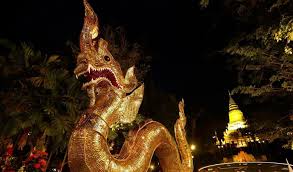
The Khmer Dragon, known locally as the Naga or Neak, is one of the most powerful and enduring symbols in Cambodian culture. Unlike Western dragons associated with fire and destruction, the Khmer Dragon is a sacred serpent linked to water, fertility, protection, and royal ancestry. The term “Naga” originates from Sanskrit, meaning serpent, and entered mainland Southeast Asia through Indian cultural exchange more than two millennia ago.
In Cambodian belief, the Naga is not merely a mythical creature but an ancestral being. Khmer tradition holds that the nation itself descends from a union between a Naga princess and an Indian prince. Because of this, the Khmer Dragon represents legitimacy, continuity, and the sacred bond between land and people.
In both Hindu and Buddhist cosmology, Nagas are semi-divine serpent beings who dwell in water realms, rivers, and subterranean worlds. In Cambodian tradition, this symbolism evolved into something uniquely Khmer. The dragon became guardian of the earth, protector of sacred spaces, and a symbol of cosmic balance. From temple carvings at Angkor to wedding rituals today, the Khmer Dragon remains central to Cambodia’s spiritual identity.
Physical Traits
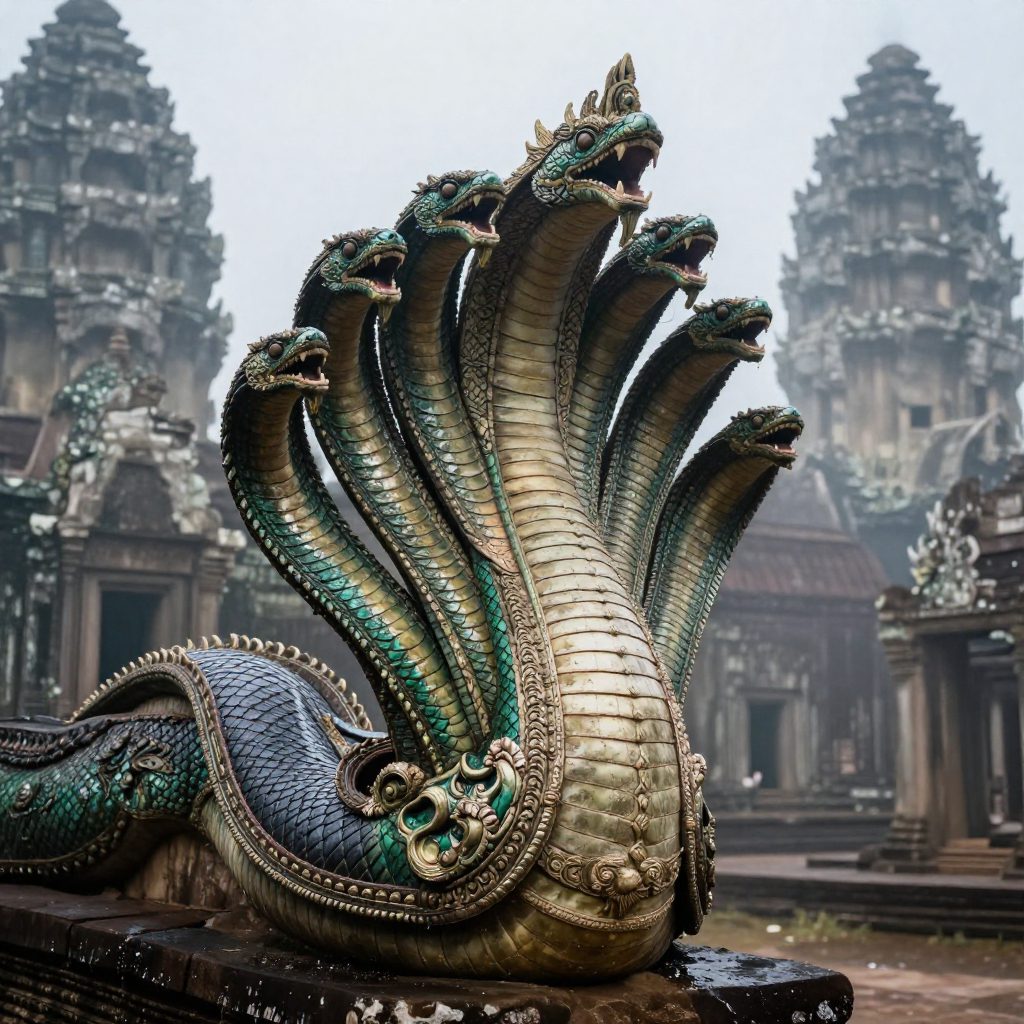
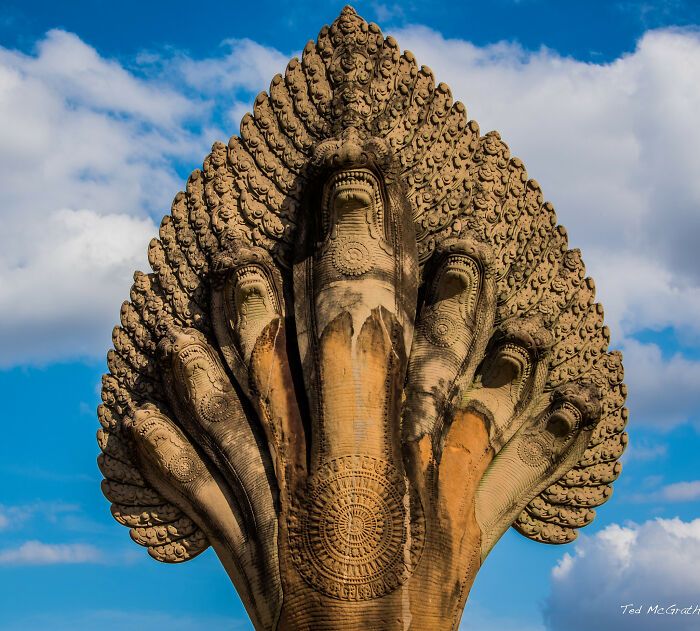
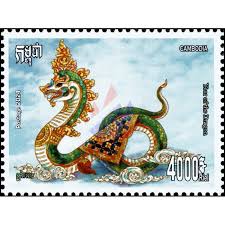
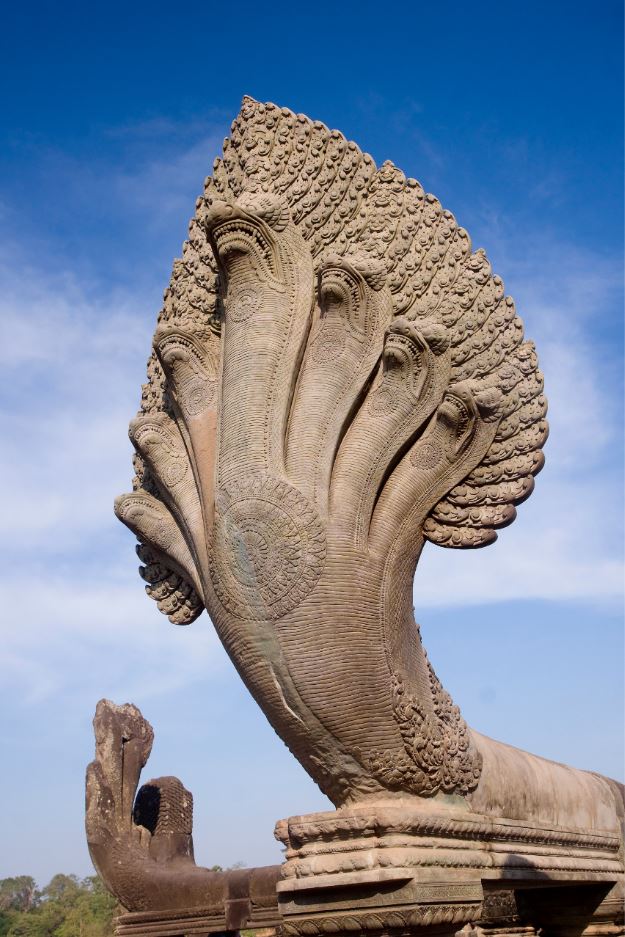
The Khmer Dragon is most commonly depicted as a multi-headed serpent with a flared cobra hood. The number of heads varies, often appearing as three, five, seven, or nine. Among these, the seven-headed Naga is the most iconic in Khmer art, especially in the balustrades of Angkor temples.
Each head typically mirrors the others, fanning outward in symmetrical formation. The central head is often slightly larger, symbolizing authority and balance. The body is elongated and serpent-like, sometimes forming entire causeways in temple architecture, visually linking the earthly realm with the divine.
The number of heads carries symbolic meaning. Odd numbers are traditionally associated with strength, protection, and immortality. Seven represents cosmic harmony and completeness in Khmer cosmology. Nine, often linked with royalty and divine authority, signifies spiritual power and sovereignty.
In some interpretations, the Naga may also appear in hybrid forms. Khmer lore includes references to serpent beings connected with crocodile-like makara figures or stylized mythical creatures integrated into temple ornamentation. However, the dominant image remains that of the multi-headed water serpent. Unlike Chinese dragons, the Khmer Dragon has no wings. Its power is fluid rather than aerial. It moves through water and earth, emphasizing its role as guardian of rivers, lakes, and fertile plains.
Family
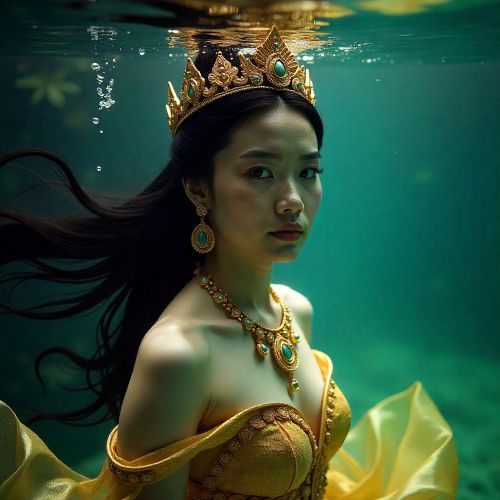
The most important family narrative surrounding the Khmer Dragon is Cambodia’s origin myth. According to legend, a Naga princess named Neang Neak, also identified in some accounts as Soma, married an Indian Brahmin prince named Preah Thaong, known in historical traditions as Kaundinya.
This union symbolizes the fusion of indigenous Khmer culture with Indian spiritual influence. The Naga king, father of Neang Neak, is said to have drunk up the surrounding ocean to create land as a dowry for the couple. That land became the foundation of early Cambodian civilization, often associated with the ancient kingdom of Funan.
Through this myth, the Khmer people regard themselves as descendants of the Naga lineage. The dragon therefore represents not just protection but ancestry. Every Khmer marriage ceremony symbolically reenacts this union. The groom traditionally holds the bride’s scarf as she leads him, representing the journey of Preah Thaong into the Naga realm. The Khmer Dragon is therefore not isolated as a solitary being. It exists within a royal serpent lineage, connected to kingship, territory, and divine blessing.
Other names
The Khmer Dragon is most widely known as Naga, derived from Sanskrit. In Khmer language, it is often called Neak. The feminine form appears as Neang Neak, meaning “Lady Dragon.” In Buddhist narratives across Southeast Asia, Nagas are sometimes referred to as serpent kings or water guardians. While the terminology varies, the underlying identity remains consistent: a semi-divine serpent being tied to water and sacred authority. The blending of Indian and Khmer traditions introduced alternative names through historical texts, including references to Soma for the Naga princess and Kaundinya for the Indian prince. These variations reflect centuries of cultural exchange rather than separate identities.
Powers and Abilities
The Khmer Dragon possesses powers rooted in water, fertility, and cosmic balance. As a water deity, it governs rivers, rain, and seasonal cycles. Cambodia’s agricultural system, historically dependent on monsoon rains and irrigation, reinforced the dragon’s association with abundance and life. Creation myths describe the Naga shaping the land itself. By withdrawing the sea, the serpent king reveals fertile ground. This act establishes the dragon as a creator figure and territorial guardian.
The Naga is also a shapeshifter. In Buddhist stories, serpent beings can assume human form. One well-known pan-Buddhist legend recounts a Naga transforming into a monk to seek enlightenment. Though discovered, the story underscores the Naga’s spiritual aspiration and connection to the Dharma.
Protection remains its most visible power. At temples such as Angkor Wat, Angkor Thom, and Preah Vihear, vast Naga balustrades guard entrances and causeways. These carvings are not decorative alone. They symbolize the dragon shielding sacred space from chaos and negative forces. The Khmer Dragon is further associated with treasure guardianship, healing symbolism, and divine legitimacy. Its multi-headed form suggests omnidirectional awareness, watching over all realms simultaneously.
Modern Day Influence
The Khmer Dragon continues to shape Cambodia’s identity in visible and symbolic ways. Angkor Wat, featured on the national flag, prominently displays Naga imagery throughout its architecture. The dragon remains a national emblem of heritage and resilience.
During Bon Om Touk, Cambodia’s Water Festival, rivers such as the Mekong and Tonle Sap are celebrated. Though the festival honors seasonal flow reversal, the spiritual association with water spirits and Nagas remains embedded in cultural memory. Khmer wedding ceremonies still reference the ancient union of Preah Thaong and Neang Neak. The ritual gestures preserve the origin myth as a living tradition rather than a forgotten legend.
In modern Cambodia, the Naga appears in logos, sculptures, amulets, tattoos, and public monuments. A large statue of Preah Thong and Neang Neak in Sihanoukville stands as a reminder of national ancestry. The Khmer Dragon is not confined to mythic past. It is a continuing symbol of unity between land, water, and people.
Related Images

Source
Behane. (2025, June 6). Neak. DeviantArt. https://www.deviantart.com/behane/art/Neak-1203871726
Khmer drama style. (2015, September). Dragon symbols and beliefs Khmer architecture. http://khmerdramastyle.blogspot.com/2015/09/dragon-symbols-and-beliefs-khmer.html
Wikipedia contributors. (2025, February 15). Khmer mythology. Wikipedia. https://en.wikipedia.org/wiki/Khmer_mythology
Archaiacreations. (2024, October 10). The legendary queen Neang Neak: The serpent queen of Cambodia. https://www.archaiacreations.com/en/blogs/blog-archaia/la-reine-legendaire-neang-neak-la-reine-serpent-du-cambodge
Uncharted ruins. (2013, January). Angkor, the city of the celestial dragon (Part III). http://unchartedruins.blogspot.com/2013/01/angkor-city-of-celestial-dragon-part-iii.html
Masaryk University. (2018). The dolphin and the dragon: Comparing Hindu and Buddhist aspects of a human/animal transformation.
https://www.muni.cz/en/research/publications/1544696
Chandler, D. (2008). A History of Cambodia (4th ed.). Boulder: Westview Press.
Coedès, G. (1968). The Indianized States of Southeast Asia. Honolulu: University of Hawaii Press.
Freeman, M., & Jacques, C. (1999). Ancient Angkor. Bangkok: River Books.
Jacobsen, T. (2008). Lost Goddesses: The Denial of Female Power in Cambodian History. Copenhagen: NIAS Press.
Frequently Asked Questions
What is the Khmer Dragon?
The Khmer Dragon refers to the Naga in Cambodian tradition, a multi-headed sacred serpent associated with water, protection, and royal ancestry.
How many heads does the Khmer Dragon have?
It commonly appears with three, five, seven, or nine heads, with seven being the most prevalent in Khmer temple art.
Is the Khmer Dragon different from Chinese dragons?
Yes. The Khmer Dragon is serpent-like, water-associated, and wingless, unlike the airborne, long-bodied Chinese dragon.
Why is the Naga important in Cambodian weddings?
Wedding rituals reenact the legendary marriage between the Naga princess Neang Neak and the prince Preah Thaong, symbolizing national ancestry.
Where can you see the Khmer Dragon today?
Naga imagery is prominently displayed at Angkor Wat, Angkor Thom, Preah Vihear, and throughout Cambodian religious and cultural architecture.