

Charun : The Etruscan Guide of Souls and Enforcer of Death
Listen
At a glance
| Description | |
|---|---|
| Origin | Etruscan Mythology |
| Classification | Spirits |
| Family Members | N/A |
| Region | Italy |
| Associated With | Death, Afterlife |
Charun
Introduction
Charun stands as one of the most haunting and unforgettable figures in Etruscan mythology, a being whose very presence shaped how the ancient Etruscans viewed death, fear, and the afterlife. Known primarily as a psychopomp, Charun did far more than escort the dead—he embodied the violent certainty of mortality itself. Unlike the Greek Charon, whose function was transactional and almost bureaucratic, Charun was sinister, active, and deeply involved in the moment of death. Etruscan tomb paintings portray him not as a quiet ferryman but as a daemon looming over heroes, warriors, and ordinary people alike, ready to ensure that no soul escaped its final destination. His terrifying form and ever-present hammer became symbolic reminders that death was not merely an ending but an unavoidable cosmic force. Understanding Charun means understanding how the Etruscans saw life’s fragility and the spiritual world that awaited them.
Physical Traits
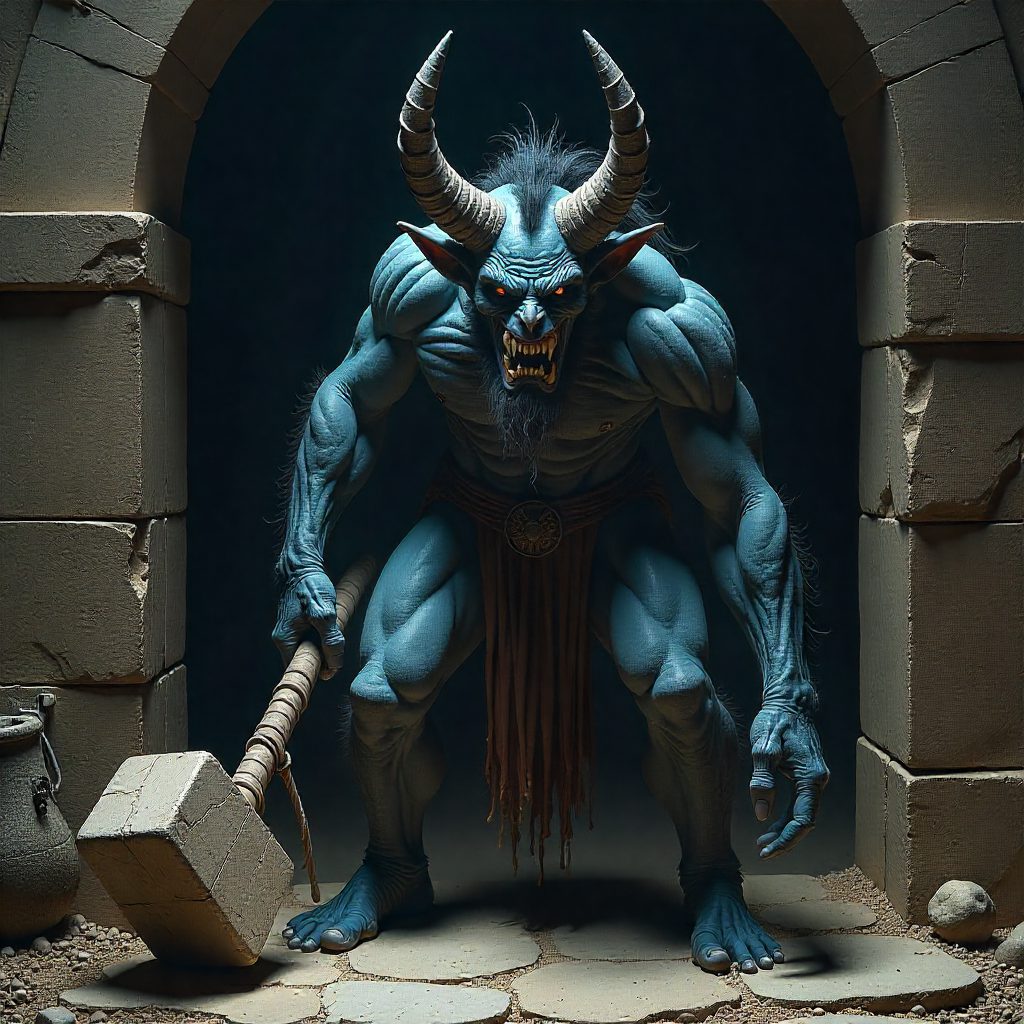
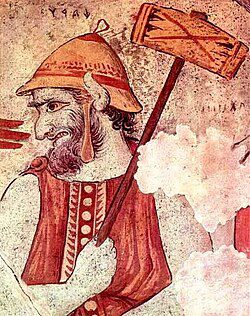
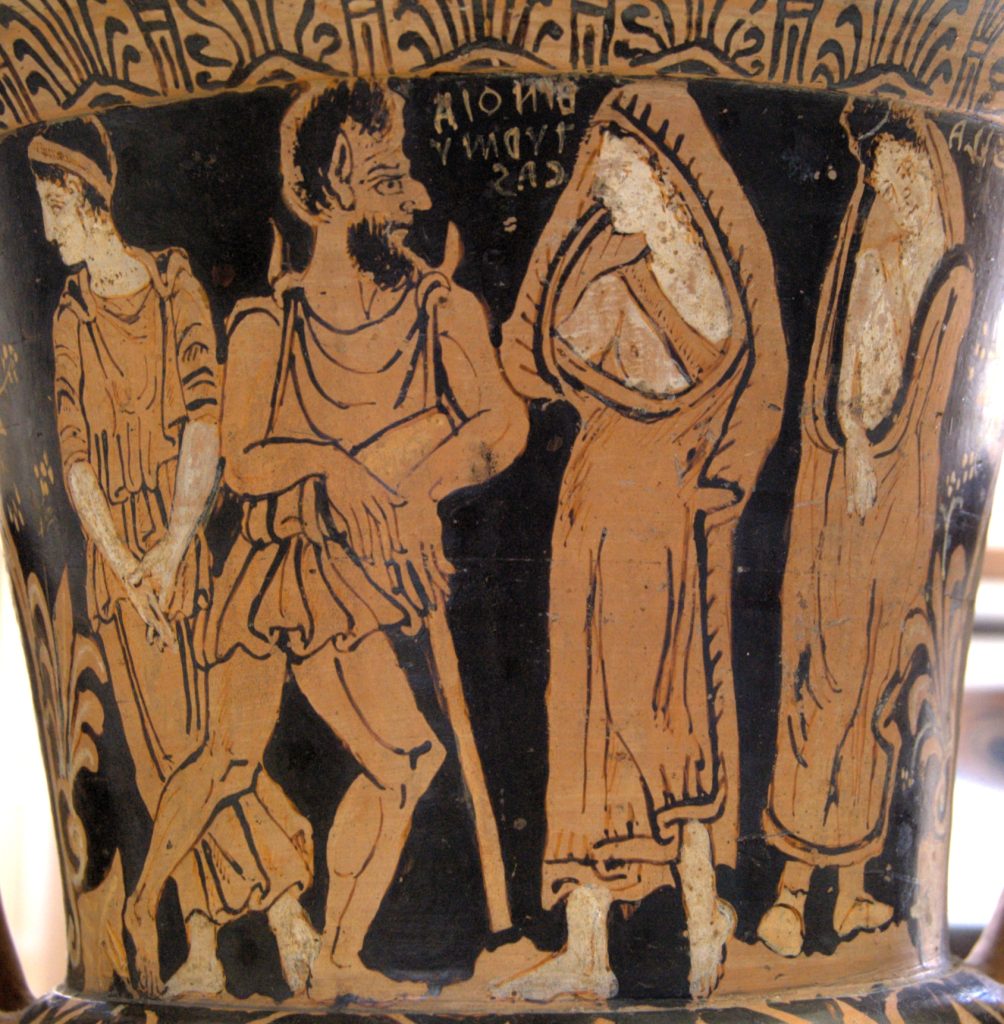
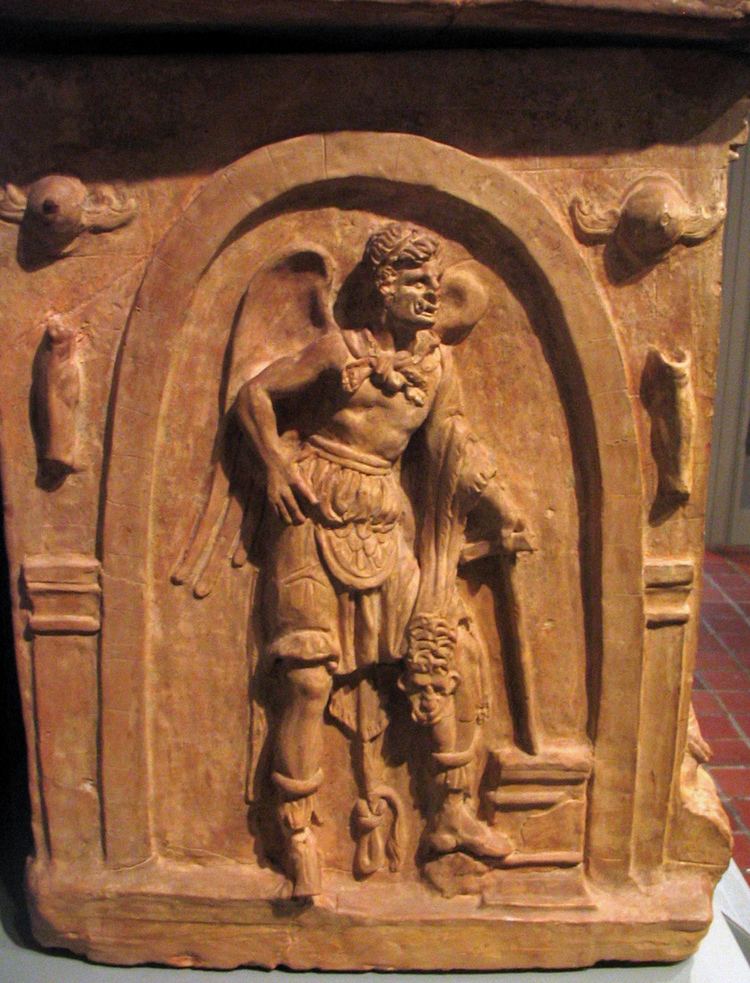
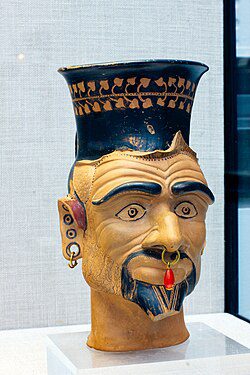
The physical image of Charun is unmistakable, crafted deliberately to evoke unease and dread. He is commonly shown with blue or grey skin, a colour associated with corpses and decay, marking him instantly as a being belonging to the realm of the dead. His face is grotesque, often contorted into a fierce grimace, with protruding tusks or a hooked, beak-like nose that gives him an almost animalistic appearance. Large pointed ears, wild hair, and expressions filled with aggression further distance him from any human likeness. His most iconic attribute is the heavy hammer he carries—sometimes called the “Charun’s Mallet”—a tool believed to represent the final blow of death or the force pushing souls into the underworld. Some depictions give him wings, hinting at his swift movement between realms, though his wings appear less frequently than those of Vanth. Each artistic detail reinforces his role as the inescapable executor of mortality, contrasting sharply with the gentler psychopomp figures found in Greek or Roman traditions.
Family
One of the most intriguing aspects of Charun is his lack of a defined family lineage. Unlike Greek or Roman deities, whose genealogies structure their narratives, Charun does not arise from a divine bloodline or mythic household. His existence is functional rather than familial. He operates within the domain of Aita, the Etruscan lord of the underworld, yet remains clearly subordinate, acting as a servant or enforcer rather than a ruling figure. His most frequent companion is Vanth, the winged spirit who appears in countless funerary scenes. Together they represent the two faces of death: Vanth as a guide offering calm transition, and Charun as the embodiment of death’s violent certainty. The absence of stories about his origin or offspring suggests that Charun was viewed less as a personified deity and more as the inevitable force that accompanies every mortal life.
Other names
Charun appears in Etruscan inscriptions under several closely related spellings, the most common being Charu and Karun. These variations reflect regional differences and the challenges of transliterating the Etruscan language rather than changes in his mythic identity. While his name bears resemblance to the Greek Charon, the two figures diverge significantly in design and role. Charun was shaped through distinct Etruscan cultural beliefs and artistic interpretation, evolving into a being far more monstrous and active than the Greek ferryman. The similarity in names likely reflects cultural borrowing, yet the Etruscans transformed the concept into something uniquely their own, suited to their darker, more ritualized vision of death.
Powers and Abilities
Charun’s powers centre entirely on death, separation, and the enforcement of fate. His primary function as a psychopomp involves guiding the soul into the underworld, but unlike many who perform this role in world mythology, Charun is not gentle, patient, or neutral. He ensures that death occurs when it must, sometimes portrayed as striking the dying with his hammer to guarantee the moment is sealed. His presence in battle scenes and violent mythic episodes suggests that he enjoys or at least embodies destruction. As a guardian of the underworld’s boundaries, he prevents the dead from returning to the world of the living and ensures that all souls reach Aita’s realm. His terrifying appearance enhances his supernatural authority, instilling fear in mortals and signalling that resistance is futile. Charun is not an arbiter of morality but an executor of destiny, carrying out death’s command with unwavering purpose.
Modern Day Influence
Though Charun is not widely known outside academic or mythological circles, his influence resonates through various forms of modern culture. Artists and scholars have long been fascinated by his macabre imagery, especially during the Renaissance, when Etruscan artifacts gained renewed attention and inspired new interpretations of demons and underworld spirits. In comparative mythology, Charun continues to be studied as an example of how the Etruscans interpreted death differently from neighbouring cultures. In contemporary fantasy literature, tabletop games, and dark art, hints of Charun’s monstrous form—blue-skinned death figures, hammer-wielding reapers, grotesque psychopomps—often emerge as creative reinterpretations of his ancient image. His psychological legacy is equally significant, reminding modern audiences that ancient cultures held complex, multifaceted visions of death that blended fear, ritual, and supernatural inevitability.
Related Images

Source
Bonfante, L. (2023). Charun: The Underworld Psychopomp of Etruscan Mythology. Weird Italy. Retrieved from https://weirditaly.com/2023/03/17/charun-the-underworld-psychopomp-of-etruscan-mythology/
Wikipedia contributors. (2025). Charun. Wikipedia. Retrieved from https://en.wikipedia.org/wiki/Charun
Grokipedia. (2025, November 26). Charun. Retrieved from https://grokipedia.com/page/Charun
Rovin, J. (Year unknown). The Encyclopedia of Monsters.
Fandom. (2025, July 31). Charun | Hellraiser Wiki. Retrieved from https://cenobite.fandom.com/wiki/Charun
Drlogy. (2025, October 19). Charun Name Meaning, Origin, Numerology & Popularity. Retrieved from https://www.drlogy.com/baby-names/meaning-of-charun
De Ruyt, F. (Year unknown). Studies in Etruscan Religion and Mythology.
Bonfante, L. (2006). Etruscan Life and Afterlife: A Handbook of Etruscan Studies. Detroit: Wayne State University Press.
de Grummond, N. T. (2006). Etruscan Myth, Sacred History, and Legend. Philadelphia: University of Pennsylvania Museum of Archaeology and Anthropology.
Turfa, J. M. (2013). The Etruscan World. London: Routledge.
Pallottino, M. (1975). The Etruscans. Bloomington: Indiana University Press.
Briquel, D. (1991). L’origine étrusque de Rome. Paris: Éditions Errance.
Frequently Asked Questions
Who is Charun in Etruscan mythology?
Charun is a terrifying death daemon who guides souls to the underworld and enforces the inevitability of death.
How is Charun different from Charon?
Unlike the Greek ferryman Charon, Charun is violent, monstrous, and actively involved in the moment of death.
What does Charun look like?
He is depicted with blue or grey skin, tusks, pointed ears, a grotesque face, and a large hammer symbolising death.
Does Charun appear in modern media?
He appears indirectly through inspirations in dark fantasy art, underworld characters, and myth-based role-playing games.
Was Charun considered a god?
Charun was not a god but a daemon, serving under Aita and acting as an executor of death rather than a ruling deity.
