
Blessing of Sak Yant : The Sacred Tattoos That Empowered Khun Phaen
Listen
At a glance
| Description | |
|---|---|
| Mythology | Thai Mythology |
| Bestowed Upon | Khun Phaen |
| Granted By | Monks and ritual masters |
| Primary Effect | Charisma, protection, Fearlessness |
| Conditions Attached | Ethical conduct, Ritual discipline |
Mythlok Perspective
In Mythlok’s Perspective, the blessing of Sak Yant in the legend of Khun Phaen represents the transformation of a warrior into a mystical champion whose power comes from both spiritual discipline and sacred protection. The tattoos are not merely charms but symbols of earned authority. They mark Khun Phaen as someone chosen and empowered through ritual knowledge, making his charisma and battlefield survival appear divinely sanctioned rather than accidental. This type of blessing reflects a broader mythic pattern where heroes gain invulnerability through sacred rituals rather than physical strength alone. Khun Phaen’s empowered body echoes figures such as Siegfried, whose dragon blood granted near invincibility, and Achilles, whose divine protection made him nearly untouchable in battle. Like these heroes, Khun Phaen’s blessing creates a powerful paradox: extraordinary protection that elevates the hero, yet never completely removes the possibility of human downfall.
Khun Phaen’s Sacred Tattoos
Introduction
Khun Phaen’s Sacred Tattoos occupy a fascinating place in Thai spiritual culture, blending folklore, martial tradition, and sacred ritual. The legendary hero Khun Phaen emerges from the famous Thai epic Khun Chang Khun Phaen, a story rooted in the Ayutthaya period that mixes history, romance, and magical warfare. Within this narrative, Khun Phaen becomes renowned not only for his charisma and combat skill but also for the mystical tattoos covering his body. These tattoos belong to the ancient tradition of Sak Yant, a sacred tattooing practice believed to grant spiritual protection, charm, and supernatural strength.
In Thai belief, Sak Yant tattoos are far more than decorative body art. They function as spiritual talismans infused with sacred geometry, Buddhist prayers, and magical incantations. Each design is activated through ritual, transforming ink and skin into a living yantra believed to channel divine forces. Khun Phaen’s tattoos symbolize blessings of invincibility, attraction, and mystical power, turning him into a legendary warrior-sorcerer whose story continues to shape Thai spiritual identity.
Mythological Background
The mythological context of Khun Phaen comes from the celebrated Thai literary epic Khun Chang Khun Phaen, one of the most important works of classical Siamese storytelling. The narrative likely began as oral tales around the seventeenth century before eventually being written down and published in the nineteenth century. Set in central Siam during the Ayutthaya period, the story revolves around a tragic love triangle between the handsome and charismatic Khun Phaen, the wealthy but unattractive Khun Chang, and the beautiful woman Wanthong.
Khun Phaen is portrayed as a warrior trained in martial arts and spiritual magic. Throughout the story he learns powerful spells, spirit summoning, and protective rituals from monks and magical teachers. His mystical tattoos become one of his defining attributes. These tattoos are believed to shield him in battle, enhance his natural charisma, and grant him supernatural abilities.
The practice of sacred tattooing itself predates the epic. Sak Yant traditions trace their roots to ancient Southeast Asian spiritual practices influenced by Khmer culture, Hindu yantra symbolism, and Buddhist ritual. Sacred diagrams written in Khom script were historically inscribed on cloth, metal charms, or directly on the body. For warriors and travelers, these tattoos acted as spiritual armor believed to protect against weapons, misfortune, and malevolent spirits.
Granting of the Boon/Blessing
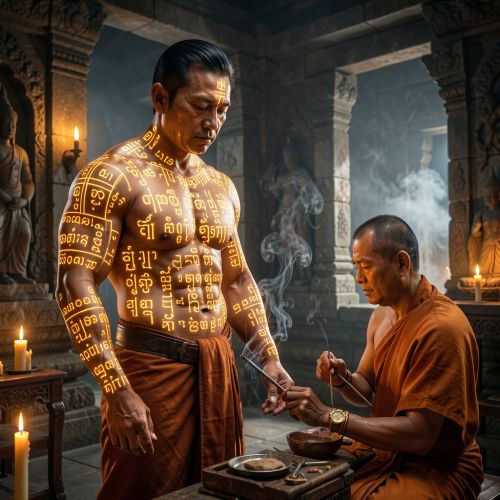
In the legend, Khun Phaen receives his sacred tattoos during his training under spiritual masters and monks. The ritual of receiving a Sak Yant tattoo is considered a sacred initiation rather than a simple tattooing session. The process begins with prayers, meditation, and offerings to spiritual guardians.
Traditionally, the tattoo master known as an Ajarn uses a long metal rod or bamboo needle to hand-poke the sacred design into the skin. The ink may be mixed with ritual substances such as herbs, charcoal, snake venom, or sacred oils. While historical practices varied, the defining feature of Sak Yant is that the tattoo is empowered through chanting and spiritual invocation.
During the ritual, the Ajarn recites Pali incantations and magical formulas called katha. These chants invoke protective spirits, Buddhist virtues, and cosmic energies associated with the yantra design. At the completion of the tattoo, the master often blows onto the mark to activate its spiritual power. This act symbolizes the transfer of sacred energy from teacher to disciple. The blessing received by Khun Phaen is therefore not simply the tattoo itself but the spiritual empowerment behind it. The ritual transforms the design into a living charm believed to guide and protect the wearer.
Nature of the Boon/Blessing
The blessings associated with Khun Phaen’s tattoos reflect the broader functions of Sak Yant magic. These sacred inscriptions are believed to grant a wide range of supernatural benefits depending on their design and the intention behind them.
One of the most famous powers attributed to Khun Phaen is Maha Sanaeh, a form of irresistible charm that attracts admiration and romantic attention. In the epic, this magical charisma helps him win the affection of many women and enhances his reputation as a heroic figure.
Another important blessing involves protection in battle. Certain yantra designs are believed to shield the wearer from weapons, accidents, and hostile magic. These tattoos function as spiritual armor, protecting the body and strengthening the warrior’s courage.
Sacred tattoos are also thought to grant confidence, luck, and spiritual protection. Designs such as the Gao Yord (Nine Spires) symbolize cosmic order and divine guardianship, while the Hah Taew (Five Lines) represents blessings of success, charm, and protection against misfortune.
However, these powers come with spiritual conditions. Traditional teachings emphasize that the wearer must follow moral rules known as Sak Yant precepts, which include avoiding dishonesty, cruelty, or immoral conduct. Violating these ethical guidelines is believed to weaken the tattoo’s power.
Recipients and Key Figures
In the mythology, Khun Phaen himself represents the ideal bearer of sacred tattoos. His combination of martial ability, magical training, and personal charisma embodies the spiritual potential associated with Sak Yant. Historically, sacred tattoos were especially common among warriors and soldiers. In premodern Southeast Asia, fighters often covered large portions of their bodies with protective yantras before entering battle. These tattoos were believed to strengthen courage and guard against injury.
Spiritual teachers known as Ajarns play a central role in granting these tattoos. They function as ritual specialists who combine Buddhist teachings, folk magic, and ancient yantra traditions. The Ajarn determines the most suitable design for each individual based on their life circumstances and spiritual needs.
In modern Thailand, Sak Yant tattoos are sought by people from many walks of life. Soldiers, Muay Thai fighters, businesspeople, artists, and even international travelers seek these blessings. Women also receive Sak Yant tattoos, although the designs may differ depending on the tradition and temple.
Effects and Consequences
Within the legend, Khun Phaen’s tattoos enhance both his physical and social power. They help him survive dangerous battles, escape capture, and command respect among warriors and nobles. His magical charisma also contributes to his romantic reputation throughout the story.
Yet the narrative also shows that supernatural blessings do not eliminate human consequences. Khun Phaen’s life is filled with conflict, jealousy, and tragic events. His actions sometimes bring suffering to others, particularly within the complicated relationship between himself, Khun Chang, and Wanthong.
In spiritual terms, Thai belief emphasizes that magical power must be balanced by moral responsibility. Sak Yant tattoos are not meant to encourage reckless behavior or harm others. If the wearer acts immorally or ignores the ethical guidelines associated with the blessing, the protective power is believed to diminish. Modern practitioners often return annually to the temple for rituals that renew the tattoo’s spiritual energy. These ceremonies reaffirm the connection between the wearer and the sacred forces represented by the yantra.
Symbolism and Spiritual Meaning
Khun Phaen’s sacred tattoos symbolize the union of body, spirit, and cosmic order. The geometric patterns known as yantras represent sacred diagrams that channel spiritual energy. Each line and symbol reflects deeper philosophical ideas drawn from Buddhist and Hindu traditions. For example, the Gao Yord design depicts nine spires representing Mount Meru, the mythical center of the universe in Buddhist and Indian cosmology. This imagery symbolizes divine protection and spiritual balance.
Animal figures, protective symbols, and sacred scripts may also appear within Sak Yant tattoos. Tigers symbolize power and authority, while Hanuman imagery reflects bravery and devotion. The use of ancient scripts reinforces the connection between language, ritual, and sacred knowledge. Ultimately, these tattoos are meant to remind the wearer of spiritual discipline. They represent a physical commitment to courage, ethical behavior, and spiritual awareness.
Cultural Impact and Legacy
The legend of Khun Phaen has had a lasting influence on Thai culture. The epic itself remains a cornerstone of Thai literature and continues to be performed in traditional theater and storytelling. Khun Phaen’s character represents the archetype of the charismatic warrior who blends martial skill with mystical wisdom.
His sacred tattoos also helped popularize the wider tradition of Sak Yant. Today thousands of people travel to temples across Thailand to receive these blessings from monks and Ajarns. One of the most famous centers is Wat Bang Phra, where an annual Sak Yant festival attracts devotees from around the world.
Beyond religious practice, Khun Phaen’s imagery appears in amulets, artworks, and modern media. These symbols promise charisma, protection, and good fortune. While commercialization has increased global awareness of Sak Yant, many practitioners continue to emphasize its spiritual roots. Through centuries of storytelling and ritual practice, Khun Phaen’s sacred tattoos remain a powerful symbol of Thailand’s mystical heritage.

Source
Department of Fine Arts. (1990). Khun Chang Khun Phaen: Thai epic poem (2nd ed.). Bangkok: Thammasat University Press.
Lyons, P. (2013). Traditional Thai tattoos: Sak Yant and their spiritual power. Singapore: Marshall Cavendish.
McFarland, G. B. (1998). Thai-English dictionary (Enlarged ed.). Bangkok: Amarin Printing.
Na Thalang, S. (2005). Amulets of Thailand: Sacred charms and their legends. Bangkok: River Books.
Pattana Kitiarsa. (2012). Mediums, monks, and amulets: Thai popular Buddhism today. Seattle: University of Washington Press.
Phongpaichit, C., & Skinner, C. (2006). The legend of Khun Chang Khun Phaen: Translated from the Thai epic poem. Chiang Mai: Silkworm Books. https://en.wikipedia.org/wiki/Khun_Chang_Khun_Phaen
Santisuk, A. (2018). Sak Yant: The sacred geometry of Thai tattoos. Bangkok: River Books.
Wat Bang Phra Temple. (2025). Sak Yant rituals and Khun Phaen blessings. http://watbangphra.com/sak-yant-history
Frequently Asked Questions
Who was Khun Phaen in Thai folklore?
Khun Phaen is a legendary warrior and sorcerer from the Thai epic Khun Chang Khun Phaen. He is known for his bravery, magical knowledge, and sacred tattoos believed to grant supernatural powers.
What are Sak Yant tattoos?
Sak Yant are sacred tattoos from Thailand that combine Buddhist prayers, yantra symbols, and magical incantations. They are believed to provide protection, luck, and spiritual strength.
What powers were Khun Phaen’s tattoos believed to grant?
According to folklore, his tattoos granted protection in battle, irresistible charisma, spiritual protection from evil, and enhanced courage.
Are Sak Yant tattoos still practiced today?
Yes. Sacred tattooing remains an important spiritual tradition in Thailand, with many temples and Ajarns performing Sak Yant rituals for devotees.
Do Sak Yant tattoos have rules or spiritual conditions?
Traditional beliefs say the wearer must follow moral guidelines such as honesty and respectful behavior. Breaking these rules is believed to weaken the tattoo’s protective power.