Olmec Mythology
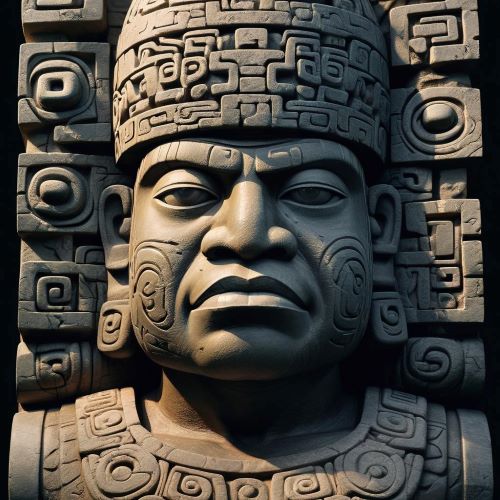
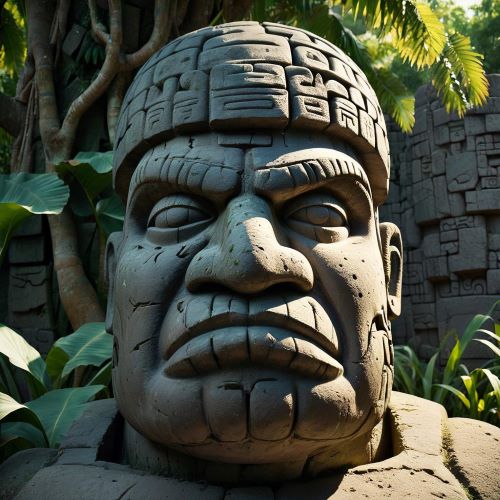
Olmec mythology refers to the religious beliefs, supernatural figures, rituals, and symbolic traditions associated with the Olmec civilisation, which flourished along the Gulf Coast of present-day southern Mexico between approximately 1500 and 400 BCE. The Olmec are among the earliest known complex societies of Mesoamerica and are particularly famous for their monumental architecture, carved jade objects, distinctive ceramics, and colossal stone heads. Although much about their religion remains uncertain, archaeological discoveries reveal a complex symbolic world that influenced, and shared features with, later Mesoamerican traditions.
The Olmec heartland was concentrated around the tropical lowlands of present-day Veracruz and Tabasco, rather than extending across most of Central America. Major centres such as San Lorenzo and La Venta contained ceremonial complexes, monumental sculptures, offerings, and burials that provide important evidence of Olmec religious life. Their artistic traditions frequently combined human and animal characteristics, producing supernatural beings associated with jaguars, serpents, birds, crocodilians, and other powerful creatures. These images suggest that animals played an important role in the Olmec understanding of supernatural power and transformation.
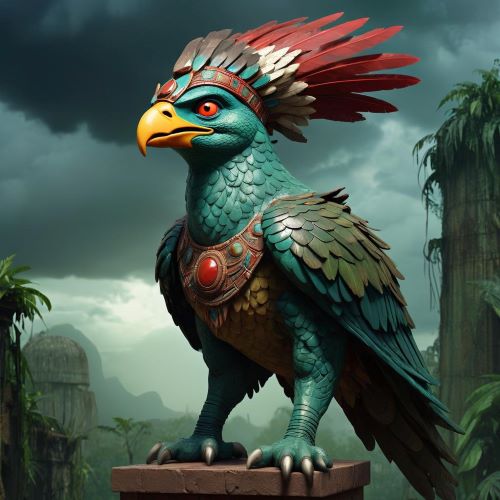
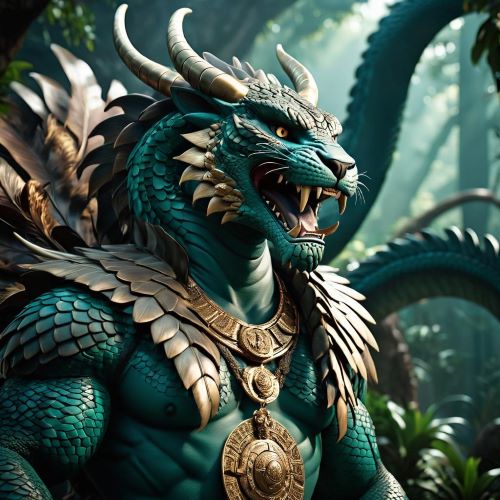
One of the most distinctive features of Olmec religious art is the recurring combination of human and animal characteristics. The so-called were-jaguar motif, characterised by features such as a broad mouth, prominent fangs, and other feline characteristics, appears in numerous Olmec sculptures and objects. Archaeologists have also identified recurring supernatural figures through shared visual characteristics, although the original Olmec names and precise identities of these beings are unknown. Modern labels such as the Olmec Dragon, Bird Monster, and Feathered Serpent are scholarly descriptions rather than names preserved by the Olmec themselves.
Ritual activity appears to have been central to Olmec society. Archaeological discoveries have revealed caches of jade and other precious materials, figurines, carved monuments, burials, and offerings placed in ceremonial locations. Caves and water sources also appear to have held religious significance, reflecting themes that later became important throughout Mesoamerica. The Olmec fascination with polished stone and reflective surfaces is particularly notable, with mirrors made from materials such as iron ore appearing in archaeological contexts. These objects may have been associated with status, ritual power, or supernatural vision, although their precise meanings remain uncertain.
Evidence for writing during the Olmec period is an important but complicated subject. The Cascajal Block, discovered in Veracruz, contains a series of symbols that some researchers have interpreted as an early writing system dating to the first millennium BCE. Other scholars have questioned whether the symbols constitute writing in the conventional sense. Because no extensive Olmec corpus of deciphered texts survives, it is not possible to reconstruct Olmec mythology from written sources in the way scholars can study Maya traditions through surviving inscriptions and manuscripts.
The name “Olmec” itself does not come from the Olmec people. It derives from the Nahuatl term Ōlmēcatl, used centuries later by the Aztecs and generally associated with the people of the rubber-producing region. The original name by which the Olmec identified themselves remains unknown. This uncertainty also means that many of the names commonly used for Olmec supernatural beings today are modern scholarly classifications rather than historically preserved names.
The relationship between Olmec mythology and later Mesoamerican religions remains an important area of research. Certain motifs, symbols, ritual practices, and supernatural concepts appear in both Olmec and later Mesoamerican contexts, suggesting cultural connections and long-term development. However, it is difficult to establish that the Olmec directly invented or transmitted every tradition later found among the Maya, Mexica, Zapotec, and other cultures.
The decline of major Olmec centres occurred over several centuries, beginning around the end of the second millennium BCE and continuing into the first millennium BCE. Environmental changes, shifts in rivers and settlements, political transformations, and other factors have all been considered in explaining the decline of major centres such as San Lorenzo and La Venta. Rather than disappearing suddenly, Olmec communities and cultural traditions continued to exist and interact with neighbouring peoples.
Olmec mythology remains one of the more challenging and fascinating subjects in Mesoamerican studies because much of it must be reconstructed from archaeology rather than written narratives. Their monumental sculptures, ritual offerings, supernatural imagery, and enigmatic symbols provide glimpses into a religious world that remains only partially understood. Exploring Olmec mythology therefore means looking closely at the archaeological evidence while recognising the many questions that remain unanswered about one of Mesoamerica’s earliest complex civilisations.