

Suvannamaccha : The Enchanted Mermaid Princess of Thailand
Listen
At a glance
| Description | |
|---|---|
| Origin | Thai Mythology |
| Classification | Hybrids |
| Family Members | Thotsakan (Father), Macchanu (Son) |
| Region | Thailand |
| Associated With | Royalty |
Suvannamaccha
Introduction
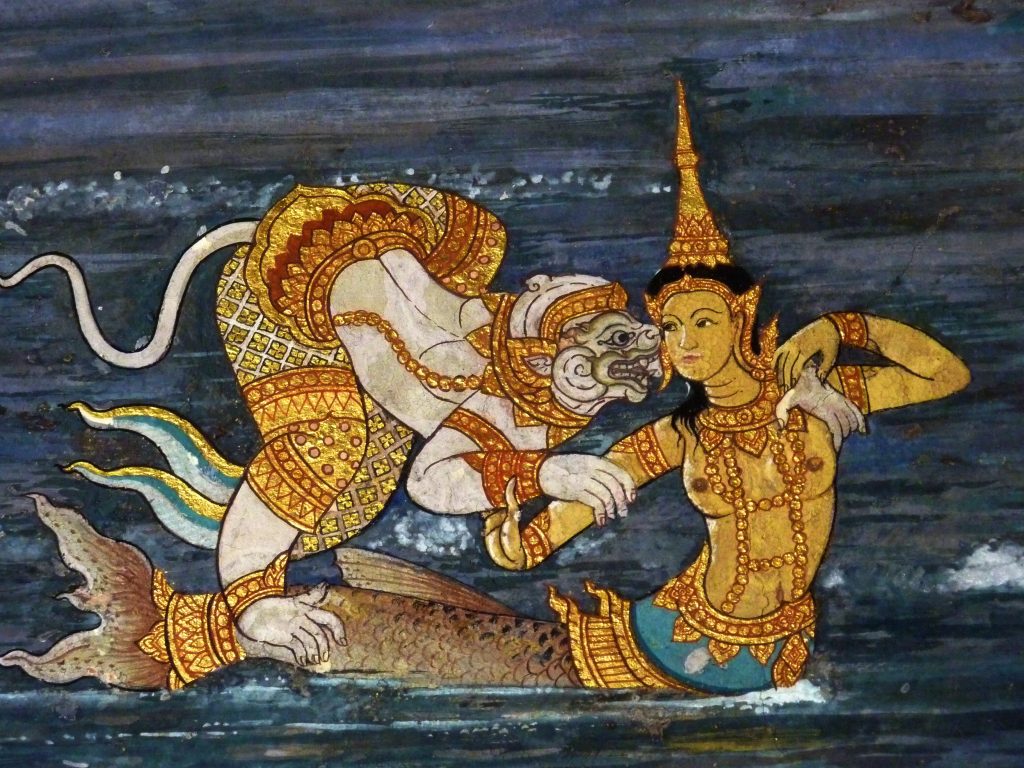
Suvannamaccha, whose name means “Golden Fish,” is among the most memorable characters in the Thai Ramakien, the Southeast Asian adaptation of the Indian Ramayana. Unlike the Indian versions of the epic, where no mermaid princess appears, Suvannamaccha is entirely local to Thai and Khmer storytelling traditions, reflecting the region’s deep connection to water spirits, fertility symbols, and oceanic lore. Her tale begins when Thotsakan, the Thai counterpart of Ravana, commands her to stop Hanuman from building a causeway to Lanka. When she confronts the mighty monkey general, however, the mission takes an unexpected turn: she falls deeply in love with him. Their romance adds a uniquely emotional layer to the Ramakien, blending themes of duty, conflict, reconciliation, and the bridging of two opposing worlds.
Physical Traits
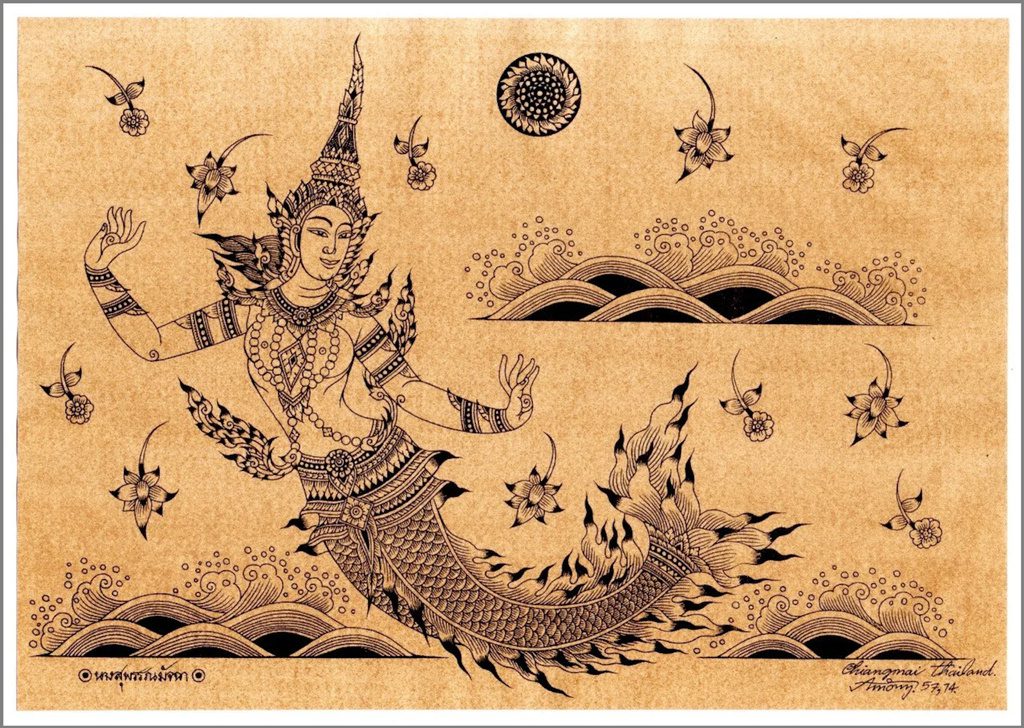
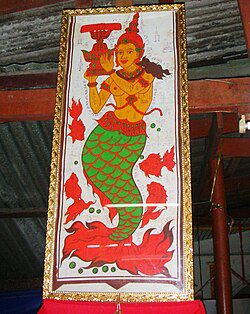
Suvannamaccha is traditionally portrayed as a radiant mermaid whose beauty combines royal elegance with aquatic mystique. Her upper body is that of a graceful woman adorned in royal Thai ornaments, often featuring intricate golden jewelry, delicate armlets, and a traditional crown that reinforces her status as a princess. Her iconic golden tail shimmers with scales that reflect light like beaten gold, symbolising prosperity, divinity, and the benevolent qualities associated with oceanic beings in Southeast Asian culture. In murals at Wat Phra Kaew in Bangkok, she appears with long flowing hair, expressive eyes, and a serene countenance, embodying both strength and tenderness. Her tail is not merely symbolic; it positions her as a guardian of the ocean realm, moving effortlessly through the waves with supernatural speed and elegance.
Family
Born into the powerful lineage of Thotsakan, the demon king of Lanka in the Ramakien, Suvannamaccha inhabits a world shaped by politics, magic, and duty. As his daughter, she is part of a vast supernatural dynasty composed of giants, demons, and mystical beings who populate the Thai epic. Although loyal to her father, Suvannamaccha shows an independence that sets her apart, especially when confronted with Hanuman’s determination and sincerity. Her love story with Hanuman eventually leads to the birth of their son, Macchanu, who inherits both aquatic characteristics and martial prowess. Macchanu later becomes a heroic figure in his own right, extending Suvannamaccha’s legacy into future chapters of the Ramakien and reinforcing her importance within the broader mythic lineage of hybrid demigods.
Other names
Across Southeast Asian storytelling traditions, Suvannamaccha’s name appears in several linguistic variations that preserve its meaning while adapting to local pronunciation. Thai sources commonly use Suphannamatcha or Suphan Matcha, both reflecting the original Pali–Sanskrit roots: suvaṇṇa (gold) and maccha (fish). In Khmer traditions, she is referred to as Sovanna Maccha, maintaining the same translation. Older poetic retellings occasionally use Suvarnamatsya, a Sanskritised form still anchored in the “golden fish” imagery. These regional variations demonstrate how her story travelled across Southeast Asia, evolving through performance, temple art, and oral tradition while retaining her symbolic identity.
Powers and Abilities
As a mermaid princess with supernatural origins, Suvannamaccha possesses abilities grounded in the elemental power of water. Her command over the sea enables her to lead an entire army of mermaids who obey her without hesitation. This authority allows her to sabotage Hanuman’s construction by quietly retrieving the stones dropped into the ocean, a task only possible through her speed and mastery of underwater movement. She can navigate turbulent waters with ease, withstand intense pressure, and communicate with aquatic creatures, marking her as a guardian of the marine world. Her allure also functions as a subtle supernatural trait—Hanuman, famed for his discipline and unwavering loyalty, finds himself disarmed by her presence. Through her son Macchanu, she passes on a blend of strength, agility, and amphibious abilities, extending her influence into the martial traditions of the Ramakien’s later heroes.
Modern Day Influence
Suvannamaccha’s presence remains deeply woven into contemporary Thai culture, where she is celebrated as a figure of beauty, prosperity, and harmonious union. Her image frequently appears on cloth talismans, framed prints, and decorative charms believed to attract good fortune. Shops, restaurants, and homes often display her likeness, particularly in coastal regions where fishermen view her as a symbol of safe journeys and plentiful catches. In temple murals, dance dramas, and Khon performances, her story is retold with vibrant choreography and elaborate costuming that highlight her significance in Thailand’s artistic heritage. Modern literature, animation, and children’s books continue to reimagine her tale, keeping the Ramakien alive for younger audiences. She also appears in tourist souvenirs, festival floats, and contemporary reinterpretations, ensuring that her legend continues to ripple across generations. In today’s cultural landscape, Suvannamaccha embodies not just romantic intrigue but also the spirit of reconciliation—proof that love and understanding can emerge even in the heart of conflict.
Related Images



Source
Ancient Scholar. (2024). Suvannamaccha: Thai mythology, art, and cultural significance. https://ancientscholar.org/suvannamaccha-thai-mythology-art-and-cultural-significance/
Godchecker. (2023). SUVANNAMACCHA – the Thai Demon (Thai mythology). https://www.godchecker.com/thai-mythology/SUVANNAMACCHA/
Wikipedia. (2007). Suvannamaccha. https://en.wikipedia.org/wiki/Suvannamaccha
DBpedia. (1999). Suvannamaccha. https://dbpedia.org/page/Suvannamaccha
Kelly, D. A. (n.d.). Chapter 3 [Academic thesis chapter on Thai Ramakien]. Chulalongkorn University Institutional Repository. https://cuir.chula.ac.th/dspace/bitstream/123456789/71656/6/Kelly_da_ch3_p.pdf
Manusya Journal. (2021). The roles of the Buddha in Thai myths. Chulalongkorn University. http://www.manusya.journals.chula.ac.th/wp-content/uploads/2021/06/22.pdf
Gosling, B. (2004). Thai Ramayana murals: Wat Phra Kaew. Bangkok: River Books.
Wyatt, D. K. (2003). Thailand: A short history. New Haven: Yale University Press.
Brandon, J. R. (1967). Theatre in Southeast Asia. Cambridge, MA: Harvard University Press.
Richman, P. (1991). Many Ramayanas: The diversity of a narrative tradition in South Asia. Berkeley: University of California Press.
Terwiel, B. J. (2011). Thailand’s political history: From the fall of Ayutthaya to recent times. Bangkok: River Books.
Frequently Asked Questions
Who is Suvannamaccha in the Ramakien?
Suvannamaccha is a golden mermaid princess in the Thai version of the Ramayana who attempts to sabotage Hanuman’s bridge-building before falling in love with him.
Is Suvannamaccha part of the original Indian Ramayana?
No. She is unique to Southeast Asian adaptations, especially Thai and Khmer traditions.
Who are Suvannamaccha’s parents?
She is the daughter of Thotsakan, the Thai counterpart of Ravana, the demon king of Lanka.
What powers does Suvannamaccha have?
She possesses mastery over water, the ability to command mermaids, and supernatural agility in the ocean.
Why is Suvannamaccha considered a symbol of prosperity?
Her golden form and association with the sea connect her to themes of abundance, fertility, and good fortune in Thai culture.