


Emakong: The Ancestral Fire-Bearer of the Baining People
Listen
At a glance
| Description | |
|---|---|
| Origin | Baining Mythology |
| Classification | Spirits |
| Family Members | N/A |
| Region | Papua New Guinea |
| Associated With | Fire, Night |
Emakong
Introduction
Emakong occupies a central place in the mythology of the Baining people of East New Britain, Papua New Guinea, where he is remembered as the culture hero who introduced essential elements that shaped human life. In Baining oral traditions, the world before Emakong’s journey existed in a state of perpetual daylight, lacking fire, night, and the natural rhythms that define existence today. His transformation begins when he inadvertently falls into a stream and discovers a hidden underwater realm inhabited by snake-like beings. These mysterious spirits possess things unknown to the human world—fire, darkness, crickets, and birds—each representing crucial aspects of life, environment, and spiritual rhythm.
Emakong’s return from the underwater house marks a turning point for the Baining people. The gifts he brings reshape human experience, allowing night to fall, fire to burn, and the soundscape of the forest to come alive. This story reflects a broader Melanesian motif in which heroes travel between realms to retrieve knowledge or elements necessary for community survival. Like similar narratives found among the Sulka and other New Britain groups, Emakong’s myth reinforces the deep interconnection between human society and the spirit world. Passed down through generations, his tale continues to be evoked in rituals, storytelling, and the celebrated Baining fire dances that anchor community identity.
Physical Traits
Traditional Baining narratives describe Emakong as an ordinary human man living before the full emergence of culture. He is not depicted with supernatural features, divine attributes, or animalistic elements. Instead, his physical humanity is central to the myth, highlighting him as a relatable figure who survives his journey through courage and adaptability rather than innate power.
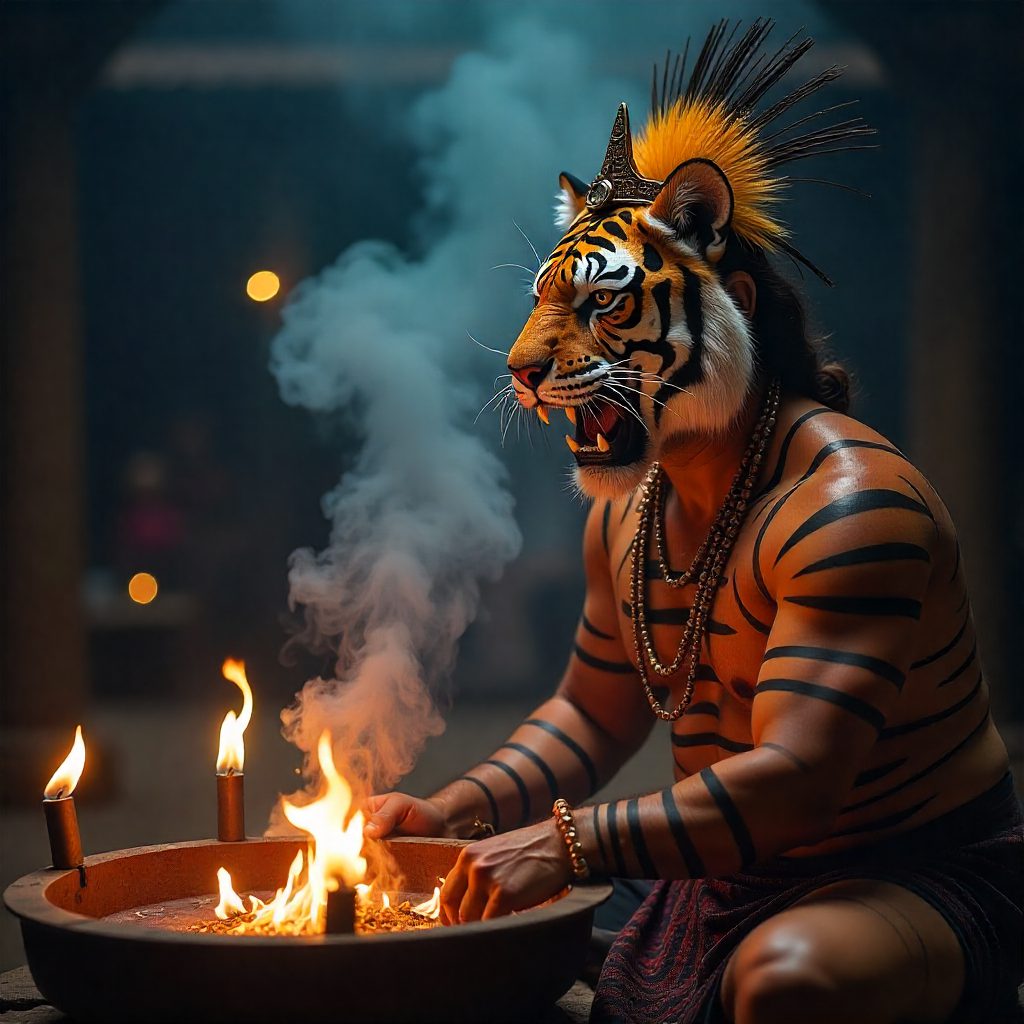
Because the myth was preserved orally, physical descriptions are not emphasized. His character becomes visually expressed instead through the ritual performances that recall his legacy. In fire dances and modern artistic depictions, performers may embody him using simple bark cloth, painted bodies, or stylized masks, yet these remain artistic interpretations rather than canonical representations. His defining “trait” is thus not how he looked, but what he accomplished—bringing essential forces of nature to his people and reshaping the world they inhabit.
Family
Baining mythology does not attribute a specific family lineage to Emakong. He is not associated with named parents, siblings, or descendants, nor is he placed within a divine genealogy. Instead, he stands as a representative ancestor whose deeds benefit the entire community. His relationship with the village is collective rather than personal; he is remembered as someone who acts on behalf of all Baining people rather than serving his own family or clan.
This absence of a defined family reflects the Baining social worldview, where many spiritual and culture-hero narratives emphasize communal bonds over individual descent. In some ritual contexts, Emakong is connected to ancestral spirits invoked during fire dances, but such connections are symbolic rather than genealogical. Through his actions, he becomes a cultural forebear to all, embodying the unity and continuity of the Baining people.
Other names
Historical and anthropological sources consistently refer to the figure as Emakong, with very few variations documented across Baining dialects. He does not possess alternate formal titles, divine epithets, or common synonyms in the literature. In oral stories, storytellers may sometimes refer to him descriptively as “the man who brought fire” or “the bringer of night,” but these are narrative labels rather than fixed names.
Unlike some Melanesian figures who appear under different names across regions, Emakong remains distinct and localized within Baining tradition. He is not conflated with figures from neighboring groups, nor does he overlap with broader Melanesian heroes such as Qat or Tagaro. His individuality in nomenclature further reinforces his identity as a unique ancestral figure specific to the cultural memory of the Baining people.
Powers and Abilities
Emakong does not possess supernatural powers in the conventional sense. His abilities emerge from human qualities—curiosity, bravery, and a willingness to engage with the unknown. His greatest achievement occurs when he enters the underwater realm and interacts with the snake-people who dwell there, demonstrating an extraordinary blend of courage and adaptability.
The snake-people entrust him with a package containing four transformative gifts: fire, night, crickets, and birds. When Emakong returns to the surface world and unwraps these gifts, each takes form and spreads across the land. Fire provides warmth and cooking; night allows rest and creates natural cycles; crickets and birds enrich the forest with sound and life. Emakong’s role is therefore that of a cultural transmitter, one who mediates between the supernatural realm and humanity to usher in the conditions necessary for a fully lived human existence.
This form of cultural heroism aligns with many Melanesian traditions, where figures gain importance through the transmission of knowledge and essential resources rather than innate magical power. Emakong’s legacy lives on in the rituals where dancers symbolically channel ancestral spirits, reaffirming the relationship between humans and the unseen world.
Modern Day Influence
Emakong’s myth remains deeply woven into contemporary Baining identity. The famed Baining fire dances, performed with towering masks and flaming arches, continue to express the spiritual worlds from which figures like Emakong emerged. Though often showcased for tourism, these dances remain rooted in initiation rites and ancestral offerings. For the Baining people, performing these ceremonies is both a cultural affirmation and an act of spiritual continuity.
Modern anthropologists studying Melanesian traditions often point to Emakong as a key example of how culture-heroes shape cosmological understanding. His story helps frame the Baining worldview of balance—between light and darkness, humans and spirits, nature and community. As Papua New Guinea navigates rapid social and environmental change, Emakong’s narrative increasingly resonates with movements promoting ecological respect and cultural preservation.
The spread of global media, ethnographic research, and digital storytelling platforms has introduced Emakong to a broader audience. Illustrations, documentaries, and academic writings continue to explore his meaning, ensuring that a myth once shared only around village fires now travels far beyond New Britain. His endurance across generations underscores the power of myth to sustain identity and inspire new interpretations in a changing world.
Related Images


Source
Baining People. (2006). Wikipedia. https://en.wikipedia.org/wiki/Baining_people
Craig, R. D. (1989). Dictionary of Polynesian mythology. Greenwood Press.
Melanesian mythology. (2006). Wikipedia. https://en.wikipedia.org/wiki/Melanesian_mythology
Lone, T. H. S. (2009). An annotated bibliography of Melanesian folklore. http://thslone.tripod.com/PNGFB.html
Poignant, A. (1967). Mythology of the Pacific islands. Hamlyn.
Tarcisius, K. (1995). Myths and legends of the Baining people. University of Papua New Guinea Press.
Wagner, R. (1986). Asiwi, papuans of the forest. Princeton University Press. (Word count: 1,012)
Frequently Asked Questions
Who is Emakong in Baining tradition?
Emakong is a culture hero from the Baining people of Papua New Guinea, known for bringing fire, night, and forest sounds to humanity.
What did Emakong receive from the snake-people?
He was given a bundle containing fire, night, crickets, and birds, which reshaped life on the surface world.
Is Emakong worshipped as a deity?
No, he is considered an ancestral cultural figure rather than a god, but his legacy is honored in rituals such as the Baining fire dance.
How is Emakong represented in modern culture?
His story is preserved in fire dances, anthropological research, oral traditions, and digital media exploring Melanesian heritage.
Are there alternate names for Emakong?
Most sources use the name Emakong consistently, with no widely documented variant titles or synonyms.
