


Boudinga : The Sacred Twin Rooted in Nzebi Identity
Listen
At a glance
| Description | |
|---|---|
| Origin | Nzebi Mythology |
| Classification | Mortals |
| Family Members | Moanda (Brother) |
| Region | Gabon, Republic of Congo |
| Associated With | Founding, Leadership |
Boudinga
Introduction
Boudinga occupies a defining place in the mythology of the Nzebi people of Gabon and the Republic of Congo. As one of the primordial twins—Moanda and Boudinga—she is celebrated in oral traditions as a guiding ancestor whose leadership shaped the early migrations and settlement patterns of the Nzebi community. Her story is deeply intertwined with Nzambi, the supreme creator, who entrusted these twins with the responsibility of leading humanity through the earliest phases of life on earth.
Mount Boudinga, a sacred landscape named in her honour, stands as a testament to her significance. The mountain is more than a geographic marker; it represents the spiritual continuity between past and present, reinforcing the Nzebi worldview where myth, land, and ancestry coexist as a single narrative. Through storytelling preserved by muyambili elders, Boudinga continues to embody the resilience, unity, and spiritual connection that define Nzebi identity.
Physical Traits
Nzebi oral traditions do not emphasise detailed physical portrayals of ancestral figures, focusing instead on their spiritual presence and symbolic attributes. Boudinga is therefore understood through qualities associated with vitality, feminine strength, and the capacity to guide her people across difficult terrain.
Her link to Mount Boudinga gives her an enduring metaphorical form—solid, protective, and shaped by the natural world. In Nzebi cosmology, ancestral figures often merge with landscape elements, allowing their presence to be felt through mountains, rivers, and forests. Boudinga’s physical essence is thus represented by the towering mountain associated with her name, reflecting her enduring role in safeguarding the community long after the migrations she led.
Family
Boudinga’s narrative is inseparable from that of her twin brother Moanda. Together, they stand at the beginning of Nzebi lineage, embodying the balance of male and female energies that structure Nzebi cosmology. Their twinship symbolises harmony, shared leadership, and the dual forces that sustain society.
From these mythic ancestors emerge the seven major Nzebi clans, each tracing symbolic descent through the broader ancestral network maintained by muyambili custodians. These elders preserve genealogies and territorial histories during ceremonial gatherings, reinforcing the idea that Boudinga’s role was foundational not only to migration but also to the organisation of Nzebi social life. Her connection to Nzambi further elevates her from historical ancestor to semi-divine guide, entrusted with safeguarding the spiritual and material wellbeing of early Nzebi communities.
Other names
While “Boudinga” remains the most consistent rendering of her name across Nzebi communities, minor variations appear depending on regional dialects within the Nzebi-speaking population. These variations tend to be phonetic rather than conceptual, reflecting the oral nature of Nzebi storytelling. In some contexts, her name becomes inseparable from the mountain itself, blurring the distinction between the ancestral figure and the geographic site that commemorates her.
Unlike mythological traditions where deities accumulate numerous epithets, Nzebi narratives foreground her role rather than additional titles, ensuring that her identity remains clearly tied to origin stories and ancestral memory.
Powers and Abilities
Boudinga’s abilities align with the spiritual logic of Nzebi mythology, where power is expressed not through supernatural feats but through influence, harmony, and ancestral guidance. As a foundational figure, she embodies the capacity to lead, protect, and sustain her people during crucial migrations. Her spiritual authority comes from Nzambi, whose divine energy allowed her to foster unity, inspire courage, and strengthen community bonds.
Her association with fertility reflects the continued growth of the clans that trace their roots to the ancestral twins. In rituals and oral teachings, Boudinga represents the assurance of continuity—cultural, genealogical, and territorial. Her power therefore lies in nurturing the balance between people and their environment, ensuring that human life develops in alignment with natural and spiritual forces.
Modern Day Influence
Boudinga’s presence remains vibrant in contemporary Nzebi identity. Mont Boudinga still carries cultural importance, functioning as both a historical landmark and a spiritual reminder of ancestral journeys. Cultural leaders and archivists frequently reference her story when discussing Nzebi heritage, demonstrating the enduring relevance of origin myths in shaping present-day community understanding.
Her narrative features prominently in oral education, where elders recount the migrations and settlements guided by Boudinga and Moanda, ensuring that younger generations inherit a clear sense of history and belonging. In modern scholarship, Boudinga is often cited as an example of how African mythologies intertwine ecological landscapes with spiritual meaning, offering insight into how communities interpret their relationship with land.
As global interest in African storytelling grows, Boudinga’s role as a mythic guide resonates in discussions of diaspora identity, cultural preservation, and the revitalization of Central African narratives in literature, film, and digital culture. Her story embodies resilience and rootedness—values that speak powerfully to contemporary audiences seeking ancestral grounding.
Related Images
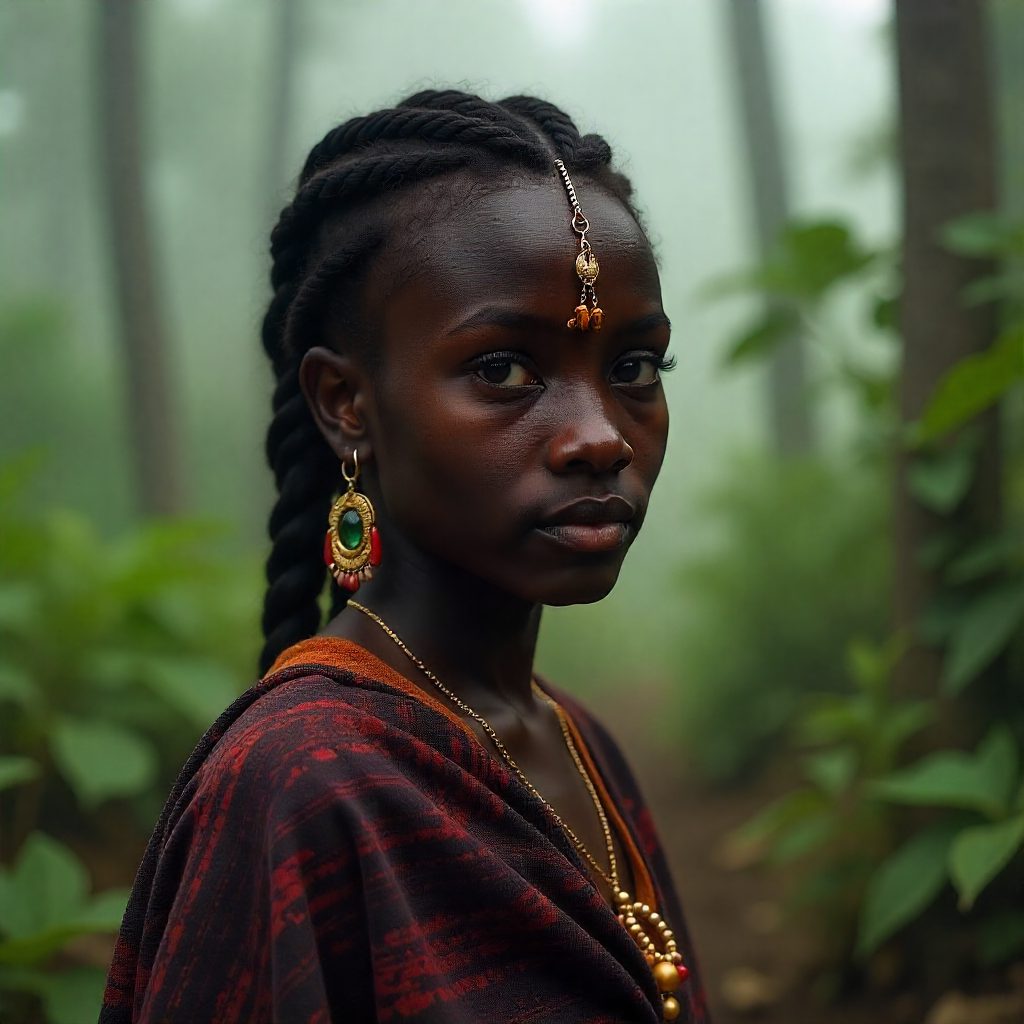



Source
Bahuchet, S. (2012). Les Pygmées aka et la forêt gabonaise: Ethnologie écologique. Peeters Publishers.
Mboué. (n.d.). Nzebi mythology. https://www.miboue.com/nzebi-mythology/
Ndong Ndoutoume, T. (1972). La mère et l’enfant chez les Fang. Presence Africaine.
101 Last Tribes. (n.d.). Nzebi people. https://www.101lasttribes.com/tribes/nzebi.html
Qiraat Africa. (2025). The Nzebi people. https://qiraatafrican.com/en/15644/the-nzebi-people/
Wikipedia. (2005). Nzebi (peuple). https://fr.wikipedia.org/wiki/Nzebi_(peuple)
World Encyclopedia of Puppetry Arts. (n.d.). Gabon. https://wepa.unima.org/en/gabon/
Vansina, J. (1990). Paths in the Rainforests: Toward a History of Political Tradition in Equatorial Africa. Madison: University of Wisconsin Press.
Fernandez, J. W. (1982). Bwiti: An Ethnography of the Religious Imagination in Africa. Princeton: Princeton University Press.
Gordon, D. M. (2002). Invisible Agents: Spirits in a Central African History. Athens: Ohio University Press.
Mbiti, J. S. (1990). African Religions and Philosophy (2nd ed.). Oxford: Heinemann.
Kopytoff, I. (1987). The African Frontier: The Reproduction of Traditional African Societies. Bloomington: Indiana University Press.
Frequently Asked Questions
Who is Boudinga in Nzebi mythology?
Boudinga is an ancestral twin who guided early Nzebi migrations and symbolizes leadership, fertility, and connection to the land.
What is the significance of Mount Boudinga?
Mount Boudinga is named after the ancestral figure and serves as a sacred symbol of identity, heritage, and the community’s mythic origins.
What powers is Boudinga believed to have?
Her powers represent ancestral guidance, spiritual authority from Nzambi, and the ability to ensure survival, harmony, and continuity.
How is Boudinga remembered today?
She remains central to oral traditions, clan histories, cultural education, and modern scholarship on Central African spirituality.
Is Boudinga worshipped as a deity?
She is honoured as a semi-divine ancestor rather than a deity, revered for her foundational role in the Nzebi lineage.
