

Bakekujira : Japan’s Legendary Ghost Whale
Listen
At a glance
| Description | |
|---|---|
| Origin | Japanese Mythology |
| Classification | Ghosts |
| Family Members | N/A |
| Region | Japan |
| Associated With | Seas, Misfortune |
Bakekujira
Introduction
Japanese coastal folklore is rich with mysterious beings shaped by the rhythms of the sea, but few are as chilling or symbolic as the Bakekujira. Meaning “ghost whale,” this legendary yōkai is said to rise from the waters of the Sea of Japan as a skeletal apparition, its arrival foretelling calamity for nearby villages. In stories from the Shimane region—where the legend is strongest—the Bakekujira moves silently through fog and rain, appearing as a grim reminder of the consequences of excessive whaling and the spiritual imbalance caused by exploiting marine life. Unlike protective sea kami, this yōkai represents grief and retribution, capturing centuries of cultural tension between survival needs and respect for nature. Its legend offers insight into Japan’s historical reliance on whales and the moral unease that accompanied a practice essential to coastal life.
Physical Traits
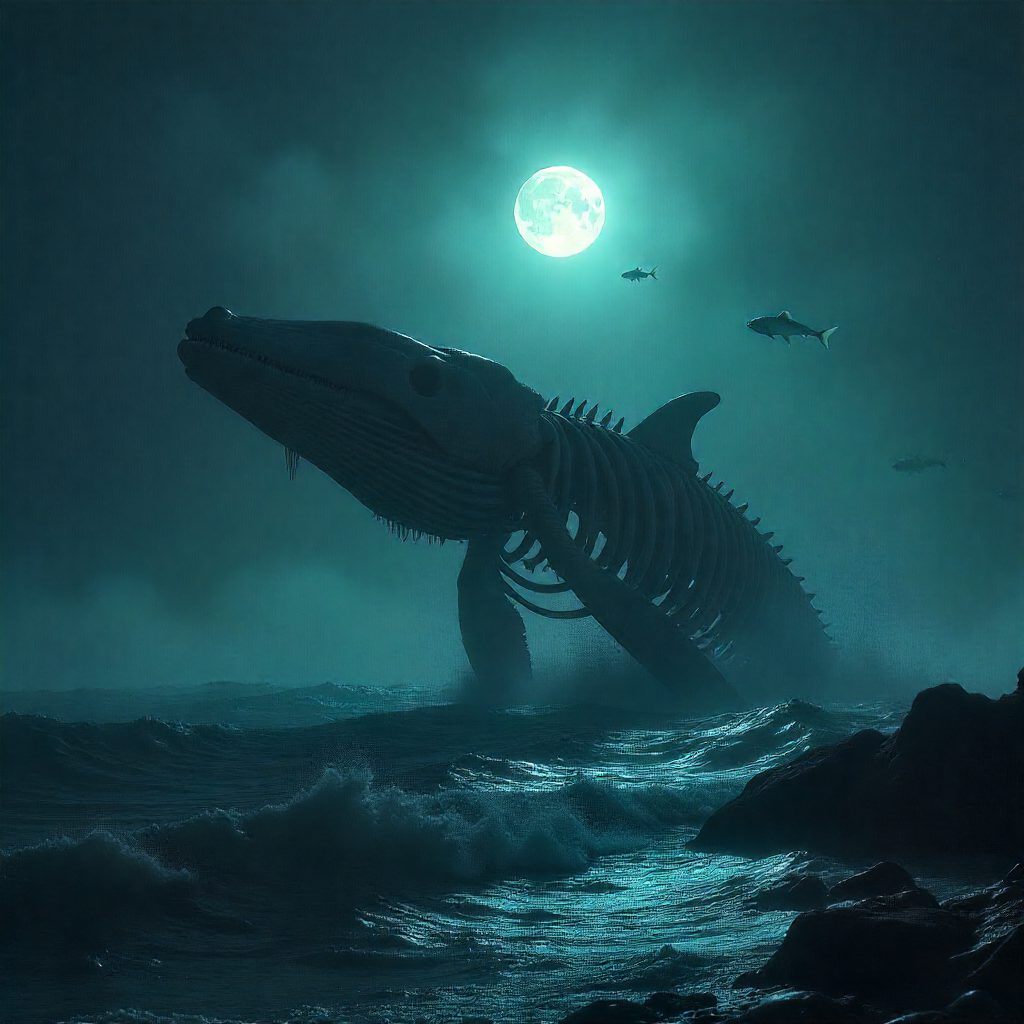
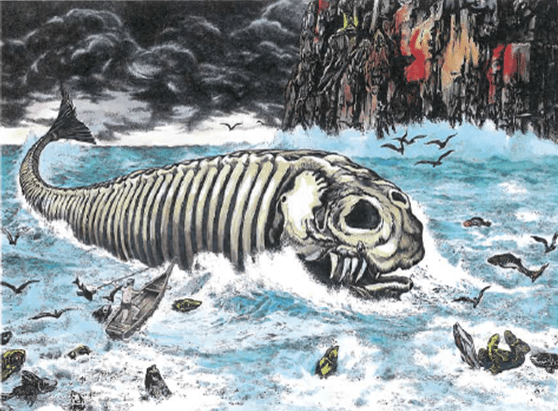
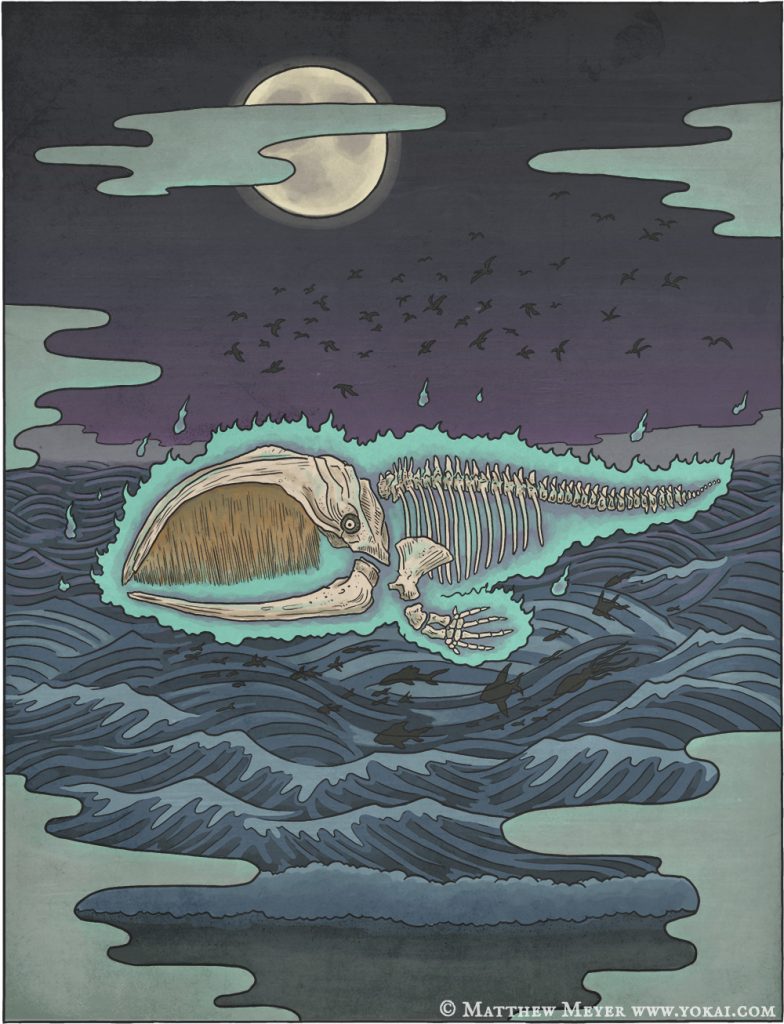
The Bakekujira is consistently described as a massive whale skeleton drifting just beneath the surface or rising eerily from the deep. Its bones emit a pale glow, giving it an appearance neither living nor fully dead. Rainy nights and thick coastal mist often accompany its sightings, heightening the sense of dread experienced by fishermen who claim its shape emerged from dark waters. Strange creatures—birds and fish unlike any known species—hover or swim alongside it, reinforcing its supernatural origin. Despite its skeletal body, the Bakekujira moves with the fluid motion of a living whale, yet no breath escapes it and no sound comes from its form. Harpoons and weapons pass through it effortlessly, emphasizing that what people witness is not a physical animal but a vengeful spirit manifesting in the shape of its former body.
Family
Unlike many figures in Japanese mythology, the Bakekujira is not part of a lineage or divine family. Instead, it is portrayed as a solitary spirit, emerging from the collective suffering of whales hunted over generations. This makes it distinct from sea deities like Ryūjin or yokai with known spiritual relatives. In older folk traditions, some communities believed in whale spirits that watched over stranded or deceased whales, treating them as sacred visitors. Within these beliefs, the Bakekujira can be seen as the embodiment of countless whale souls merging into one formidable presence. Its “family,” therefore, is conceptual rather than literal—a reflection of communal memories and the lingering spirits of all whales lost to human actions.
Other names
The Bakekujira is sometimes referred to as Hone Kujira, literally “bone whale,” a name that highlights its skeletal appearance. While “Bakekujira” emphasizes its nature as a transformed or supernatural being—“bake” meaning to change or appear as an apparition—regional storytellers often used simpler phrases like “ghost whale” when recounting the legend to younger generations. These variations never alter the essence of the myth: a spectral whale returning from death to challenge human greed. Whether as Bakekujira or Hone Kujira, the creature’s identity remains tied to its haunting form and its message of ecological caution.
Powers and Abilities
The Bakekujira’s abilities are rooted not in physical strength, but in its role as a harbinger of misfortune. Many tales warn that villages encountering the ghost whale soon face outbreaks of disease, sudden fires, or long periods of poor harvest and depleted fisheries. These curses symbolize the natural consequences of overhunting, especially in communities where whales were both revered and heavily relied upon. The creature’s appearance often tricks fishermen into believing they have spotted a living whale, only for the truth to reveal itself as a spectral illusion. While some yōkai shapeshift or interact directly with humans, the Bakekujira maintains its skeletal form, representing an unwavering spirit of vengeance. Its retinue of strange animals heightens its supernatural power, suggesting it commands forces from a realm beyond ordinary nature.
Modern Day Influence
Despite its ancient origins, the Bakekujira has found new life in modern culture. Popular creators such as Shigeru Mizuki featured the ghost whale in manga and anime, reimagining it as a mysterious but occasionally sympathetic figure. This helped introduce the yōkai to a global audience and sparked renewed interest in lesser-known regional myths. Artists frequently depict the Bakekujira in atmospheric illustrations, emphasizing its haunting glow and immense skeleton rising from stormy seas. Environmental discussions also reference the Bakekujira as a symbolic reminder of the dangers of overexploitation and the long-term consequences of disturbing marine ecosystems. In Shimane Prefecture, the legend continues to attract folklore enthusiasts and tourists intrigued by ghost stories rooted deeply in local history. Through these reinterpretations, the Bakekujira endures as a vivid representation of humanity’s relationship with the ocean—beautiful, powerful, and unforgiving when mistreated.
Related Images


Source
Foster, M. D. (2015). The book of yokai: Mysterious creatures of Japanese folklore. University of California Press.
Mizuki, S. (2007). Yokai encyclopedia. Kodansha.
Kwaidan Publishing. (2020). Japanese yokai legends: Sea spirits and ghosts. Tokyo Folklore Society.
Yokai.com. (n.d.). Bakekujira. Retrieved December 5, 2025, from https://yokai.com/bakekujira/
Wikipedia contributors. (2025). Bake-kujira. Wikipedia, The Free Encyclopedia. Retrieved December 5, 2025, from https://en.wikipedia.org/wiki/Bake-kujira
Hyakumonogatari Kaidankai. (2013, May 10). Bakekujira and Japan’s whale cults. Retrieved December 5, 2025, from https://hyakumonogatari.com/2013/05/10/bakekujira-and-japans-whale-cults/
Wars & History. (2024, October 18). What is the BakeKujira? Retrieved December 5, 2025, from https://warsandhistory.com/what-is-the-bakekujira/
Japan Makes Me Scared. (2025, March 12). Bakekujira: The ghostly yokai whale. Retrieved December 5, 2025, from https://japan-makes-me-scared.com/bakekujira/
Frequently Asked Questions
What is the Bakekujira in Japanese mythology?
The Bakekujira is a spectral whale yōkai said to appear as a glowing skeletal whale that brings misfortune to coastal villages.
Where does the Bakekujira legend originate?
The legend primarily comes from Shimane Prefecture along the Sea of Japan, a region historically connected with whaling traditions.
Can the Bakekujira be harmed or hunted?
No. Folklore states that weapons pass through its skeletal body since it is a spiritual apparition rather than a physical creature.
Does the Bakekujira appear in modern media?
Yes. It features in manga, anime, yokai encyclopedias, digital art, and environmental storytelling, reinforcing its symbolic relevance today.
Why is the Bakekujira considered a vengeful spirit?
It symbolizes the collective spirits of whales killed by humans, returning as a ghostly force to punish greed and ecological imbalance.