

Curse of Setna : Egypt’s Tale of Punishment and Power
Listen
At a glance
| Description | |
|---|---|
| Mythology | Egyptian Mythology |
| Cursed Individual(s) | Prince Setna Khamwas & Naneferkaptah |
| Cursed By | Thoth |
| Primary Consequence | Humiliation, loss of honor, forced repentance, death of family, eternal unrest |
| Symbolism | Hubris, forbidden knowledge, cosmic order, dangers of divine secrets, tragic fate |
Curse of Setna
Introduction
The Curse of Setna is one of ancient Egypt’s most enduring cautionary tales, blending myth, morality, and supernatural consequence into a powerful narrative. Centered on Prince Setna Khamwas—son of Pharaoh Ramesses II and famed magician-priest—the story explores what happens when human ambition collides with divine boundaries. In the tale, Setna’s pursuit of the legendary Book of Thoth, a text said to grant unimaginable knowledge and control over the natural and spiritual worlds, leads him into a web of illusions, disgrace, and spiritual danger. The story illustrates a core Egyptian belief: that sacred things must remain undisturbed, and that those who violate cosmic order inevitably face divine retribution.
Mythological Background
Setna’s legend draws from a mix of historical memory and mythological imagination. The real Khaemwaset, a revered son of Ramesses II, was known for restoring tombs and preserving ancient inscriptions, earning a reputation as an early archaeologist. Over centuries, this scholarly persona developed into the folkloric figure of Setna, celebrated for his mastery of magical arts. The Curse of Setna appears in Demotic Egyptian literature from the Ptolemaic period, where he stars in two major narratives: Setna I and Setna II.
The central object of temptation in the tale—the Book of Thoth—symbolized absolute knowledge. Said to be written by the god of wisdom himself, the book promised mastery over the heavens, earth, and underworld. Yet Egyptian myth consistently warned against mortals overstepping divine boundaries, and Setna’s determination to possess Thoth’s sacred writings sets the stage for the calamity that follows.
At the heart of this myth stands another tragic figure: Prince Naneferkaptah, who originally stole the Book of Thoth and paid for it with the lives of his wife Ahwere and their son Merab. Their spirits become central to enforcing the curse that later ensnares Setna.
Origin of the Curse
The Curse of Setna begins with Naneferkaptah’s own doomed quest. Despite Thoth’s explicit prohibition, Naneferkaptah sought out the book in Coptos, using sorcery to seize what the gods had forbidden. As punishment, his family suffered horrific fates—his son drowned, his wife died by suicide, and Naneferkaptah eventually took his own life in despair. Their spirits were bound to the book, ensuring that no future trespasser could claim what cost them everything.
Generations later, Setna arrives at their tomb. Although Naneferkaptah’s ghost pleads with him to turn back, Setna rejects the warning, determined to acquire the book for himself. Ignoring the sanctity of the burial chamber, he removes the text, unleashing the layered curse: one shaped by Thoth’s divine wrath and intensified by the suffering of the trapped spirits who guard it.
Nature of the Curse
The curse that falls upon Setna does not rely on physical harm but instead attacks his dignity, morality, and psychological stability. This slow unravelling is designed to mirror what Naneferkaptah endured, forcing Setna to confront the destructive consequences of unchecked ambition.
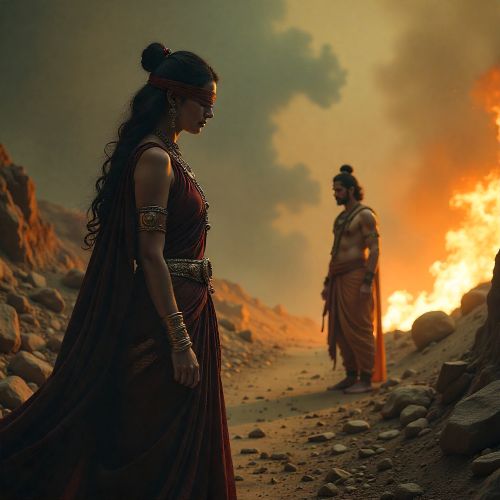
Through illusions and ghostly manipulations, Setna becomes entangled with a mysterious woman named Taboubu, whose beauty enthralls him. In this elaborate deception, Setna believes himself willing to give up his wealth, family, and reputation to win her affection. Each step deepens his humiliation until the final moment when he appears to murder his own children—an act intended to break his spirit entirely.
The illusion collapses only when Setna finds himself lying naked on the ground before Pharaoh Ramesses II, exposed and disgraced. The emotional devastation is the true heart of the curse: divine forces show him what he is capable of becoming when blinded by pride.
Other supernatural elements intensify the torment. At one point, Setna is forced into a senet match with Naneferkaptah, where each loss pulls him magically into the ground. Spirits drain the light from the tomb, distort perception, and bind him to the consequences of his theft until he accepts his wrongdoing.
Victims and Key Figures
Setna is the central victim of the curse, experiencing a psychological dismantling that leaves him shaken and humbled. But his suffering echoes that of Naneferkaptah, Ahwere, and Merab, whose tragedies originally forged the curse’s power. These spirits act not as villains but as guardians trapped in perpetual unrest due to the misuse of divine knowledge.
Pharaoh Ramesses II emerges as a stabilizing force, guiding Setna toward repentance. The god Ptah—Setna’s patron deity—intervenes subtly by providing magical protection that allows Setna to survive his ordeal. Meanwhile, the Book of Thoth itself is a key figure: a symbol of sacred, untouchable power and the catalyst for every misfortune.
Consequences and Resolution
Once the illusions dissolve, Setna collapses under the weight of what he believes he has done. His father listens patiently, recognizing that the curse is a result of divine justice rather than personal failure. Ramesses instructs Setna to return the Book of Thoth and make amends with the spirits he wronged.
Setna obeys, restoring the book to its rightful place and performing rituals to bring peace to Naneferkaptah’s family. Only after Setna retrieves Ahwere and Merab’s bodies from their watery graves and reunites them with Naneferkaptah does the curse lift. His humility and restitution restore balance—an essential theme in Egyptian thought, where cosmic harmony (ma’at) must be protected at all costs.
Symbolism and Moral Lessons
The Curse of Setna offers a layered moral message. The Book of Thoth embodies forbidden knowledge—wisdom too powerful and too dangerous for human hands. Setna’s downfall illustrates the inevitable consequences of challenging divine authority. The curse itself represents cosmic justice, functioning not as vengeance but as correction, guiding Setna back to moral clarity.
Egyptian mythology consistently teaches that power without humility leads to destruction. The tale reinforces the sanctity of tombs, the importance of respecting the dead, and the belief that spiritual forces guard the boundaries between human and divine realms. Setna’s final repentance underlines the value of accountability and the possibility of redemption.
Cultural Impact and Legacy
The Curse of Setna has influenced Egyptian storytelling for centuries, shaping depictions of mummies, haunted tombs, and cursed artifacts across modern literature, archaeology narratives, and cinema. The legend’s themes reappear in everything from early Gothic fiction to contemporary video games and films, particularly those centered on Egypt’s mystical heritage.
Today, the tale stands as one of the most vivid explorations of ambition and consequence in ancient mythology, proving that stories crafted thousands of years ago still speak powerfully to modern audiences about responsibility, humility, and the allure—and danger—of forbidden knowledge.


Source
Egyptopia. (2009). Tale of Setna: Pharaonic history of Egypt. https://egyptopia.com/en/articles/Egypt/history-of-egypt/Tale-of-Setna.s.29.13751/
Bookey. (2024). Tales of ancient Egypt chapter summary. https://www.bookey.app/book/tales-of-ancient-egypt
Mystery in History. (n.d.). Story of Prince Setna and the magic book of Thoth. https://mysteryinhistory.com/prince-setna-and-the-magic-book-of-thoth/
Pinch, R. (1994). Magic in ancient Egypt. University of Texas Press.
Lichtheim, M. (2006). Ancient Egyptian literature: Volume III: The late period. University of California Press.
Ritner, R. K. (1993). The mechanics of ancient Egyptian magical practice. Oriental Institute of the University of Chicago.
Wilkinson, R. H. (2003). The complete gods and goddesses of ancient Egypt. Thames & Hudson.
Te Velde, H. (1977). Set: The terrifying seventh god. Orientalia Batava.
Mark, J. J. (2017, May 2). The Tales of Prince Setna. World History Encyclopedia. https://www.worldhistory.org/article/1054/the-tales-of-prince-setna/
Mystery in History. (n.d.). Story of Prince Setna and the Magic Book of Thoth. https://mysteryinhistory.com/prince-setna-and-the-magic-book-of-thoth/
Colavito, J. (n.d.). The Story of Setna. Retrieved from https://www.jasoncolavito.com/the-story-of-setna.html
Griffith, F. L. (1896). Stories of the High Priests of Memphis: The Setna Cycle. Oxford: Clarendon Press.
Lichtheim, M. (1973). Ancient Egyptian Literature, Volume II: The New Kingdom. Berkeley: University of California Press.
Frequently Asked Questions
What is the Curse of Setna in Egyptian mythology?
The Curse of Setna refers to the supernatural punishments Prince Setna faces after stealing the sacred Book of Thoth, including illusions, humiliation, and spiritual torment.
Why was the Book of Thoth forbidden?
The book contained divine secrets and magical powers intended only for the gods, and Egyptian tradition warned that mortals who sought it would face severe consequences.
How did Setna break the curse?
He broke the curse by returning the Book of Thoth, restoring the tomb, and performing rituals to reunite Naneferkaptah’s family in peace.
Who cursed Setna in the story?
Setna is cursed by the combined forces of Thoth’s divine wrath and the restless spirits of Naneferkaptah and his family, who died because of the book.
What is the moral of the Curse of Setna?
The story teaches that forbidden knowledge must be respected, pride leads to downfall, and balance with the divine order must always be maintained.