

Ruhanga : The Supreme Creator of the Nkole People
Listen
At a glance
| Description | |
|---|---|
| Origin | Nkole Mythology |
| Classification | Gods |
| Family Members | N/A |
| Region | Uganda |
| Associated With | Creation |
Ruhanga
Introduction
Ruhanga stands at the heart of Nkole mythology as the supreme creator and moral architect of the universe. Revered by the Banyankole of southwestern Uganda and acknowledged across other Rutara-speaking peoples such as the Banyoro, Batooro, and Bahaya, Ruhanga embodies origin, order, and cosmic truth. His name translates directly to “He Who Creates,” reflecting his foundational role in shaping the world, humanity, animals, and the structures that govern life.
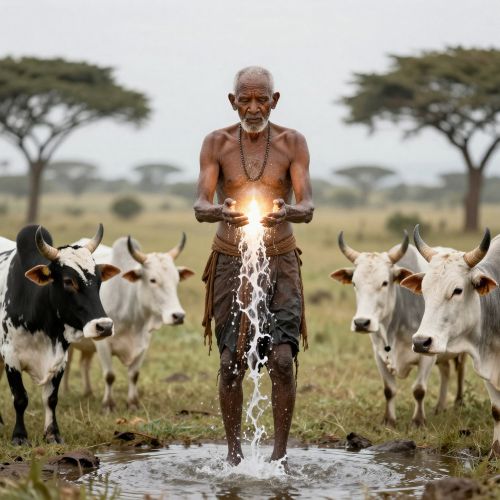
The Nkole world is deeply pastoral, and their cosmology places cattle, land, and lineage at the centre of divine order. Ruhanga’s presence is felt not through elaborate temples or direct worship but through the framework of creation stories and moral teachings attributed to him. Among the most well-known myths is the account of how he molded the first humans through symbolic trials that determined social roles—farmer, herder, and ruler—establishing the hierarchical structure still echoed in historical Nkole society. Though remote and inaccessible, Ruhanga remains the unseen force maintaining balance in the natural and spiritual worlds.
Physical Traits
While Ruhanga does not possess an extended divine family in the style of Greek or Mesopotamian pantheons, his role as a progenitor is central. Myths recount that he brought forth the first humans, including three men—Kairu, Kahima, and Kakama—whose destinies shaped Nkole society. Through these figures, Ruhanga becomes the symbolic ancestor of all clans, linking social structure directly to divine intention.
Ancestors, rather than additional gods, form the intermediate spiritual family surrounding him. These ancestral spirits act as channels through which communities seek guidance, blessings, and protection. Ruhanga remains above them all, the ultimate source of their existence and authority. This structure reflects the Banyankole worldview, where lineage, inheritance, and social order act as spiritual extensions of creation.
Family
While Ruhanga does not possess an extended divine family in the style of Greek or Mesopotamian pantheons, his role as a progenitor is central. Myths recount that he brought forth the first humans, including three men—Kairu, Kahima, and Kakama—whose destinies shaped Nkole society. Through these figures, Ruhanga becomes the symbolic ancestor of all clans, linking social structure directly to divine intention.
Ancestors, rather than additional gods, form the intermediate spiritual family surrounding him. These ancestral spirits act as channels through which communities seek guidance, blessings, and protection. Ruhanga remains above them all, the ultimate source of their existence and authority. This structure reflects the Banyankole worldview, where lineage, inheritance, and social order act as spiritual extensions of creation.
Other names
Although Ruhanga is the most commonly used name across Rutara cultures, variations and related titles appear in regional traditions. In some contexts, he is associated with the broader Bantu concept of a sky-creator, paralleling deities such as Katonda in Buganda and Rurema (“the creator”) in other western Ugandan groups. However, Ruhanga’s identity remains distinct within Nkole cosmology, shaped by pastoral life and the cultural prominence of cattle.
These linguistic and cultural variations demonstrate how different communities adapted the idea of a creator to their own environments, yet maintained a shared understanding of a supreme being who oversees creation and moral order.
Powers and Abilities
Ruhanga’s powers encompass all aspects of creation and cosmic regulation. He is credited with forming the earth, sky, celestial bodies, animals, and the first humans. Beyond physical creation, he establishes the moral laws governing life, ensuring justice, balance, and continuity.
His authority extends into mortality and destiny. One prominent narrative describes how humans originally possessed the ability to return to life after death. This gift was withdrawn after a woman failed to observe proper rites when her dog died, illustrating Ruhanga’s role as guardian of moral behavior and cosmic fairness.
Ruhanga’s influence over fertility—whether in cattle, people, or land—remains a defining aspect of his power. Droughts, illness, and misfortune are traditionally attributed to disruptions in moral or spiritual harmony, which fall under his jurisdiction. Although distant, he remains the ultimate regulator of order, ensuring that human actions align with the ethical principles embedded in creation.
Modern Day Influence
In contemporary Uganda, Ruhanga’s mythology continues to shape cultural memory, even as most Banyankole follow Christianity or Islam. His stories are preserved through oral performances, proverbs, initiation teachings, and discussions of ancestry. The creation myth involving Kairu, Kahima, and Kakama still informs traditional interpretations of social hierarchy, leadership, and pastoral identity.
Artists, scholars, and cultural custodians increasingly draw upon Ruhanga’s narratives to explore indigenous cosmology and represent pre-colonial African thought. His mythology appears in literature, academic studies of Bantu spirituality, and efforts to revive oral traditions among younger generations. For many Banyankole, Ruhanga symbolizes a link to their heritage and a reminder that moral order, community values, and respect for nature originate from sacred beginnings.
Related Images


Source
Britannica Editors. (2015). Ruhanga. Encyclopaedia Britannica. https://www.britannica.com/topic/Ruhanga
Karamura, G. P. (1998). The interplay of Christianity, ethnicity and politics in Ankole [Doctoral dissertation, University of Leeds]. White Rose eTheses Online. https://etheses.whiterose.ac.uk/id/eprint/530/1/uk_bl_ethos_496559.pdf
Nyakato, R. (n.d.). Textual analysis of social dynamics in selected Ankole myths [Master’s thesis, Kabale University]. KYUspace. https://kyuspace.kyu.ac.ug/bitstreams/d714e746-120a-47dc-891e-f5409382022c/download
Red Pepper Uganda. (2025). Understanding the history of Ankole, their traits and norms. https://www.redpepper.ug/culture/understanding-the-history-of-ankole-their-traits-and-norms.html
Roscoe, J. (1923). The Banyankole. Cambridge University Press. (Referenced in multiple Ugandan cultural studies)
Aderinto, S. (2014). African Spirituality and the Bantu Worldview. SAGE Publications.
Mbiti, J. S. (1990). African Religions and Philosophy (2nd ed.). Oxford: Heinemann.
Karamaga, A. (2008). The Role of Myth in East African Societies. Kampala: Fountain Publishers.
Nkurunziza, D. (2012). Banyankole Cultural Heritage and Oral Traditions. Makerere University Press.
Ray, B. C. (1976). African Religions: Symbol, Ritual, and Community. Englewood Cliffs, NJ: Prentice-Hall.
Uganda Heritage Tales and Trails. (2010). Ruhanga. WordPress. https://ugandapeopleandculture.wordpress.com/tag/ruhanga/
Bunyoro-Kitara USA. (2018). Gods & worship. https://www.bunyorokitarausa.org/gods/
Frequently Asked Questions
Who is Ruhanga in Nkole mythology?
Ruhanga is the supreme creator god of the Banyankole people of Uganda, responsible for shaping the world, humanity, and moral order.
What role does Ruhanga play in the creation of humans?
He creates the first men—Kairu, Kahima, and Kakama—and assigns their roles through a symbolic test involving milk pots.
Why is Ruhanga considered a distant or remote deity?
Nkole tradition views him as transcendent and formless, influencing the world through natural order rather than through direct interaction.
Are there temples dedicated to Ruhanga?
Traditional Nkole spirituality did not use temples; Ruhanga was honored through ancestral rites and oral tradition rather than formal worship structures.
Does Ruhanga still influence modern Banyankole culture?
Yes. His myths continue to shape cultural identity, social values, oral storytelling, and studies of Bantu cosmology.
