

Ramakien : The Legendary Tale at the Heart of Thailand
Listen
At a glance
| Attribute | Description |
|---|---|
| Mythology | Thai Mythology |
| Language Written | Thai |
| Age | 18th Century |
| Author | King Rama I |
| Main Characters | Phra Ram, Sida, Tosakanth, Hanuman, Phra Lak |
Ramakien
Introduction
The Ramakien (รามเกียรติ์) stands as Thailand’s national epic, a sweeping narrative that blends divine heroism with the country’s cultural imagination. Though rooted in the ancient Indian Ramayana, the Ramakien evolved into a uniquely Thai masterpiece, enriched with local landscapes, Buddhist ethics, court traditions, and artistic interpretations. Its influence radiates across Thai art, classical dance, temple architecture, and national identity, making it far more than a retelling—it is a cultural lens through which generations have understood virtue, morality, and kingship.
Historical Background
The earliest forms of the Ramakien emerged during the Sukhothai and Ayutthaya periods, when Indian religious texts and epics spread throughout Southeast Asia via trade networks and Brahmin scholars. After Ayutthaya’s fall in 1767, many manuscripts were destroyed, prompting King Rama I of the Chakri Dynasty to reconstruct and refine the epic in 1797. His version became the authoritative text that remains central to Thai culture.
King Rama II later adapted the narrative for Khon masked theatre, shaping its choreography and dramatization, while King Rama VI encouraged literary study and modern scholarly analysis. The result is an epic shaped by centuries of reinterpretation—equal parts Ramayana foundation and Thai cultural innovation, with Buddhist moral principles and animistic traditions shaping its worldview.
Synopsis & Themes
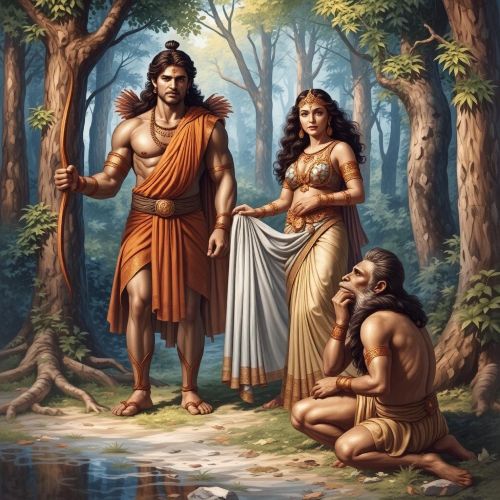
The Ramakien centres on Phra Ram, an incarnation of Phra Narai (Vishnu), who is banished from his kingdom. During his exile, his wife Nang Sida is abducted by the demon king Thotsakan of Longka. Determined to rescue her, Phra Ram joins forces with his loyal brother Phra Lak and the legendary monkey general Hanuman, leading to a long campaign that culminates in Thotsakan’s downfall and the restoration of order.
The epic explores themes that bridge divine mythology and Thai cultural ethics. It reinforces the triumph of righteousness over malevolence, presenting Phra Ram as the embodiment of disciplined virtue and moral duty. Nang Sida illustrates unwavering devotion and resilience under hardship, while Thotsakan represents destructive desire, ego, and disorder. The story also highlights the importance of loyalty through characters like Hanuman and Phra Lak, whose faithfulness strengthens the moral core of the narrative.
Unlike its Indian counterpart, the Ramakien often emphasises Thai geography, kingship ideology, and Buddhist karmic lessons, giving the saga a distinctly local identity.
Key Characters
Phra Ram is the heroic centre of the Ramakien, portrayed as an ideal ruler whose actions reflect moral clarity and compassion. His commitment to justice and restraint reinforces his role as a model of righteous kingship. Nang Sida personifies purity, dignity, and steadfast love. Her abduction drives the central conflict, and her endurance throughout captivity highlights the emotional weight of the story.
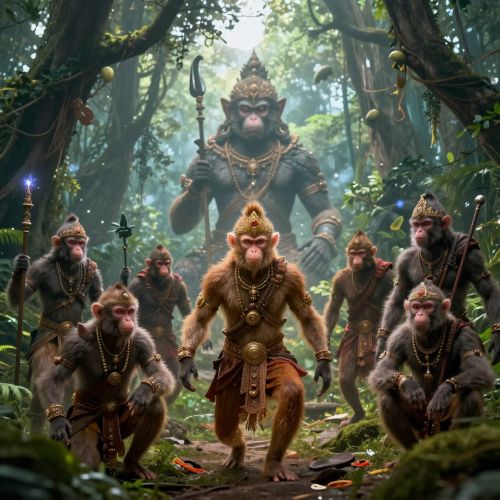
Thotsakan, the ten-headed demon king, is one of the most compelling characters in Thai literature. Although powerful, learned, and bold, his flaw lies in his overwhelming desire and lack of discipline, ultimately leading to his destruction. Hanuman is celebrated across Thailand as a symbol of wit, strength, and unwavering loyalty. As the white monkey general, he plays a decisive role in locating Nang Sida, leading assaults on Longka, and turning the tide of battle.
Phra Lak, Phra Ram’s devoted brother, exemplifies integrity and selfless duty, standing by Phra Ram through every stage of the journey. Phiphek, Thotsakan’s righteous brother, eventually shifts allegiance to Phra Ram, illustrating the triumph of truth even within the demon realm.
Cultural & Religious Significance
The Ramakien is deeply woven into Thailand’s religious and artistic traditions. It is central to Khon, the classical masked dance drama where performers enact battles, romances, and divine interventions through stylised movement and elaborate costumes. This art form, now recognised by UNESCO, is one of the primary ways Thais experience the epic.
Visual interpretations of the Ramakien dominate temple art, especially the famed murals surrounding the Emerald Buddha Temple (Wat Phra Kaew). These murals serve as both decorative art and illustrated scripture, guiding viewers through moral lessons and historical symbolism.
In Buddhist contexts, the Ramakien reinforces ideas of karmic consequence, righteous leadership, and disciplined action. Historically, Thai kings associated themselves with Phra Ram to legitimise their rule, emphasising virtues of just governance. The epic also shapes cultural customs, spiritual tattoos (Sak Yant), folklore, and even ceremonial language, preserving its relevance in everyday life.
Modern Adaptations
The Ramakien continues to evolve in the modern era, capturing the imagination of new generations through contemporary media. Filmmakers and television creators reinterpret its battles and emotional arcs for mainstream audiences. Graphic novels and illustrated storybooks provide accessible retellings for younger readers, blending traditional narratives with modern design.
Contemporary theatre and dance often weave Ramakien motifs into experimental performances, merging classical Thai aesthetics with global artistic influences. Elements from the epic appear in music videos, brand advertising, fashion, and even video games, demonstrating the story’s adaptability and enduring cultural power.
The Ramakien’s presence in global pop culture also grows year by year, with international artists discovering its rich characters and epic scope. Through these adaptations, the Ramakien remains a living, breathing story—both ancient and modern, both Thai and universal.


Source
Bharat Ideology. (2024, January 14). The Ramakien: Thailand’s national epic and the Thai adaptation of the Ramayana. https://bharatideology.com/the-ramakien-thailands-national-epic-and-the-thai-adaptation-of-the-ramayana/
Mysakonnakhon. (2023, September 21). The Ramakien story summary – Thailand Khon drama. https://mysakonnakhon.com/ramakien-story-thailand-khon-drama-summary/
Fabulahub. (2024, September 12). The Ramakien: A Thai epic of love, loyalty, and the triumph of good over evil. https://fabulahub.com/en/story/the-ramakien/sid-369
GKToday. (2019, August 8). Ramakien. https://www.gktoday.in/ramakien/
Britannica. (2025, October 12). Ramayana | Summary, characters, themes, & facts. https://www.britannica.com/topic/Ramayana-Indian-epic
Times of India. (2025, April 2). Ramayana in the history and cultural life of Thailand. https://timesofindia.indiatimes.com/blogs/voices/ramayana-in-the-history-and-cultural-life-of-thailand/
Slow Travel Thailand. The Ramakien, inspiration for the soul. https://slowtravel.fun/ramakien-inspiration-for-the-soul/
Wyatt, D. K. (2003). Thailand: A short history. Yale University Press.
Reynolds, F. E., & Reynolds, M. (1982). Three worlds according to King Ruang: A Thai Buddhist cosmology. Asian Humanities Press.
Griswold, A. B. (1972). The Ramakien murals at Wat Phra Kaew. Bangkok: Fine Arts Department.
Jory, P. (2007). Thailand’s theory of monarchy: Political legitimacy and the Ramakien. Asian Studies Review, 31(4), 403–419.
Brandon, J. R. (1967). Theatre in Southeast Asia. Harvard University Press.
Frequently Asked Questions
What is the Ramakien and why is it important in Thailand?
The Ramakien is Thailand’s national epic, adapted from the Indian Ramayana, and is essential to Thai culture, performing arts, religion, and national identity.
How is the Ramakien different from the Ramayana?
While based on the Ramayana, the Ramakien incorporates Thai geography, Buddhist principles, local characters, and traditions, giving it a uniquely Thai identity.
Who are the main characters in the Ramakien?
Key characters include Phra Ram, Nang Sida, Hanuman, Thotsakan, and Phra Lak, each symbolising moral and cosmic principles.
Where can I see Ramakien murals in Thailand?
The most famous Ramakien murals are at Wat Phra Kaew (Temple of the Emerald Buddha) in Bangkok.
Is the Ramakien still relevant today?
Yes, the Ramakien appears in modern films, TV series, comics, performing arts, and popular culture, remaining influential in Thai society.