


Hundun : The Chinese Mythic Force of Primordial Chaos
At a glance
| Description | |
|---|---|
| Origin | Chinese Mythology |
| Classification | Hybrids |
| Family Members | N/A |
| Region | China |
| Associated With | Chaos, Pre Creation |
Mythlok Perspective
In Mythlok’s Perspective, Hundun stands apart from most mythological figures because it represents not a force within creation, but the undefined state before order takes shape. Like Greek Chaos, it embodies a primordial condition preceding the structured universe, but Hundun is more closely associated with the absence of distinctions and the dangers of imposing artificial order. Its contradictory forms across Chinese texts—from an amorphous state to a strange, sensory-deficient creature—reflect the same underlying idea: that what appears chaotic or incomplete may possess its own form of wholeness.
Hundun
Introduction
Hundun (混沌 or 渾沌) is a mysterious figure and concept in Chinese mythology and philosophy associated with chaos, formlessness, and the undifferentiated state that precedes order. The term is commonly translated as “chaos,” “muddled confusion,” or “undifferentiated.” Rather than representing a single, consistently described deity, Hundun appears in several ancient Chinese traditions with different forms and meanings.
One of the best-known accounts appears in the Zhuangzi, a major Daoist philosophical text. There, Hundun is the ruler of the central region and is portrayed as lacking the seven openings through which humans see, hear, eat, and breathe. When two other rulers attempt to give him these openings, their actions ultimately cause his death. The story presents Hundun as a symbol of primordial wholeness that is disrupted when distinctions and imposed order are introduced.
Hundun also appears in other classical works as a supernatural creature. These different traditions have contributed to Hundun’s enduring association with the mysterious state between chaos and order.
Physical Traits
Hundun has no single canonical physical form. In philosophical contexts, Hundun represents an undifferentiated state without clearly defined boundaries or characteristics. This abstract conception has led to later artistic portrayals of Hundun as a shapeless or amorphous being representing primordial chaos.
A very different description appears in the Shenyi Jing, a collection of accounts concerning strange and supernatural beings. In this tradition, Hundun is described as a strange creature associated with Mount Kunlun. It resembles a dog and possesses unusual characteristics, including eyes that cannot see and ears that cannot hear. Its body is also described in paradoxical terms, lacking conventional internal organs while nevertheless being able to eat and digest food.
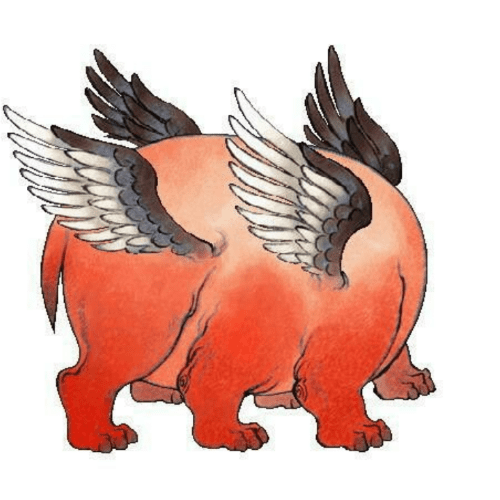
Another ancient tradition connects the name Hundun with Dijiang (帝江) in the Shanhaijing. Dijiang is described as a strange, sack-like being with six feet and four wings, without eyes or a conventional face, yet capable of singing and dancing. These descriptions demonstrate that Hundun’s appearance varies considerably between sources rather than following one established physical design.
Family
Hundun does not have a consistent family lineage in Chinese mythology. In the Zhuangzi, Hundun functions primarily as a symbolic figure rather than as a member of a divine genealogy. The text provides no parents, consort, children, or established divine family.
The association between Hundun and primordial chaos has sometimes encouraged later interpretations to place it before the emergence of ordered cosmic forces such as yin and yang. However, this should not be treated as evidence that Hundun was universally regarded as the first being or creator of the universe.
The situation becomes more complicated in the Zuo Zhuan, where Hundun appears in a different tradition as one of the Four Evils, or Four Malevolent Ones. This Hundun is associated with Di Hong and is presented as a figure representing disorder and moral corruption. This tradition is distinct from the philosophical Hundun of the Zhuangzi and demonstrates why the various appearances of the name should not automatically be treated as one continuous genealogy.
Other Names
Hundun is primarily known by the Chinese forms 混沌 and 渾沌, with 渾敦 also appearing in classical texts. Romanizations such as “Hun Tun” and “Hun Dun” are transliteration variants rather than separate mythological identities.
The Chinese term Hundun carries meanings associated with confusion, muddling, chaos, and an undifferentiated condition. In philosophical contexts, it can describe a state in which distinctions have not yet emerged. Consequently, translations such as “Chaos,” “Primordial Chaos,” “The Unformed,” and “The Undifferentiated” are useful descriptions of its meaning, but they should not be treated as formal alternate names.
Hundun is sometimes compared with Wuji (無極), a Daoist and Chinese philosophical concept describing an unlimited or undifferentiated state. However, Wuji is not an alternate name for Hundun. The two concepts may be discussed together when examining ideas about existence before differentiation, but they belong to distinct philosophical frameworks and should not be presented as synonymous.
Powers and Abilities
Hundun is not traditionally characterized by a defined collection of supernatural powers. Its significance lies primarily in what it represents rather than in specific feats or abilities. In the Zhuangzi, Hundun’s defining characteristic is its lack of the seven bodily openings possessed by ordinary humans. This unusual condition symbolizes a state that exists outside conventional distinctions and perceptions. The story of Hundun’s death after the seven openings are artificially created illustrates the consequences of imposing human categories and structures upon an undifferentiated state.
The creature described in the Shenyi Jing possesses similarly paradoxical characteristics. Its inability to see or hear despite having eyes and ears, together with its unusual internal anatomy, reinforces its strange and incomprehensible nature. These traits are better understood as elements of its supernatural description than as conventional powers.
Hundun’s association with chaos should therefore not be interpreted as evidence that it possesses cosmic creation powers, controls destruction, or generates supernatural energy. Its principal significance is symbolic: it represents a condition in which distinctions, boundaries, and established order have not yet been fully formed.
Modern Day Influence
Hundun continues to attract interest because its themes of chaos, order, transformation, and the limits of human understanding remain relevant beyond ancient Chinese thought. Modern discussions of Daoist philosophy frequently examine Hundun’s role in the Zhuangzi, particularly its relationship to naturalness, imposed distinctions, and the dangers of interfering with an original state of wholeness.
Hundun has also become a compelling subject for modern artists, writers, and creators interested in Chinese mythology. Its lack of a single definitive appearance provides considerable creative freedom, allowing it to be represented as an amorphous being, a strange animal, or an abstract embodiment of chaos. These interpretations often draw on different classical traditions rather than reproducing a single canonical image.
The concept has also gained wider recognition through modern interest in Chinese mythology and Daoist philosophy. Its paradoxical nature makes Hundun particularly distinctive among mythological figures: it can represent both the mysterious state before distinctions emerge and a supernatural being whose very characteristics challenge ordinary ideas about the physical world.
Hundun’s enduring significance ultimately comes from this ambiguity. Rather than functioning simply as a god of chaos, it represents the tension between undifferentiated existence and the ordered world that follows. Across its different appearances in Chinese literature, Hundun remains a powerful symbol of what lies beyond familiar boundaries of form, perception, and order.
Related Images




Sources
“Hundun (混沌).” Wikipedia. https://en.wikipedia.org/wiki/Hundun
“Hundun: The Mystical Chaos and Formless Essence of the Cosmos.” Gods & Monsters. https://godsandmonsters.info/hundun/
“The Legend of Hundun – Daoist Fighting Arts.” Daoist Fighting Arts. https://www.daoistfightingarts.com/the-legend-of-hundun/
“The Mysterious Hundun in ‘Shanhaijing’.” Vocal Media. https://vocal.media/humans/the-mysterious-hundun-in-shanhaijing
Girardot, N. J. (1983). Myth and Meaning in Early Taoism: The Theme of Chaos (Hun-tun). Berkeley & Los Angeles: University of California Press.
Robinet, I. (1997). Taoist Meditation and Longevity Techniques. Albany: SUNY Press.
Eberhard, W. (1976). A Dictionary of Chinese Symbols: Hidden Symbols in Chinese Life and Thought. London: Routledge & Kegan Paul.
Girardot, N. J. (1985). Myth and Meaning in Early Taoism: The Theme of Chaos. Philosophy East & West, 35(4), 431-443. https://doi.org/10.2307/1398542
Frequently Asked Questions
What is Hundun in Chinese mythology?
Hundun represents the state of formless chaos before the universe was created. It symbolizes the raw, undefined potential from which all things emerge.
How is Hundun described in ancient Chinese texts?
In works like the Zhuangzi and Shanhaijing, Hundun is depicted as a faceless, featureless entity — often a round being without eyes, ears, or a mouth. It embodies pure primordial existence.
Why is Hundun associated with Daoist philosophy?
Hundun reflects Daoism’s idea of the Tao as a limitless, undifferentiated source of all creation. The myth teaches that imposing order too quickly can destroy natural harmony.
What is the famous myth involving Hundun’s death?
Two visiting deities drilled holes in Hundun’s body to give him senses like humans — but he died, showing that chaos destroyed becomes the end of creation’s source.
How does Hundun compare with chaos figures in other mythologies?
Similar to Greek Chaos or Egyptian Nun, Hundun represents the cosmic void. But unlike them, Hundun is treated more as a lesson in preserving balance rather than a villainous force.


