

Akwasidae : Ghana’s Legendary Celebration of the Golden Stool
At a glance
| Description | |
|---|---|
| Location | Kumasi |
| Country | Ghana |
| Dedicated To | Ancestors |
| Duration | 1 day |
| Time of Year | Every 6 weeks on Sunday |
Akwasidae
Introduction
Akwasidae is one of the most important traditional festivals in Ghana, celebrated by the Ashanti people every six weeks in accordance with their ancient calendar. Deeply woven into Ashanti spirituality, Akwasidae blends ritual devotion, royal ceremony, and mythological symbolism into a vibrant cultural experience that has endured for centuries. Far more than a formal gathering, the festival serves as a spiritual bridge between the living and their revered ancestors, ensuring that the wisdom, authority, and protection of past generations continue to shape present-day Ashanti society. Through elaborate rituals at the Manhyia Palace, Akwasidae preserves the rhythm of Ashanti communal life and stands as a profound expression of identity and continuity.
Connection with Mythology
Akwasidae is inseparable from Ashanti mythology, especially the belief that ancestors remain active guardians of the living. Central to the festival is the Golden Stool—Sika Dwa Kofi—the divine emblem believed to contain the soul of the Ashanti nation. According to tradition, the Golden Stool miraculously descended from the heavens through the spiritual power of Okomfo Anokye, landing in the lap of King Osei Tutu I, thus establishing the divine authority of the Ashanti monarchy.
During Akwasidae, the Golden Stool is honored as a living spiritual entity. The Ashanti believe that the ancestors reside in stools blackened through ritual, and these ancestral spirits continue guiding the kingdom. Offerings and prayers during the festival invite ancestral blessings, reinforce the sacred covenant between generations, and affirm the Ashanti worldview in which humans, spirits, and deities form a continuous chain of existence. The rituals of Akwasidae thus embody the Ashanti understanding that mythology is not merely a story—it is a living force shaping community and destiny.
Main Activities
Akwasidae unfolds primarily at the Manhyia Palace in Kumasi, where the Asantehene presides over ceremonies that blend spirituality with royal pageantry. The day begins with sacred palace rites, including purification rituals that prepare the community to communicate with the ancestral realm. One of the most profound rituals involves the Asantehene entering the Stool House, where he offers prayers and libations to ancestral stools kept in a protected chamber. These offerings symbolically nourish the spirits and invite their guidance for the kingdom.
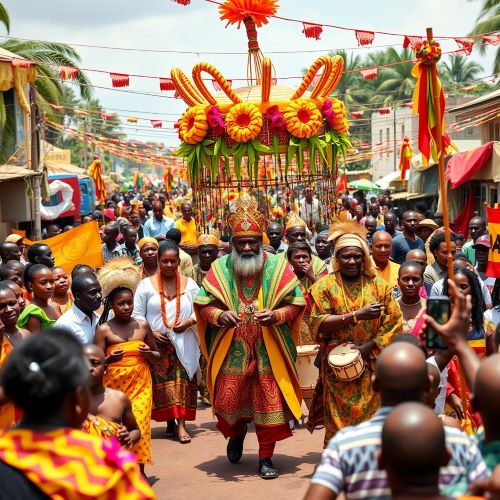
Outside the inner rituals, the festival transforms into a spectacular display of Ashanti culture. The Asantehene appears in elaborate gold regalia carried in a palanquin, surrounded by chiefs, drummers, sword bearers, and attendants in vibrant Kente cloth. Traditional dances such as Adowa and Kete energize the courtyard, while griots recount historical victories, royal lineages, and mythic tales that educate younger generations. Visitors pay homage to the Asantehene during public durbars, strengthening communal ties. The atmosphere is filled with music, storytelling, and shared food, creating a sense of unity and collective celebration unique to Akwasidae.
Importance in Cultural History
Akwasidae has played a strategic and cultural role in Ashanti history. It served as a ritual mechanism for maintaining political order, as chiefs renewed their allegiance to the Golden Stool and affirmed loyalty to the Asantehene. The festival preserved oral history, cemented social hierarchy, and transmitted moral codes essential to the functioning of the Ashanti Empire.
During the colonial period, Akwasidae gained additional significance as the Golden Stool became a symbol of resistance against British attempts to control Ashanti sovereignty. The spiritual power associated with the Stool unified the people during conflicts, ensuring cultural survival even under external pressure.
Today, Akwasidae continues to anchor Ashanti identity. Its rituals preserve artistic traditions—gold-working, drumming, dancing, textile weaving—and pass them on to future generations. The festival remains a living archive of Ashanti knowledge, celebrating continuity in a rapidly modernizing world.
Need a place to stay? Book your hotel room now!
International Appeal
Akwasidae has grown into a globally recognized cultural event, attracting tourists, researchers, and diasporic communities. Visitors travel to Kumasi to witness the magnificence of the Asantehene’s court, the sacred rituals, and the extraordinary display of Ashanti craftsmanship and regalia. For many in the African diaspora, Akwasidae provides a meaningful connection to ancestral heritage and traditional African spirituality.
Cultural institutions worldwide frequently highlight Akwasidae in exhibitions, documentaries, and academic studies, recognizing it as one of the most well-preserved examples of African royal and ritual culture. Its ability to maintain authenticity while engaging international interest showcases its lasting power and cultural resilience. Akwasidae now stands not only as an Ashanti festival but also as a global symbol of African ancestral reverence and cultural endurance.



Source
Meraki Channels. (2024, June 15). The history of the Akwasidae Festival and its cultural significance. Meraki Channels. Retrieved December 8, 2025, from https://merakichannels.com/the-history-of-the-akwasidae-festival/
Moments Log. (2024, July 2). The celebration of Ghanaian Akwasidae Festival: Traditions, rituals, and cultural significance. Moments Log. Retrieved December 8, 2025, from https://www.momentslog.com/culture/the-celebration-of-ghanaian-akwasidae-festival-traditions-rituals-and-cultural-significance
Wikipedia contributors. (2024, October 20). Akwasidae Festival. In Wikipedia. Retrieved December 8, 2025, from https://en.wikipedia.org/wiki/Akwasidae_Festival
Planet Janet Travels. (2023, August 10). Ghana’s Akwasidae Festival: Celebrating Ashanti Kingdom vibrant culture. Planet Janet Travels. Retrieved December 8, 2025, from https://www.planetjanettravels.com/ghana-akwasidae-festival-celebrating-ashanti-kingdom-vibrant-culture/
Amponsah, E. K. (2019). The Golden Stool of Ashanti: Spiritual and Political Symbolism. Journal of African Cultural Studies, 31(2), 178-192.
Boaten, S. A. (2021). Celebrating Ancestral Reverence: Akwasidae and the Ashanti Tradition. Ghana Heritage Review, 14(1), 45-62.
Dumett, R. E. (2003). African Traditional Festivals and Modernity: The Case of Akwasidae. African Studies Quarterly, 7(3), 55-68.
Kimble, D. (1963). A Political History of Ghana: The Ashanti Kingdom and its Legacy. Clarendon Press.
Meyer, B. (2020). Rituals of Power: Kingship and Religion in Ashanti Culture. Journal of Ritual Studies, 34(1), 23-41.
Frequently Asked Questions
What is the meaning of Akwasidae?
Akwasidae is a sacred Ashanti festival dedicated to honoring ancestors and the Golden Stool, celebrated every six weeks in alignment with the traditional Ashanti calendar.
Why is the Golden Stool important during Akwasidae?
The Golden Stool represents the soul of the Ashanti nation, and during Akwasidae, it is spiritually honored as the embodiment of unity, authority, and ancestral power.
How often is Akwasidae celebrated in Ghana?
Akwasidae occurs every 42 days, following the Akan calendar cycle, making it one of the most regularly observed traditional festivals in Ghana.
What happens during Akwasidae at the Manhyia Palace?
The Asantehene leads rituals, offers libations to ancestors, conducts a public durbar, and participates in cultural displays including drumming, dancing, and storytelling.
Can tourists attend the Akwasidae Festival?
Yes, Akwasidae is open to visitors, and many tourists travel to Kumasi to witness the vibrant ceremonies, royal regalia, and rich Ashanti cultural traditions.