


Cangjie : The Four-Eyed Creator of Chinese Writing
At a glance
| Description | |
|---|---|
| Origin | Chinese Mythology |
| Classification | Demigods |
| Family Members | N/A |
| Region | China |
| Associated With | Writing, Alphabet |
Mythlok Perspective
In Mythlok’s Perspective, Cangjie is distinctive as the four-eyed culture hero credited with transforming patterns observed in nature into Chinese characters. Like Thoth of Egyptian mythology, he connects writing with knowledge and record-keeping, though Cangjie represents the mythical origin of writing itself rather than an established divine scribal tradition. His evolution from legendary historian of the Yellow Emperor to a revered figure associated with writing demonstrates how Chinese mythology used culture heroes to explain the origins of fundamental human institutions.
Cangjie
Introduction
Cangjie is a legendary figure in Chinese mythology traditionally credited with creating or systematizing the Chinese writing system. He is closely associated with the Yellow Emperor, one of the most important culture heroes of ancient Chinese tradition, and is described in classical sources as an official historian in the emperor’s court. According to legend, Cangjie developed written characters after studying the patterns found in the natural world, including the tracks of birds and animals. His story provides a mythological explanation for the origins of Chinese writing and reflects the ancient belief that written symbols could reveal and preserve the underlying order of the world. Although Chinese writing developed gradually over many centuries and cannot historically be attributed to a single inventor, Cangjie’s legendary role made him an enduring symbol of language, record-keeping, and intellectual observation.
Physical Traits
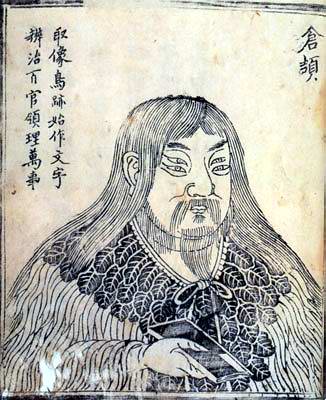
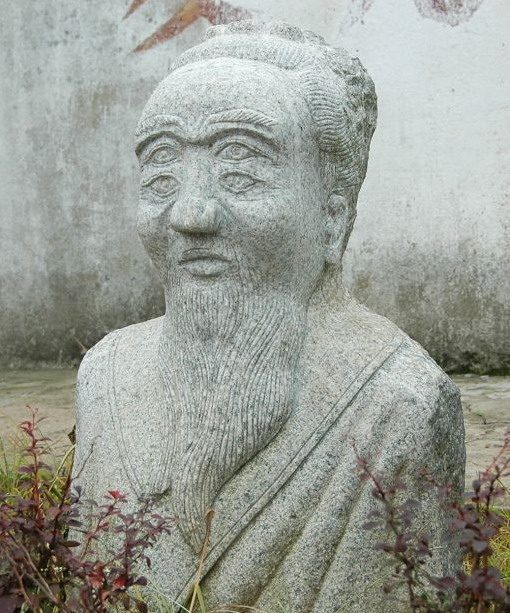
Cangjie is most famously distinguished by his four eyes, one of the defining features attributed to him in traditional Chinese accounts. This unusual appearance sets him apart from ordinary humans and emphasizes his exceptional powers of observation. Rather than simply representing physical abnormality, his four eyes are commonly interpreted as a symbol of his ability to perceive patterns and details that others could not recognize.
Some traditional accounts also give Cangjie unusual facial characteristics, including features described as being dragon-like. Such descriptions place him within the broader tradition of Chinese culture heroes whose extraordinary physical qualities reflect their unusual relationship with the natural or supernatural world. His appearance therefore reinforces his role as a figure capable of seeing meaning within the forms of nature.
The four eyes are particularly significant because Cangjie’s legendary achievement depends upon observation. He is said to have studied the tracks of animals, the forms of birds, and other natural patterns before transforming what he saw into written signs. His physical appearance consequently mirrors the central quality of his mythology: an extraordinary capacity to observe, interpret, and translate the world into symbols.
Family
Very little is known about Cangjie’s family life in the surviving mythology. His stories focus overwhelmingly on his service to the Yellow Emperor and his legendary contribution to the development of writing rather than on his genealogy or descendants.
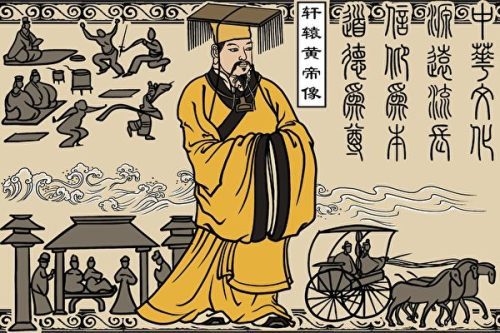
Cangjie’s most important relationship is therefore his association with the Yellow Emperor, whom traditional sources describe as the ruler under whom he served as a historian or court official. Some classical traditions identify Cangjie specifically as the emperor’s left historian, while another figure, Jushong, is associated with the role of right historian. These accounts reinforce Cangjie’s position as a keeper and organizer of knowledge within the legendary imperial court.
Unlike many Chinese mythological figures, Cangjie is not primarily defined through a large divine family or a network of mythological descendants. His importance instead rests on his intellectual achievement and his role in transforming human knowledge into a permanent written form.
Other Names
Cangjie is known by different forms of his name across East Asian languages. His Chinese name is written 倉頡 in traditional characters and 仓颉 in simplified Chinese, with the Mandarin pronunciation Cāngjié. In Cantonese, the name is commonly romanized as Cong Kit, while Korean uses Changhil (창힐), and Japanese traditionally renders the name as Sōketsu (そうけつ).
The character 頡 has contributed to several historical pronunciations and romanizations of his name, which explains the differences found across languages. His name has remained particularly prominent because of its association with writing itself.
The modern Cangjie input method, a system used to enter Chinese characters electronically, also takes its name from the legendary figure. The connection is deliberate: the modern system breaks Chinese characters into their component forms, echoing the traditional association between Cangjie and the analysis of written symbols.
Powers and Abilities
Cangjie’s most important ability was his extraordinary power of observation and interpretation. Traditional accounts describe him as studying the natural world and recognizing meaningful patterns in things that ordinary people might overlook. Animal tracks, bird forms, natural markings, and other visible patterns became sources of inspiration for the written signs he was said to develop.
According to legend, Cangjie transformed these observations into characters representing different objects and concepts. In this way, his ability was not simply the power to see but the intellectual capacity to translate what he saw into a symbolic system. His four eyes reinforce this aspect of the mythology, portraying him as someone capable of perceiving the world on a deeper level.
One of the most famous episodes associated with Cangjie’s achievement describes the supernatural reaction to the creation of writing. When he completed the characters, heaven is said to have caused millet to rain from the sky, while ghosts wept during the night. The story suggests that writing was regarded as an extraordinarily powerful invention. Written knowledge could preserve information, distinguish things, record events, and alter the relationship between humans and the world around them.
The legend should not be interpreted as evidence that Cangjie historically invented every Chinese character. Archaeological evidence shows that Chinese writing emerged through a long process of development, with the earliest securely attested examples appearing many centuries after the legendary age of the Yellow Emperor. Cangjie’s importance lies instead in the mythological explanation he provides for this transformation: writing emerged because an extraordinary observer learned to recognize and record the patterns of the world.
Modern Day Influence
Cangjie’s legacy remains closely connected with the Chinese written tradition. His name was associated with the Cangjiepian, an early Chinese character primer traditionally attributed to the Qin period. Although the original work has not survived intact, references to it demonstrate the longstanding association between Cangjie and the teaching and organization of written characters.
His influence also entered the technological age through the Cangjie input method, developed in the twentieth century for entering Chinese characters on computers. Rather than typing characters phonetically, the system represents them through their visual components and structures. Naming the method after Cangjie reflects the enduring cultural association between him and the analysis of Chinese characters.
Cangjie is also commemorated through temples, shrines, tomb traditions, and other sites across China associated with his legendary life and achievements. These locations demonstrate that his mythology has remained part of local religious and cultural traditions long after the legendary age to which he belongs.
His influence has even extended beyond Earth. A rock examined by NASA’s Spirit rover on Mars was given the name “Cangjie,” linking the legendary Chinese creator of writing with humanity’s exploration of another world.
Cangjie’s enduring significance ultimately comes from what he represents rather than from a historically verifiable biography. He embodies the ancient idea that writing transformed human knowledge by giving visible form to the patterns of the world. His four eyes symbolize extraordinary perception, his association with the Yellow Emperor places him within China’s legendary age of cultural innovation, and his creation of characters represents the transition from memory and oral transmission toward recorded knowledge. Through mythology, language, scholarship, and even modern computing, Cangjie remains one of China’s most enduring symbols of the written word.
Related Images




Sources
Chinese Text Project. (n.d.). The book of calligraphers’ histories: Volume 3 (書小史: 卷三). https://ctext.org/wiki.pl?chapter=740572&if=en&remap=gb
Chinese Text Project. (n.d.). Shu duan: Volume 1 (書斷: 卷上). https://ctext.org/wiki.pl?chapter=191495&if=en
Chinese Text Project. (n.d.). Qunshu zhiyao: Volume 11 (群書治要: 卷十一). https://ctext.org/qunshu-zhiyao/11
Galambos, I. (2006). Orthography of early Chinese writing: Evidence from newly excavated manuscripts. Department of East Asian Studies, Eötvös Loránd University.
Needham, J., & Wang, L. (1954). Science and civilisation in China: Vol. 1. Introductory orientations. Cambridge University Press.
Unicode Consortium. (2025). Appendix: A brief history of the Cangjie input method. https://www.unicode.org/L2/L2025/25216-kcangjie.pdf
University of Southern California. (2014). Cang Jie and the origin of the Chinese writing system. USC Digital Folklore Archives. https://folklore.usc.edu/cang-jie-and-the-origin-of-the-chinese-writing-system/
Frequently Asked Questions
Who was Cangjie in Chinese mythology?
Cangjie was a legendary historian of the Yellow Emperor, traditionally credited with creating or systematizing Chinese characters after observing patterns in nature.
Why does Cangjie have four eyes?
Cangjie is traditionally depicted with four eyes, symbolizing his extraordinary powers of observation and his ability to recognize patterns that ordinary people could not see.
Did Cangjie really invent Chinese writing?
Cangjie is mythologically credited with creating Chinese writing, but historically, Chinese characters developed gradually over centuries rather than through one person’s invention.
What happened when Cangjie created Chinese characters?
Is Cangjie one of the Eight Immortals?
No. Cangjie is not one of the Eight Immortals. He is a legendary Chinese culture hero associated with writing, later revered as a figure connected with knowledge and literacy.


