

Num : The Sky Father of the Nenets Tradition
Listen
At a glance
| Description | |
|---|---|
| Origin | Nenets Mythology |
| Classification | Gods |
| Family Members | N/A |
| Region | Siberia |
| Associated With | Creation, Sky |
Num
Introduction
Among the Nenets communities of Siberia, Num embodies the vastness and authority of the Arctic heavens. Worshipped as the supreme sky god, he governs creation, natural order, and the rhythm of existence in a landscape where survival relies on harmony with the environment. As the figure who sustains cosmic balance, Num stands at the center of Nenets spiritual life, shaping their understanding of the interconnected forces that govern the world. His myths often portray him as a calm but powerful force whose presence forms the boundary between life-giving benevolence and the threatening chaos represented by his rival, Nga. This interplay between creation and destruction mirrors the extreme conditions of the tundra, where the Nenets have developed deep spiritual resilience. Across generations, Num has remained the guiding celestial presence who influences reindeer migrations, weather patterns, and the invisible forces shaping human destiny.
Physical Traits
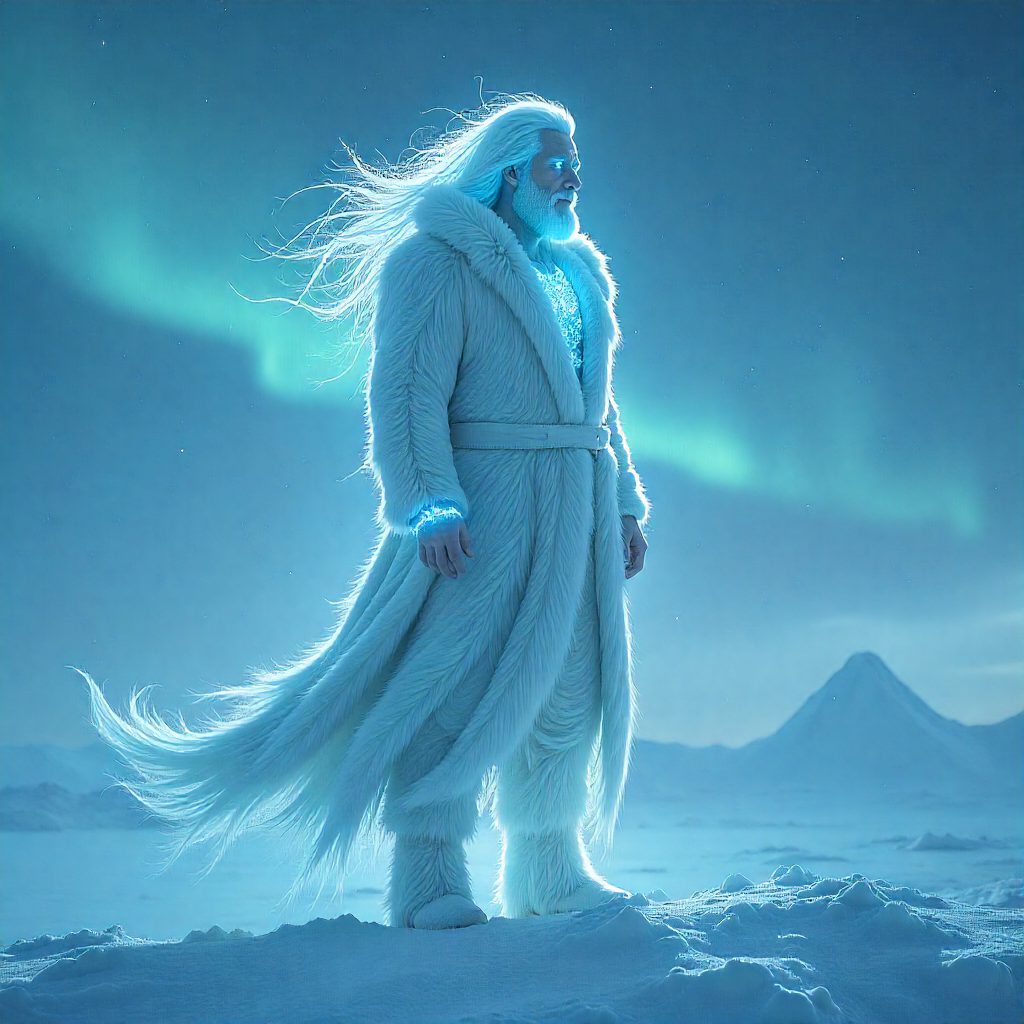
Num differs from deities described through human forms; instead, he is envisioned as the sky itself. His name in the Nenets language directly translates to “heaven,” emphasizing that his essence is not confined to a body but spans the entire celestial dome. Through oral storytelling, he is portrayed as a radiant, expansive presence whose brilliance is sensed during clear polar skies and whose power reveals itself in storms or northern lights. His form is not depicted in carvings or icons, reflecting the Nenets preference for conceptual rather than anthropomorphic representations of the divine. The immensity of the Arctic sky becomes his body, and its shifting moods are interpreted as expressions of his will. This abstract portrayal reinforces his role as a force beyond human limitation, a deity whose power flows through weather, light, and the rhythms of the natural world.
Family
Num’s most defining relationship is with his son and counterpart, Nga, the ruler of the underworld. Their dynamic expresses the Nenets understanding of dualism, where creation and destruction must coexist for the world to remain in balance. Myths describe them as co-creators of the earth, working together even when their intentions differ. In one well-known tale, the world begins to collapse, prompting a shaman to seek Num’s guidance. Num directs him into Nga’s realm, where the shaman marries Nga’s daughter and becomes the “Old Man of the Earth,” physically supporting the world with his hand. This story reveals the interdependence of the two deities: Num generates order while Nga introduces challenge, and together they shape existence. Some traditions also describe Num as having multiple sons who rule separate layers of the heavens, extending his authority across a multi-tiered cosmos.
Other names
Num is often addressed simply as “Heaven,” reinforcing his identity as the sky personified. He may also appear in ethnographic records under variations such as Num-Torum or Num-Nisya, depending on regional dialect and shamanic context. Scholars occasionally compare him to other Eurasian sky gods, including Tengri of the Turkic world, though the Nenets integrate his attributes into a uniquely Arctic cosmology. His names carry layers of reverence, symbolizing not only the physical heavens but also the divine order governing the cycles of life, weather, and cosmic stability.
Powers and Abilities
Num’s abilities operate on a cosmic scale, shaping the world and maintaining its equilibrium. As the creator, he generates life, landscapes, and the forces that sustain the tundra. His dominion extends over the heavens, where each sphere may be ruled by one of his sons, forming a layered celestial architecture. Through his complex relationship with Nga, he ensures that both generative and destructive forces remain in tension, preventing the universe from collapsing into chaos. Num is also known for guiding humanity through shamans, who communicate with him during rituals for protection, healing, and ecological balance. He grants wisdom in times of crisis, influencing critical decisions such as migrations or seasonal preparations. As the sky deity, he shelters the world beneath his celestial canopy, offering stability and safeguarding the delicate harmony between humans and nature.
Modern Day Influence
Despite the pressures of modernization, climate change, and industrial activity in the Siberian Arctic, Num continues to hold deep cultural significance for the Nenets. Shamans still invoke him during ceremonies tied to reindeer herding, weather prediction, and community wellbeing. His mythology echoes in contemporary Nenets discourse on ecological stewardship, symbolizing the fragile balance between human survival and environmental disruption. As global interest in Indigenous knowledge grows, Num’s stories appear in academic research, cultural preservation projects, and modern retellings that respect the spiritual heritage of the Arctic. For many Nenets, Num remains not just a mythic figure but a living presence reflecting their enduring connection to the sky, land, and ancestral traditions.
Related Images


Source
Gorodensky, N. (2000). The Nenets. Spiritual culture. Atlas of indigenous small-numbered peoples of the North, Siberia and Far East. https://mobile.atlaskmns.ru/page/en/people_nentsy_spirit.html
Encyclopedia.com. (2025). Num. https://www.encyclopedia.com/environment/encyclopedias-almanacs-transcripts-and-maps/num
Viking Religion. (2021). A brief introduction to Nenets folk religion. https://vikingreligion.com/2021/03/23/an-introduction-to-nenets-folk-religion/
Wikipedia contributors. (2023). Num (god). Wikipedia. https://en.wikipedia.org/wiki/Num_(god)[5]
Povoroznyuk, O. (2024). Visualizing spirit entities: Naming, classification, and representation in Nenets shamanic practice. Folklore, 135(1), 1-25. https://doi.org/10.1080/0015587X.2024.2426885
Khomich, L. V. (1995). Nenetskaya mifologiya [Nenets mythology]. In Mify narodov mira [Myths of the peoples of the world] (Vol. 2, pp. 245-247). Sovetskaya entsiklopediya.
Nagy, G. (2010). Nenets cosmology and shamanism. In J. D. Halsall (Ed.), Shamanism in Siberia (pp. 112-130). Routledge.
Frequently Asked Questions
Who is Num in Nenets tradition?
Num is the supreme sky deity in the Nenets spiritual system, governing creation, weather, and cosmic order across the Arctic world.
What is the relationship between Num and Nga?
Num represents benevolence and creation, while Nga embodies chaos; together they form a dualistic pair balancing the universe.
How do the Nenets depict Num’s appearance?
Num is conceptualized as the sky itself, not as a human figure, symbolizing his vast and omnipresent nature.
What powers is Num believed to possess?
Num controls creation, weather, cosmic order, and communicates with humans through shamans during rituals.
Does Num still influence Nenets culture today?
Yes, his presence remains strong in rituals, ecological worldviews, and cultural revival efforts in modern Nenets communities.
