


Ocasta : The Stone-Clad Being Who Taught the Cherokee
At a glance
| Description | |
|---|---|
| Origin | Cherokee Mythology |
| Classification | Gods |
| Family Members | N/A |
| Region | United States of America |
| Associated With | Creation, Medicine Men |
Mythlok Perspective
In Mythlok’s Perspective, Ocasta is more than a stone-clad monster; he embodies the paradox of danger becoming wisdom. Like the Greek Talos and the Japanese Gashadokuro, he combines an imposing supernatural body with a threat to humans, yet Ocasta’s story takes a distinctive turn. His destruction becomes a moment of transmission, transforming a feared being into a source of songs, healing, hunting, and sacred knowledge.
Ocasta
Introduction
In a Yamasee-Cherokee tradition of the southeastern United States, Ocasta is described as a supernatural being known as Stone Coat. The figure is closely related to the broader Cherokee tradition of Nun’Yunu’Wi, whose name is generally translated as “Dressed in Stone” or “Stone Coat.” Accounts vary, but Stone Coat is portrayed as a powerful supernatural being whose body was protected by stone or flint and who possessed knowledge and abilities beyond those of ordinary humans.
In the Ocasta version, he was initially sent by the Creator to help and teach humanity. Over time, however, jealousy and resentment caused him to turn against the people and use his knowledge for destructive purposes. His eventual defeat and death became associated with the transmission of songs, dances, hunting knowledge and healing traditions.
Physical Traits
In legend, Ocasta is portrayed as a gigantic humanoid being whose body is protected by a covering of stone or flint. In the Ocasta tradition, he fashions a coat from pieces of flint, making himself extraordinarily resistant to weapons. The broader Cherokee Stone Coat tradition similarly describes Nun’Yunu’Wi as a supernatural being whose stone-like body could not easily be pierced or injured by ordinary weapons. His stone covering is the defining feature of the figure and gives Stone Coat his name and formidable reputation.
Family
Ocasta is described in the Yamasee-Cherokee tradition as one of the Creator’s helpers, originally sent to humanity to provide knowledge and assistance. His character eventually changes, however, as jealousy and resentment lead him toward destructive behavior.
Some accounts associate Ocasta with the creation or teaching of witches and describe him as travelling between communities and spreading disorder. These elements belong particularly to the Ocasta version of the tradition and should not be assumed to occur in every Cherokee account of Stone Coat.
Other names
Ocasta is identified as Stone Coat in a Yamasee-Cherokee version of the tradition. In Cherokee sources, the Stone Coat figure is more commonly associated with the name Nun’Yunu’Wi or related forms such as Nvyvunuwi, generally interpreted as “Dressed in Stone” or “Stone Coat.
Because the tradition exists in different versions, Ocasta should not be regarded as the universal Cherokee name for Stone Coat. Instead, the name belongs to one particular form of a wider southeastern Indigenous tradition surrounding the stone-clad supernatural being.
Powers and Abilities
Ocasta’s defining supernatural power is his extraordinary resistance to physical harm. His stone or flint covering protects him from ordinary weapons, making him extremely difficult for humans to defeat. Some Cherokee accounts also describe Stone Coat as possessing the ability to become invisible. This allowed him to approach people without being detected and contributed to his reputation as a dangerous supernatural being.
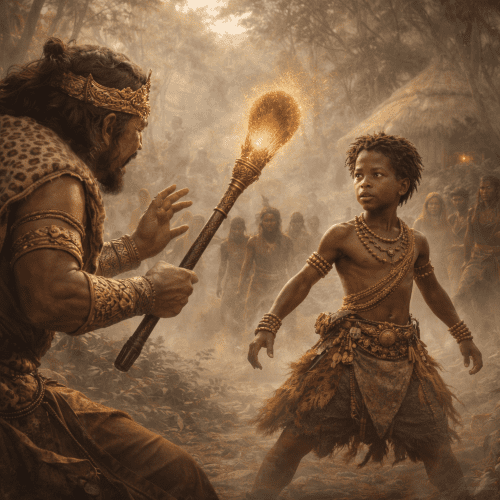
A magical staff or cane is also associated with Stone Coat in some versions of the tradition. The object possesses supernatural properties and is connected with his ability to pursue or locate victims. Stone Coat is generally portrayed as a dangerous being who preys upon humans, with some Cherokee accounts describing him as a cannibal. However, specific details about his preferred foods and other magical abilities vary between sources and should not be treated as universal features of the tradition.
Ocasta’s power ultimately proved insufficient against the spiritual forces used by the people to overcome him. His unusual vulnerability to menstruating women plays a central role in several versions of the story.
Modern Day Influence
The Ocasta and Stone Coat traditions continue to appear in modern retellings of Cherokee and southeastern Indigenous mythology. Contemporary interpretations often emphasize the figure’s distinctive stone-covered body, supernatural strength and resistance to weapons.
However, claims that Ocasta directly inspired particular modern comic-book characters or the broader tradition of fictional earth-element characters are not well documented. His cultural significance is better understood through the traditional stories themselves, particularly those connecting Stone Coat with supernatural danger, spiritual power, songs, healing and ceremonial knowledge.
Related Images


Sources
Howard, J. H., Shaffer, S. R., & Shaffer, J. (1959). Altamaha Cherokee folklore and customs. The Journal of American Folklore, 72(284), 134–138. https://doi.org/10.2307/538476
Kilpatrick, J. F., & Kilpatrick, A. G. (1964). Friends of Thunder: Folktales of the Oklahoma Cherokees. Southern Methodist University Press.
Loftin, J. D., & Frey, B. E. (2019). Eastern Cherokee creation and subsistence narratives: A Cherokee and religious interpretation. American Indian Culture and Research Journal, 43(1), 83–98. https://doi.org/10.17953/aicrj.43.1.loftin-frey
Loftin, J. D., & Frey, B. E. (2024). People of Kituwah: The Old Ways of the Eastern Cherokees. University of California Press. https://doi.org/10.1525/9780520400344
Mooney, J. (1891). The sacred formulas of the Cherokees. U.S. Government Printing Office.
Mooney, J. (1902). Myths of the Cherokee. In Nineteenth annual report of the Bureau of American Ethnology, 1897–1898 (pp. 3–548). U.S. Government Printing Office.
Mooney, J. (1890). Cherokee theory and practice of medicine. The Journal of American Folklore, 3(8), 44–50. https://doi.org/10.2307/533027
Speck, F. G., & Broom, L. (1951). Cherokee dance and drama. University of Oklahoma Press.
Frequently Asked Questions
Who is Ocasta in Cherokee mythology?
Ocasta is a Stone Coat figure in a Yamasee-Cherokee tradition, portrayed as a powerful supernatural being whose stone covering made him resistant to weapons.
What does Ocasta look like?
Ocasta is described as a gigantic humanoid covered in stone or flint. His supernatural stone covering protected him from ordinary weapons.
How was Ocasta defeated?
Ocasta was weakened through the spiritual power associated with menstruating women and was eventually captured and killed before his body was burned.
What powers did Ocasta have?
Ocasta possessed extraordinary resistance to weapons and, in some Cherokee accounts, the ability to become invisible. He was also associated with a magical staff.
What did Ocasta teach the Cherokee?
As he died, Ocasta was said to transmit songs and knowledge associated with hunting, warfare, healing, and ceremonial traditions to the people.


