

Yurlungur : The Rainbow Serpent of the Yolngu Tradition
Listen
At a glance
| Description | |
|---|---|
| Origin | Yolngu Mythology |
| Classification | Animals |
| Family Members | N/A |
| Region | Australia |
| Associated With | Rain, Storms, Fertility |
Yurlungur
Introduction
Yurlungur stands at the heart of Yolngu cosmology as one of the most powerful ancestral beings in Arnhem Land. Known widely as a Rainbow Serpent, Yurlungur embodies creation, destruction, fertility, and the laws established during the Dreamtime. For the Yolngu people of northeastern Arnhem Land, Yurlungur is not merely a symbolic guardian of water and renewal but a force that shapes the land and enforces sacred order through mythic events. The most influential of these stories is the tale of the Wawalag (Wawilak) Sisters. Their encounter—marked by taboo, upheaval, and transformation—anchors many Yolngu ceremonies and articulates the immense spiritual authority of Yurlungur. Through this myth, themes of blood, kinship, land ownership, and ritual origin converge, forming a cultural foundation that continues to guide Yolngu identity.
Physical Traits
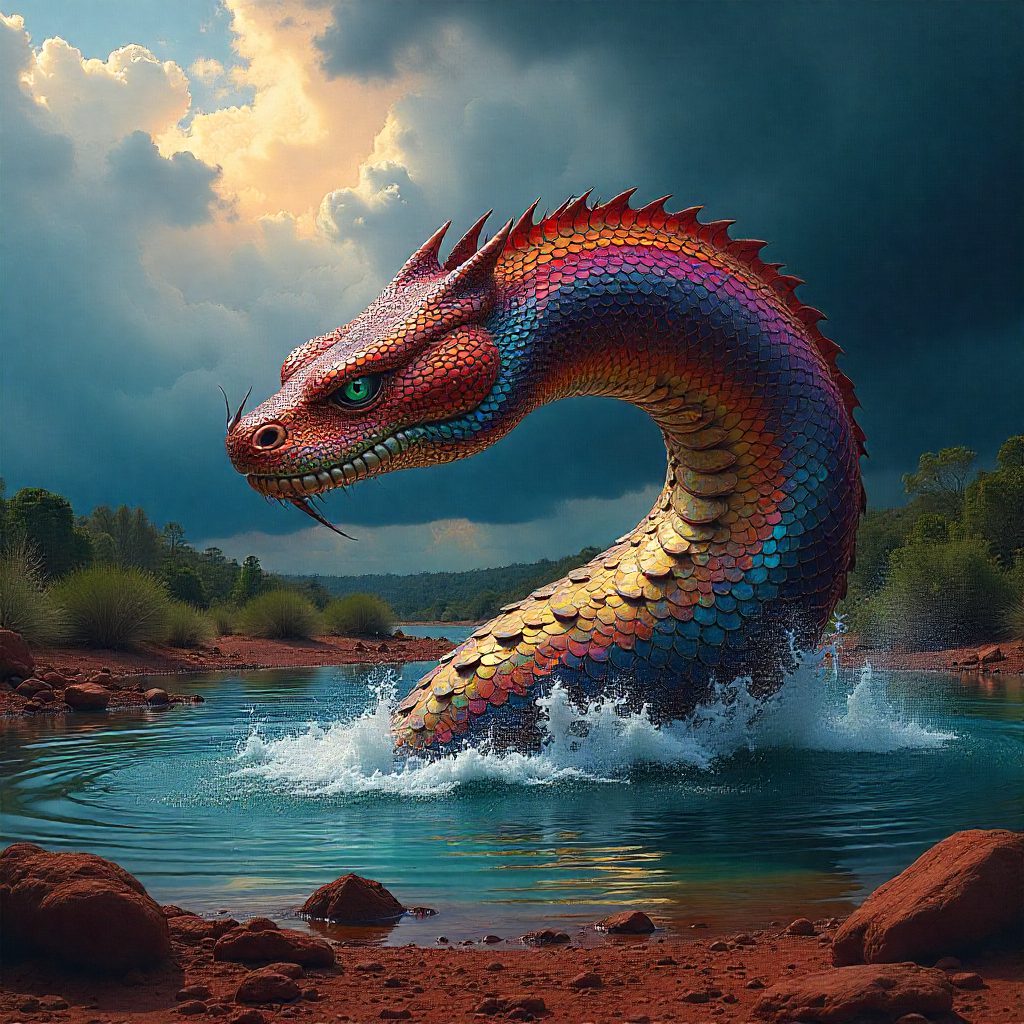
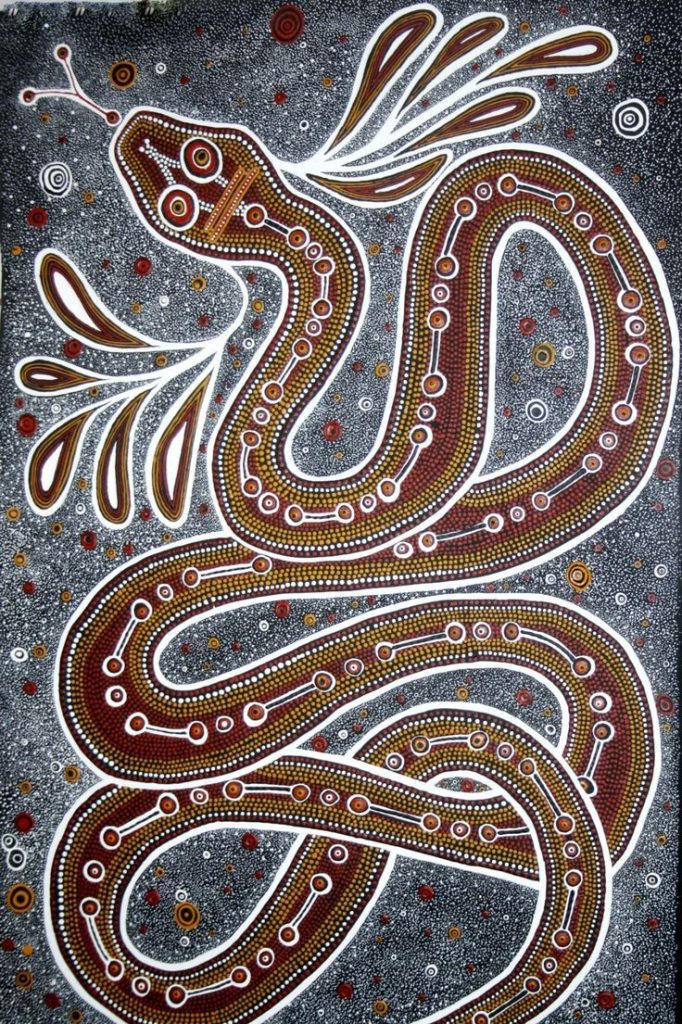
Yurlungur is commonly visualised as a vast serpent whose shimmering scales evoke the colours of a rainbow, signifying its connection to storms, waterholes, and the life-giving power of rain. Early Yolngu bark paintings depict the serpent with elongated curves and intricate cross-hatching, emphasising the fluidity of a being capable of reshaping the earth. While some Aboriginal regions portray Rainbow Serpents with multiple heads, legs, or unusual tails, Yurlungur of Arnhem Land is typically a single-headed, copper-toned serpent of immense size. Its body is said to move through underground water systems, permanent pools, and sacred billabongs, linking it to fertility and the unseen forces beneath the land. In many representations, the creature’s open jaws and sinuous form communicate both danger and protection, highlighting its status as an apex spiritual presence.
Family
The mythology surrounding Yurlungur does not describe a clear lineage in a genealogical sense. Instead, its relationships are expressed through interactions with other ancestral beings and the clans connected to them. In Yolngu tradition, Yurlungur is tied closely to the Wawalag Sisters, whose violation of ceremonial taboo leads to their swallowing and later regurgitation. This transformative act establishes sacred songs, ceremonies, and the moral laws known as Maḏayin. While not presented as a parent or offspring within Yolngu narratives, Yurlungur belongs to a larger spiritual network of Rainbow Serpents across Aboriginal Australia. Some regions speak of primordial serpents like Yingarna or Ngalyod, but these belong to different linguistic and cultural traditions. Within Yolngu country, Yurlungur’s kinship is more symbolic than familial, binding it to the land and to the clans who inherit its ceremonial responsibilities.
Other names
Yurlungur appears in Yolngu traditions under various spellings—Yrlunggur, Yulunggur, and Jurlungur—reflecting differences in dialect and early anthropological transcription. The name Julunggul is often associated with its presence in initiation ceremonies, highlighting the serpent’s role in guiding spiritual transformation. Although Yurlungur is part of the broader Rainbow Serpent archetype found across Aboriginal Australia, its identity is specific to Arnhem Land and its cultural laws. Outside Yolngu regions, similar serpents may be known as Ngalyod, Goorialla, Numereji, or Wagyl, but these are distinct beings tied to their own Dreaming tracks and clan territories. Yurlungur’s significance rests in its Yolngu origin and the particular rituals that emerged from its foundational myth.
Powers and Abilities
As a Rainbow Serpent, Yurlungur is deeply connected to water, storms, and fertility. It commands rainfall, controls the flooding of waterholes, and shapes the channels and ridges that define the landscape. When angered or disturbed, Yurlungur is capable of unleashing thunderstorms, cyclones, and spiritual upheaval, demonstrating the dual nature of its power—life-giving yet capable of destruction. The myth of the Wawalag Sisters reveals another dimension of its ability: the act of swallowing and regurgitating them brings forth sacred ceremonies such as Djungguwan, Gunabibi, and Djungan. These rituals encode Yolngu law, kinship structures, and linguistic patterns, making Yurlungur a custodian of spiritual knowledge. Its association with blood links the serpent to fertility and rebirth, while its dominion over underground water systems ties it to the continuous renewal of land and life.
Modern Day Influence
Yurlungur remains a vital presence in Yolngu cultural life and broader Australian identity. Its form appears in bark paintings, larrakitj burial poles, rock art, and contemporary artworks sold across the world, helping preserve Yolngu stories and visual traditions. The serpent is invoked in ceremonies that reinforce Maḏayin and the spiritual connection between people, country, and law. Yurlungur’s symbolic link to land and water resonates strongly in environmental discussions, especially within movements advocating for Indigenous land rights and ecological protection. Historical milestones such as the Yirrkala bark petitions draw upon this deep spiritual framework, highlighting the inseparability of land, identity, and ancestral beings. Beyond Indigenous contexts, the Rainbow Serpent has found its way into literature, festivals, video games, and modern interpretations of mythology. Yet, among the Yolngu, Yurlungur is not a metaphor—it is an active ancestral presence whose story continues to guide cultural continuity and community resilience.
Related Images

Source
Encyclopedia.com. (n.d.). Wawalag. https://www.encyclopedia.com/environment/encyclopedias-almanacs-transcripts-and-maps/wawalag
Wikipedia contributors. (2025). Yolngu. https://en.wikipedia.org/wiki/Yolngu
Morphy, H. (1991). Ancestral connections: Art and an Aboriginal system of knowledge. University of Chicago Press.
Warner, W. L. (1937). A black civilization: A social study of an Australian tribe. Harper.
Lévi-Strauss, C. (1995). The story of the lynx. University of Chicago Press. (Discusses serpent myths in Aboriginal contexts)
Bücher, H. (1988). Dreamtime: Ancient wisdom for our time. Element Books.
Munuŋgurr, D. (2024). Yolŋu power: The art of Yirrkala. Artlink Magazine. https://www.artlink.com.au/articles/6153/yolu-power-the-art-of-yirrkala/
Berndt, R. M., & Berndt, C. H. (1989). The Speaking Land: Myth and Story in Aboriginal Australia. Penguin Books.
Eliade, M. (1998). Myths, Dreams and Mysteries: The Encounter Between Contemporary Faiths and Archaic Realities. HarperOne.
Maddock, K. (1972). The Australian Aborigines: A Portrait of Their Society. Penguin Books.
Morphy, H. (1991). Ancestral Connections: Art and an Aboriginal System of Knowledge. University of Chicago Press.
Stanner, W. E. H. (1979). White Man Got No Dreaming: Essays, 1938–1973. Australian National University Press.
Frequently Asked Questions
Who is Yurlungur in Aboriginal mythology?
Yurlungur is the Yolngu Rainbow Serpent, a powerful ancestral being linked to creation, water, fertility, and Dreamtime law.
What is the story of Yurlungur and the Wawalag Sisters?
The serpent swallows and later regurgitates the Wawalag Sisters, a myth that establishes major Yolngu ceremonies and taboos.
Is Yurlungur the same as the Rainbow Serpent?
Yurlungur is a Yolngu version of the Rainbow Serpent, but each Aboriginal region has its own distinct serpent ancestor.
What powers does Yurlungur have?
Yurlungur controls storms, water, fertility, and can transform landscapes through its movements.
How is Yurlungur represented in modern culture?
It appears in Indigenous art, environmental symbolism, cultural revival movements, and international portrayals of Aboriginal mythology.
