
Yeomna : The Korean Judge of the Afterlife
Listen
At a glance
| Description | |
|---|---|
| Origin | Korean Mythology |
| Classification | Gods |
| Family Members | N/A |
| Region | South Korea |
| Associated With | Underworld, Afterlife |
Yeomna
Introduction
Yeomna (염라대왕, Yeomna Daewang) stands as one of the most influential and enduring figures in Korean mythology, governing the afterlife with unwavering authority. Deeply rooted in Buddhist cosmology yet shaped by Korean shamanistic and Confucian ideas, Yeomna evolved from the pan-Asian deity Yama into a distinctly Korean guardian of moral law. As the supreme judge among the Ten Kings of the Underworld, Yeomna presides over the fate of every soul, weighing their virtues and sins before assigning rebirth, reward, or punishment. His court forms the backbone of Korea’s mythological understanding of karma, justice, and cosmic order. More than a punisher, Yeomna embodies ethical accountability, ensuring that every action in life has consequences beyond death.
Physical Traits
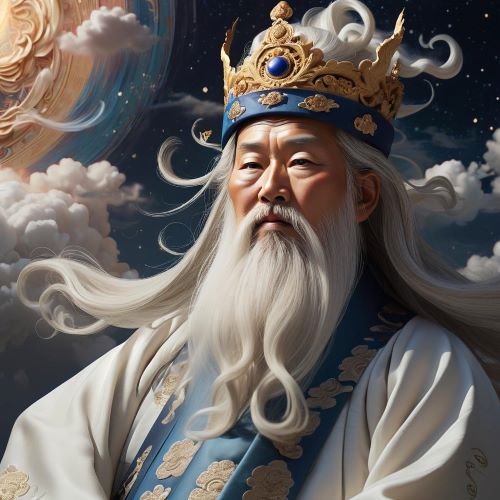
Artistic and literary depictions of Yeomna highlight both his majesty and terrifying presence. He is often portrayed seated upon a vast infernal throne, his expression severe and unyielding. His face is frequently red or darkened to convey wrathful authority, while his eyes—enlarged and penetrating—are believed to reveal the truth within any soul. In some portrayals, Yeomna appears with multiple arms holding symbolic weapons such as a staff, a noose, or scrolls documenting human deeds, echoing the iconography of Yama while incorporating Korean stylistic elements. Traditional robes, flaming backdrops, and infernal attendants reinforce the magnitude of his role. These physical traits are not merely aesthetic; they serve to intimidate the wicked and reassure the innocent that justice will be delivered without partiality.
Family
Unlike many deities who possess elaborate familial narratives, Yeomna’s myths rarely attribute to him a conventional family. Instead, he operates within an intricate bureaucratic realm of the dead, a structure that mirrors historical Korean governance systems. His closest “associates” are the underworld judges who preside over nine other courts as well as scribes, executioners, and messengers known as jeoseung saja. Among these attendants is the famous death messenger Gangnim, whose appearance in the Chasa Bonpuli epic underscores the complex relationship between mortals and the divine. Yeomna’s extended network also includes Paritegi, the shamanic guide of souls, who helps lead spirits to his court. While not a family in the biological sense, these figures form a functional spiritual hierarchy that supports Yeomna’s immense responsibility.
Other names
Across East Asia, Yeomna’s identity intersects with multiple cultural variations of the same archetypal judge. In Korean Buddhist texts, he is often referred to as Yeomra or Yeomra Daewang. His Chinese counterpart is Yanluo Wang (閻羅王), while in Indian tradition, his origins trace back to Yama, the Vedic god of death. In Japanese mythology, he emerges as Emma-Ō (閻魔大王). These variations demonstrate not only linguistic differences but centuries of cultural exchange, where the concept of a divine arbiter became universal. Despite regional distinctions, the essence remains consistent: Yeomna represents the solemn and righteous force overseeing the fate of souls.
Powers and Abilities
Yeomna’s authority encompasses every aspect of the afterlife. His most significant ability is his complete omniscience regarding human actions. Records maintained by underworld scribes—sometimes visualised as a karmic mirror called the Eopgyeongdae—allow Yeomna to discern truth from deception instantly. He assigns judgment based solely on moral conduct, ensuring fairness in the distribution of reward and punishment. Yeomna commands vast legions of spirits and executioners who carry out his decrees in the various hells, each tailored to specific moral transgressions in Buddhist cosmology. He also controls pathways of reincarnation, determining whether a soul’s next life will elevate or diminish their spiritual progress. Myths also describe Yeomna wielding supernatural tools capable of binding wandering spirits, summoning flames of purification, or testing souls with illusions during their passage along Hwangcheon Road.
Modern Day Influence
Although ancient in origin, Yeomna remains a dynamic figure in modern Korean culture. Contemporary films, dramas, and webtoons frequently reinterpret him as a stern but just cosmic administrator. The massively popular film Along with the Gods introduced elaborate depictions of underworld courts inspired by traditional beliefs, bringing Yeomna’s mythology to new generations. In gaming and manhwa, he often appears as a boss character or supernatural judge who challenges players with moral or narrative trials. Ritual traditions also preserve his presence; shamanic ceremonies occasionally invoke his authority to safeguard the dead or ensure fair passage into the afterlife. Even everyday expressions referring to “facing Yeomna” subtly acknowledge his enduring role as the ultimate moral adjudicator. Through these modern portrayals, Yeomna continues to symbolize justice, accountability, and the lasting power of myth in Korean identity.
Related Images




Source
Peterson, M. A. (2003). Korean mythology. In Wikipedia. https://en.wikipedia.org/wiki/Korean_mythology
Ghost Alley Cat Wiki. (2025). Yeomna. Fandom. https://ghostalleycat.fandom.com/wiki/Yeomna
Kim, Y. (2010). Myths and legends of Korea. Hollym International.
Lee, S. (1997). Encyclopedia of Korean folklore. Korean Studies Press.
Park, J. (2005). Underworld deities in East Asian Buddhism. Journal of Korean Religions, 12(2), 45-67.
Avid Archer. (2024, March 23). Korean mythology gods and the first kingdom. Retrieved from https://avid-archer.com/korean-mythology-gods-and-folklore/
Grayson, J. H. (2002). Korea: A religious history. Routledge.
Choi, G. J. (2014). Myths of Korea: An introduction to Korean mythology. Seoul: Hollym International.
Kendall, L. (1985). Shamans, housewives, and other restless spirits: Women in Korean ritual life. University of Hawaii Press.
Kim, T. H. (2010). Buddhism and Korean culture: The role of Yeomna in afterlife beliefs. Journal of Korean Studies, 15(2), 45–67.
Yu, H. (2018). Mythological figures in Korean popular culture: From Yeomna to modern cinema. East Asian Cultural Review, 22(3), 112–130
Frequently Asked Questions
Who is Yeomna in Korean mythology?
Yeomna is the Korean King of the Underworld responsible for judging the souls of the dead and determining their fate based on their lifetime deeds.
Is Yeomna the same as Yama?
Yeomna originates from the same archetype as Yama in Indian and Chinese traditions, but Korean culture shaped him into a distinct deity with unique attributes and mythology.
What powers does Yeomna have?
He possesses omniscient knowledge of human actions, commands underworld spirits, controls reincarnation, and delivers karmic judgment.
How is Yeomna depicted in Korean art?
He is usually shown with a stern expression, dark or red skin, and traditional robes while seated on a throne surrounded by underworld attendants.
Does Yeomna appear in modern Korean media?
Yes, Yeomna frequently appears in films, dramas, webtoons, and games, especially in stories involving the afterlife or themes of moral judgment.