

Mylitta : The Mesopotamian Goddess Behind the Greek Name
Listen
At a glance
| Description | |
|---|---|
| Origin | Mesopotamian Mythology |
| Classification | Gods |
| Family Members | Enlil, Ninlil, Ashur, Nanna, Ereshkigal |
| Region | Iraq |
| Associated With | Love, Fertility, Sexuality, War |
The Mythlok Perspective
From the Mythlok perspective, Mylitta is not a lost goddess but a mirror held up by history. She shows how myth transforms when viewed from the outside, reshaped by translation, misunderstanding, and cultural comparison. What Greeks called Mylitta was a simplification of a far older and more complex power. Across cultures, similar patterns emerge. Like Aphrodite in Greece or Hathor in Egypt, the goddess behind Mylitta embodies love while quietly carrying the weight of cosmic order. Yet unlike her Mediterranean counterparts, she never lost her darker edge. In Mesopotamia, desire and destruction were never separated, reminding us that creation and collapse share the same source.
Mylitta
Introduction
Mylitta is a name preserved almost entirely through outsiders’ eyes. The Greek historian Herodotus records Mylitta as the Assyrian name for Aphrodite, describing her worship in Babylon and associating her with fertility, sexuality, and generative power. Modern scholarship agrees that Mylitta was not an independent goddess with a distinct mythology, but a Greek rendering of major Mesopotamian goddesses already central to Near Eastern religion. Most identifications connect her to Ishtar, the Akkadian and Assyrian goddess of love and war, and to her earlier Sumerian form Inanna.
The name “Mylitta” reflects how Greek writers translated foreign divinities into familiar terms, equating her with Aphrodite while simplifying the complexity of Mesopotamian theology. What survives under the name Mylitta is therefore a cultural lens rather than a full mythic corpus, revealing how Babylonian religion appeared to the classical world rather than how it functioned internally.
Physical Traits
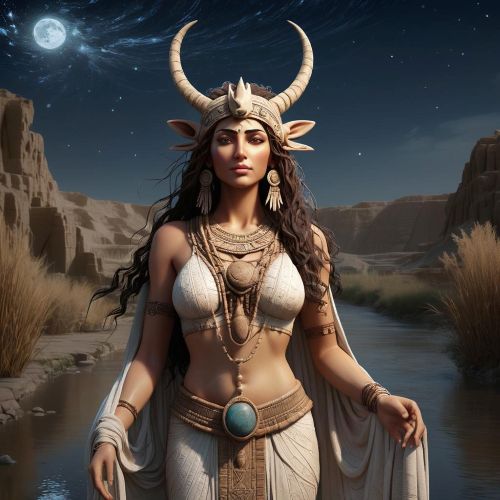
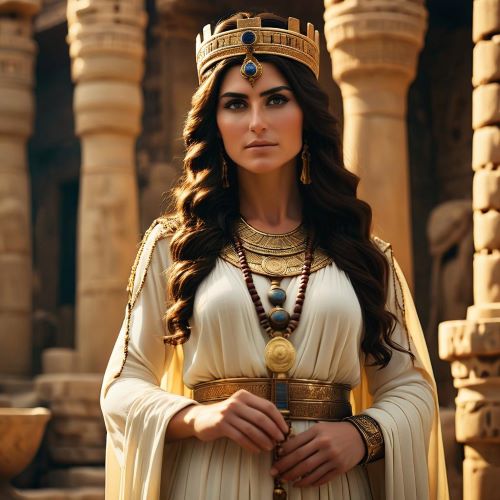
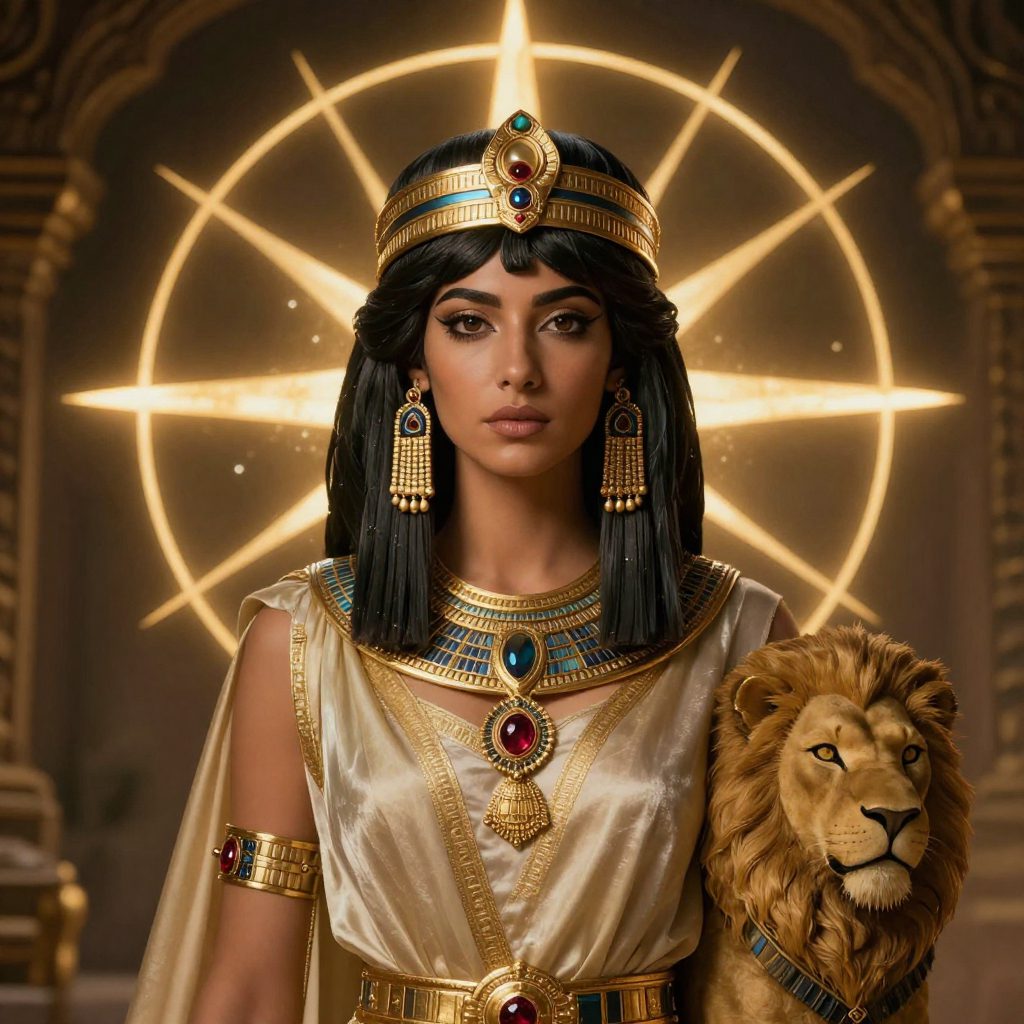
Mesopotamian religious texts rarely dwell on detailed physical descriptions, and no surviving source offers a direct portrayal of Mylitta herself. Instead, appearance was communicated through symbols and attributes. Because Mylitta is equated with Ishtar, her visual identity can be inferred rather than described. Ishtar was frequently associated with the lion, emphasizing dominance and ferocity, and with the eight-pointed star of Venus, reflecting her celestial authority. She was imagined adorned in rich garments and jewelry, signaling erotic power and divine status, yet also depicted with weapons that marked her as a goddess of battle.
This symbolic contrast is essential. The goddess behind the name Mylitta was envisioned as both alluring and dangerous, capable of inspiring desire and unleashing destruction. Her presence was felt through iconography and ritual rather than through a fixed physical form.
Family
The divine relationships associated with Mylitta shift depending on which Mesopotamian identity is emphasized. In her earliest Sumerian dimension as Inanna, she was linked to the lunar god Nanna and the goddess Ningal, placing her within a celestial family tied to time and fertility. She was also connected to Ereshkigal, ruler of the underworld, establishing a mythic tension between life and death.
In later Assyrian theology, the goddess identified as Mullissu, often equated with Mylitta, appears as the consort of Ashur, the supreme god of the Assyrian state. Some traditions merge her with Ninlil, wife of Enlil, reinforcing her role as a queenly figure within the divine hierarchy. These overlapping genealogies reflect not confusion but continuity, showing how a single goddess absorbed multiple identities across centuries and empires.
Other names
Mylitta is one name in a long chain of linguistic and cultural transformations. In Sumerian sources, she appears as Inanna. Akkadian and Assyrian traditions call her Ishtar. In formal titles she was known as Beltis or Bilit, meaning “the Lady,” a designation emphasizing authority rather than personality. The Assyrian name Mullissu further anchors her as a royal and national goddess.
Greek writers rendered these names as Mylitta, aligning her with Aphrodite and smoothing cultural differences for their audience. Related figures such as Astarte in the Levant demonstrate how her cult radiated outward, adapting to local religious frameworks while retaining core themes of fertility and power.
Powers and Abilities
The goddess identified as Mylitta embodied one of the most complex divine portfolios in the ancient world. As a fertility deity, she governed sexual desire, reproduction, and the rhythms of life that sustained cities and kingdoms. Sacred rituals dedicated to her emphasized union, abundance, and continuity.
At the same time, her identity as Ishtar granted her dominion over warfare and political power. She was invoked by kings seeking victory and protection, feared as much as she was desired. Her association with the planet Venus reinforced her role as a goddess of cycles, appearing and disappearing in the sky just as life fades and returns on earth. Myths such as the descent of Inanna into the underworld portray her as a deity who confronts death directly and returns transformed, reinforcing her authority over renewal, loss, and rebirth.
Modern Day Influence
Although the name Mylitta is rarely used outside classical scholarship, the goddess behind it remains influential. Herodotus’ account shaped how generations of Western readers imagined Babylonian religion, particularly discussions around sacred sexuality, even when those descriptions are now debated by historians.
In academic circles, Mylitta serves as a case study in religious syncretism, illustrating how divine identities evolve across languages and empires. In modern literature, art, and feminist reinterpretations, Inanna and Ishtar continue to symbolize autonomous female power, sexual agency, and resilience. Astrology still associates Venus with themes inherited from her cult, while popular culture frequently reimagines Ishtar-like figures in novels, games, and films. The survival of her archetype far outlasts the name Mylitta itself.
Related Images


Source
Biblical Cyclopedia. (n.d.). Mylitta. https://www.biblicalcyclopedia.com/M/mylitta.html
Brisch, N. (2019). Ninlil (Mulliltu, Mullissu, Mylitta) (goddess). Ancient Mesopotamian Gods and Goddesses. Oracc, University of Pennsylvania. http://oracc.museum.upenn.edu/amgg/listofdeities/ninlil/
Herodotus. (n.d.). Histories 1.199.1. Lexundria. https://lexundria.com/hdt/1.199.1/mcly
Krebernik, M. (1998-2001). Ninlil A. Philologisch. In Reallexikon der Assyriologie (Vol. 9, pp. 453-458). de Gruyter.
Black, J., & Green, A. (1992). Gods, demons and symbols of ancient Mesopotamia. British Museum Press.
Dalley, S. (1989). Myths from Mesopotamia. Oxford University Press.
George, A. R. (1993). House most high: The temples of ancient Mesopotamia. Eisenbrauns.
Hislop, A. (1853). The two Babylons.
Frequently Asked Questions
Who was Mylitta in ancient mythology?
Mylitta was the Greek name used for a major Mesopotamian goddess, most commonly identified with Ishtar or Inanna.
Is Mylitta the same as Ishtar?
Yes, most scholars agree Mylitta is a Greek transliteration referring to Ishtar, rather than a separate deity.
Why did Herodotus compare Mylitta to Aphrodite?
Greek writers often equated foreign goddesses with familiar ones, and Aphrodite best matched Ishtar’s associations with love and fertility.
Was Mylitta worshipped independently?
There is no evidence of an independent cult named Mylitta; worship was directed to Ishtar, Inanna, or Mullissu under local names.
What is Mylitta’s significance today?
Mylitta helps scholars understand how ancient religions were interpreted across cultures and how divine identities evolved through translation.