Milu : The Hawaiian Deity of the Underworld
Listen
At a glance
| Description | |
|---|---|
| Origin | Hawaiian Mythology |
| Classification | Gods |
| Family Members | N/A |
| Region | Hawaii |
| Associated With | Afterlife, Underworld |
The Mythlok Perspective
Milu represents an underworld philosophy built on stillness rather than fire. Unlike cultures that weaponize death through fear, Hawaiian tradition frames the afterlife as consequence without cruelty. Milu does not punish, he contains. Across cultures, underworld rulers often enforce morality through suffering, but Milu reflects an elemental truth instead. Stagnation, forgetfulness, and disconnection are the true costs of imbalance. In this sense, Milu feels closer to nature itself, indifferent, enduring, and shaped by what humans leave behind.
Milu
Introduction
Milu occupies a distinctive and often misunderstood position in Hawaiian belief systems. Known as the ruler of Lua-o-Milu, the Hawaiian underworld, he presides over a realm that reflects Polynesian ideas of death not as punishment, but as transition. In traditional Hawaiian thought, the afterlife was not framed as moral judgment in the later Abrahamic sense. Instead, it was a continuation of existence in another state, governed by rules, hierarchy, and consequence.
Unlike fiery hells or reward-based heavens, Lua-o-Milu is described as dim, cool, and shadowed, a place where spirits linger rather than suffer. Milu’s authority is absolute within this domain, yet his role is not purely malevolent. Oral traditions suggest that he was once human, a powerful aliʻi whose actions in life shaped his fate after death. This origin reinforces a recurring Hawaiian theme: spiritual authority is earned through conduct, not birth alone. Through Milu, Hawaiian cosmology expresses the belief that imbalance, cruelty, or misuse of power inevitably reshapes one’s destiny beyond death.
Physical Traits
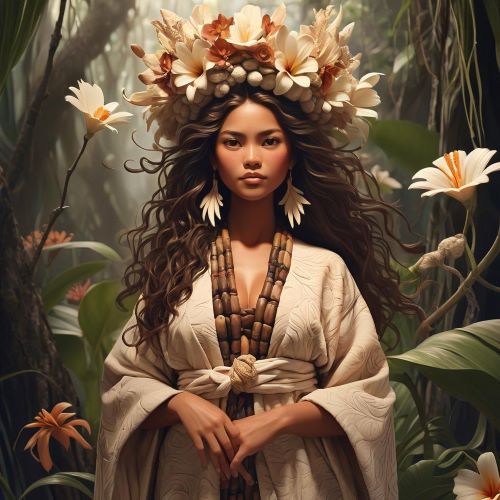
Descriptions of Milu’s appearance vary widely across chants and oral accounts, reflecting the fluid nature of Hawaiian storytelling rather than a fixed iconography. He is most often portrayed as a shadowy humanoid figure, tall and imposing, with a presence that feels cold and heavy rather than violently threatening. Some traditions describe him with pale or decaying features, white hair, and a long bluish-black nose, emphasizing the visual language of death and stagnation rather than monstrous aggression.
Milu is frequently said to appear indistinct, as though partially dissolved into mist or darkness. This lack of a solid form reinforces his connection to the unseen world and his ability to move freely between physical and spiritual boundaries. His appearance is not meant to inspire worship through beauty, but recognition through unease. In Hawaiian symbolism, what unsettles often teaches, and Milu’s form reflects the discomfort humans feel when confronted with mortality itself.
Family
Unlike many Hawaiian deities whose genealogies stretch across heavens, oceans, and volcanoes, Milu stands largely alone. Traditional sources do not assign him a spouse, offspring, or divine lineage in the conventional sense. This absence is significant rather than accidental. Milu’s isolation reflects his role as ruler of a realm separated from life, warmth, and growth.
Some legends suggest that Milu was once a mortal chief whose cruelty or dishonorable leadership caused him to descend into Lua-o-Milu after death, where he eventually became its ruler. This narrative removes him from divine family networks and instead frames him as a cautionary figure shaped by personal choice. While he commands spirit catchers and lesser entities within the underworld, these beings function as extensions of his authority rather than familial relations. His solitude reinforces the Hawaiian idea that death ultimately strips away status, leaving only consequence.
Other names
Milu is primarily known by his singular name, which becomes inseparable from his domain. Lua-o-Milu, meaning “the pit of Milu,” is both a place and an extension of his identity. In some chants and regional variations, the underworld itself is simply called Milu, blurring the boundary between ruler and realm.
It is important to distinguish the Hawaiian Milu from similarly named figures elsewhere in Polynesia. In Māori and Cook Islands traditions, a deity named Miru appears as a female underworld figure with different attributes and narratives. While linguistic similarities suggest shared ancestral roots, these beings are culturally distinct and should not be merged. Hawaiian Milu remains uniquely tied to island concepts of spiritual consequence, volcanic geography, and ancestral memory.
Powers and Abilities
Milu’s authority centers on governance rather than conquest. As ruler of Lua-o-Milu, he controls the movement, containment, and experience of souls after death. Spirits who wander too close to the world of the living are captured by his spirit catchers and returned to his realm, ensuring that boundaries between worlds remain intact.
Legends describe Lua-o-Milu as a place of distraction where spirits gamble, play games, and lose awareness of time. This reflects Milu’s most subtle power: not torment, but entrapment through stagnation. Souls forget their former lives, slowly dissolving into the underworld’s shadowed rhythm. In one famous tale, a living chief infiltrates Milu’s realm and temporarily blinds him, suggesting that even death’s ruler is not omnipotent. Yet Milu’s authority is ultimately restored, reinforcing the inevitability of the afterlife’s order.
Milu is also associated with dreams and visions, appearing as an omen rather than an active hunter of the living. His power lies in reminding humans that life is temporary and that imbalance carries lasting spiritual weight.
Modern Day Influence
Milu remains a powerful symbolic presence in contemporary Hawaiian cultural discourse, particularly in discussions surrounding ancestral respect, death rituals, and ecological balance. He appears in modern storytelling, visual art, tattoos, and educational media that explore pre-colonial Hawaiian belief systems. Rather than being framed as a villain, Milu is increasingly understood as a representation of consequence and restraint.
In digital folklore spaces, Milu is often compared to underworld rulers from other cultures, yet Hawaiian scholars emphasize his neutrality rather than cruelty. As climate change reshapes volcanic landscapes and burial traditions, Milu’s association with land, caves, and spiritual thresholds has gained renewed relevance. His mythology continues to inform how Hawaiians conceptualize death as a continuation tied to place, ancestry, and responsibility rather than moral reward or punishment.
Related Images

Source
Beckwith, M. (1970). Hawaiian mythology. University of Hawaii Press. (Original work published 1915).
Nogelmeier, M. P. (2003). *The epic of Hiiakaikīkēikī i ka wehi o ke koko: A translation of the Hawaiian chant. *ScholarSpace, University of Hawai’i at Mānoa. https://scholarspace.manoa.hawaii.edu/bitstreams/5010f4c1-a66d-4036-91b1-314449e18c2e/download.
Pōmaikaʻi Elementary School. (2018). Local learning. Journal of Folklore and Education, 5. https://jfepublications.org/wp-content/uploads/2018/09/Complete-2018-JFE-v.5.pdf.
Westervelt, W. D. (1915). Hawaiian legends of ghosts and ghost-gods. Sacred Texts. http://sacred-texts.com/pac/hm/hm12.htm.
Wikipedia contributors. (2020, April 9). Milu (mythology). In Wikipedia. https://en.wikipedia.org/wiki/Milu_(mythology).[3]
GhostAlleyCat Wiki. (2025). Milu. Fandom. https://ghostalleycat.fandom.com/wiki/Milu.
Malo, D. (1951). Hawaiian antiquities (Moolelo Hawaii). Honolulu: Bishop Museum Press.
Valeri, V. (1985). Kingship and sacrifice: Ritual and society in ancient Hawaii. Chicago: University of Chicago Press.
Kanahele, G. S. (1992). Ku Kanaka: Stand tall, a search for Hawaiian values. Honolulu: University of Hawaii Press.
Frequently Asked Questions
Who is Milu in Hawaiian belief?
Milu is the ruler of the Hawaiian underworld, Lua-o-Milu, governing the realm where spirits reside after death.
Is Milu considered evil?
No, Milu is not a figure of punishment but of consequence, reflecting Hawaiian views of death as transition rather than torment.
Was Milu once human?
Some traditions suggest Milu was originally a powerful chief whose actions in life shaped his role in the afterlife.
What is Lua-o-Milu?
Lua-o-Milu is the Hawaiian underworld, a shadowed realm where spirits linger in a state of detachment from the living world.
Is Milu related to other Polynesian underworld gods?
While similar names exist across Polynesia, Hawaiian Milu is culturally distinct and should not be directly equated with figures like Miru.