

Kasa-Obake : The Umbrella Spirit of Japanese Folklore
Listen
At a glance
| Description | |
|---|---|
| Origin | Japanese Mythology |
| Classification | Spirits |
| Family Members | N/A |
| Region | Japan |
| Associated With | Mischief, Surprise |
Kasa-Obake
Introduction
Among the many eccentric beings found in Japanese folklore, the Kasa-Obake occupies a unique space between humor and unease. Often translated as the “umbrella ghost,” this yōkai reflects a deeply rooted Japanese worldview in which even ordinary objects can possess spiritual essence. The Kasa-Obake belongs to a broader folkloric idea associated with tsukumogami, objects that gain awareness after long use or neglect, though early sources suggest its classification emerged later through artistic convention rather than ancient scripture. Popularized during the Edo period, the Kasa-Obake became a visual shorthand for playful supernatural mischief, appearing more often in illustrated scrolls, games, and urban legends than in structured mythic narratives. Its enduring appeal lies in how it transforms a mundane household item into something watchful, animated, and faintly unsettling, reminding people that nothing is ever entirely lifeless.
Physical Traits
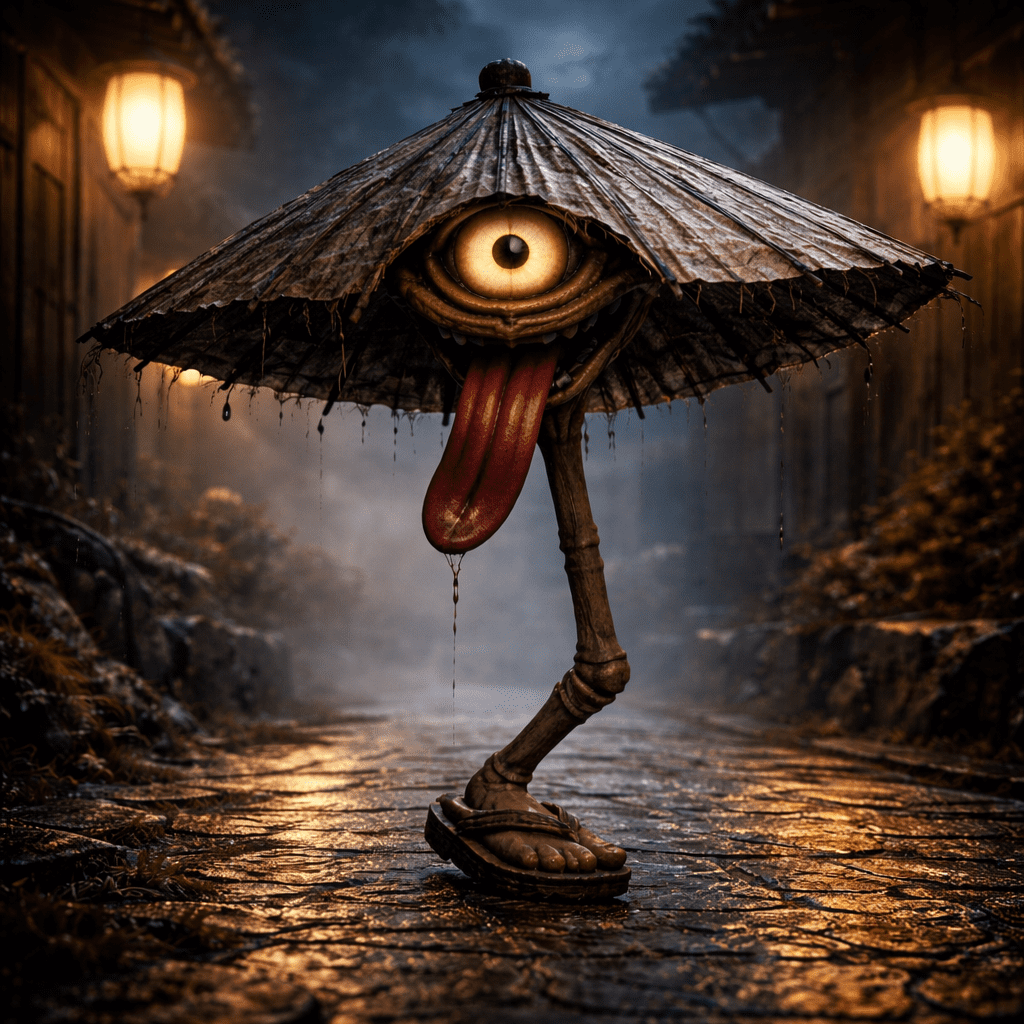
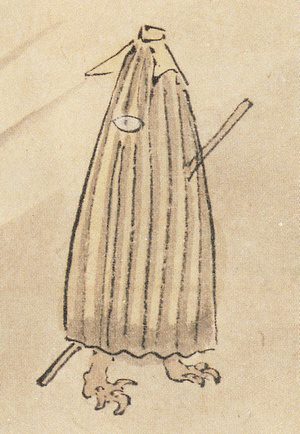
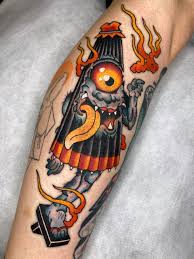
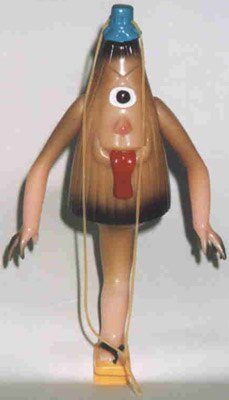
The appearance of the Kasa-Obake is instantly recognizable and deliberately exaggerated. It is most commonly depicted as an aged wagasa, a traditional Japanese paper umbrella, weathered and bent with time. From the canopy peers a single oversized eye, giving the impression of constant awareness. A long tongue often hangs loosely from beneath the umbrella’s edge, enhancing its absurd and slightly grotesque charm. Instead of a handle touching the ground, the Kasa-Obake balances on a single leg, frequently shown wearing a wooden sandal, allowing it to hop rather than walk. While earlier artworks sometimes portrayed umbrella spirits with multiple limbs or more humanoid traits, Edo-period yōkai artists such as Toriyama Sekien helped standardize the now-iconic one-eyed, one-legged form. The result is a creature that feels comical at first glance yet oddly unsettling when imagined in a dark, empty street.
Family
The Kasa-Obake does not belong to a divine lineage, heroic genealogy, or spiritual hierarchy in the conventional sense. Instead, it exists within a loose collective of animated objects that populate Japanese folklore. These beings are often grouped under the umbrella of tsukumogami, alongside entities such as haunted sandals, possessed lanterns, and musical instruments that gained awareness through age and abandonment. Rather than sharing blood relations, these spirits are connected through a shared symbolic function. They embody the belief that objects treated carelessly may develop resentment or agency of their own. In this sense, the Kasa-Obake’s “family” is philosophical rather than literal, representing a worldview where respect for possessions mirrors respect for unseen spiritual forces.
Other names
Across regions and artistic traditions, the Kasa-Obake appears under several related names. Karakasa-Obake emphasizes the style of umbrella commonly depicted, while Kasa-bake functions as a shortened, colloquial variation. Another well-known name, Karakasa-kozō, translates roughly to “umbrella boy,” a term that highlights its impish and childlike behavior rather than its ghostly nature. These naming variations reflect the flexible and localized nature of yōkai lore, where identity often shifts depending on storyteller, medium, and audience. Rather than indicating entirely separate beings, these names represent different interpretations of the same core concept.
Powers and Abilities
The Kasa-Obake is not a creature of violence or destruction. Its abilities are subtle and rooted in surprise rather than force. Most tales describe it hopping silently through deserted streets or appearing suddenly behind lone travelers, startling them with its sudden movement or dangling tongue. It is often associated with mild illusions and uncanny appearances, vanishing as abruptly as it arrives. In folklore, its actions rarely cause harm and instead serve to unsettle or amuse. Symbolically, its greatest “power” lies in what it represents: the idea that neglect breeds unrest. Whether or not it is formally treated as a tsukumogami in early sources, later traditions use the Kasa-Obake as a reminder that objects discarded without thought may return in unexpected ways, transformed by time and resentment into something uncanny.
Modern Day Influence
In modern Japan, the Kasa-Obake has evolved from folklore curiosity into a widely recognized cultural icon. It appears frequently in manga, anime, and video games, often portrayed as harmless, comedic, or even endearing. Series such as GeGeGe no Kitarō helped introduce the character to younger audiences, while games like Touhou Project reimagined umbrella yōkai as fully developed personalities. Beyond entertainment, the Kasa-Obake has found a place in merchandise, festival imagery, and educational materials exploring traditional folklore. In contemporary interpretations, it is sometimes linked to themes of sustainability and mindful consumption, reinforcing the old idea that objects deserve care and respect. Through these adaptations, the Kasa-Obake continues to bridge the gap between historical belief and modern creativity.
Related Images

Source
Foster, M. D. (2015). The book of yokai: Mysterious creatures of Japanese folklore. University of California Press.
Seki, K. (1963). Folktales of Japan. University of Chicago Press.
Toriyama, S. (1776). Gazu hyakki yagyō. (Original ukiyo-e series on yokai).
Yokai.com. (n.d.). Karakasa-obake. Retrieved December 19, 2025, from https://yokai.com/karakasa/
Wikipedia. (2025). Kasa-obake. Retrieved December 19, 2025, from https://en.wikipedia.org/wiki/Kasa-obake
Modern Tokyo Times. (2016, February 29). Art and folklore of Japan: Mischievous nature of the one-legged umbrella ghost. Retrieved from https://moderntokyotimes.com/art-and-folklore-of-japan-mischievous-nature-of-the-one-legged-umbrella-ghost/
The Japan Box. (n.d.). Kasa-obake. Retrieved December 19, 2025, from https://thejapanbox.com/blogs/japanese-mythology/kasa-obake
Snyman, M. (2025, June 13). Meet the Kasa-Obake, Japan’s forgotten folklore freak. Retrieved from https://moniquesnyman.com/kasa-obake-japans-forgotten-folklore-freak/
Komatsu, K. (1994). An introduction to yōkai culture: Monsters, ghosts, and mysterious creatures in Japanese tradition. International House of Japan.
Mizuki, S. (2003). Yōkai encyclopedia. Tokyo: Kodansha.
Reider, N. T. (2010). Japanese demon lore: Oni from ancient times to the present. Utah State University Press.
Yoda, H., & Alt, M. (2013). Yōkai attack! The Japanese monster survival guide. Tokyo: Tuttle Publishing.
Frequently Asked Questions
What is Kasa-Obake in Japanese folklore?
Kasa-Obake is a yōkai often depicted as a living umbrella, associated with playful mischief rather than danger.
Is Kasa-Obake a tsukumogami?
It is commonly classified as one in later folklore, though early sources suggest the association developed through artistic tradition.
Is Kasa-Obake evil?
No, it is generally portrayed as mischievous and harmless, designed to startle rather than injure.
When did Kasa-Obake become popular?
It gained prominence during Japan’s Edo period through illustrated scrolls, games, and urban storytelling.
Why is Kasa-Obake important in folklore?
It symbolizes respect for everyday objects and reflects animistic beliefs embedded in Japanese cultural thought.