
Kane Milohai : The Hawaiian Deity of Land and Balance
Listen
At a glance
| Description | |
|---|---|
| Origin | Hawaiian Mythology |
| Classification | Gods |
| Family Members | Pele, Hiʻiaka, Kāmohoaliʻi, Nāmaka (Siblings), Haumea (Mother) |
| Region | Hawaii |
| Associated With | Land, Stability, Balance, Guardianship |
The Mythlok Perspective
Kane Milohai is not a god of command but of endurance. Within the Mythlok framework, he represents land as consciousness rather than territory, an elemental force that absorbs upheaval without surrendering form. Unlike fire deities such as Pele, who transform through eruption, or sea beings like Kāmohoaliʻi, who act through movement, Kane Milohai persists through stillness. Comparable to earth-bound figures in other cultures, he affirms that stability itself is an active and sustaining power.
Kane Milohai
Introduction
Kane Milohai, sometimes rendered as Kāne Milohai or Kāne-milo-haʻi, is a lesser-known but symbolically important figure within Hawaiian oral tradition. He does not belong to the four supreme gods of the Hawaiian pantheon, yet his presence is firmly embedded in the cycle of myths surrounding Pele and her divine siblings. Kane Milohai is remembered primarily as a terrestrial guardian, a figure associated with land, boundaries, and stability during periods of divine migration and upheaval.
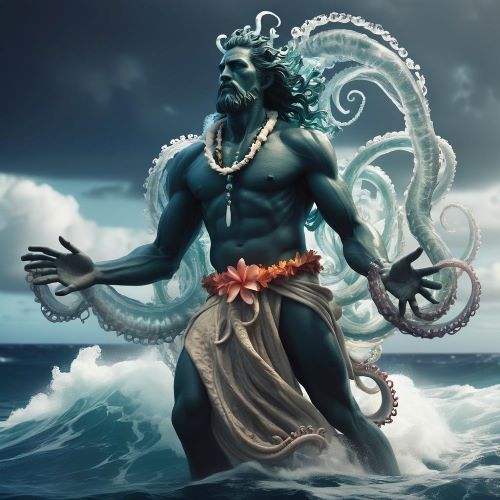
Within the Pele narratives, he appears as a counterpart to his oceanic brother Kāmohoaliʻi, the shark god. While Kāmohoaliʻi governs movement, passage, and protection across the sea, Kane Milohai represents the anchoring force of land itself. His role highlights a central Hawaiian cosmological principle: creation is not driven by a single dominant power but by the balance between elemental domains. Through Kane Milohai, land is not passive terrain but an active, conscious presence within the mythic world.
Physical Traits
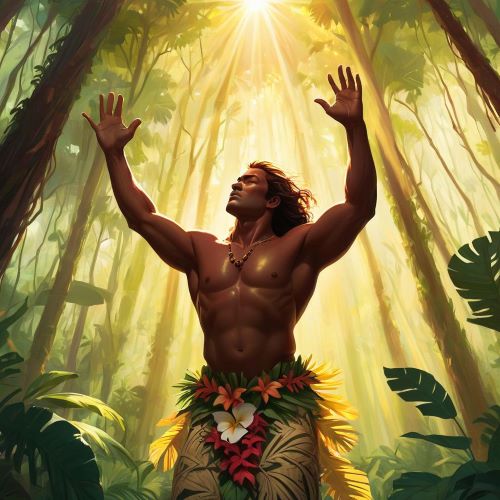
Hawaiian mythology rarely offers fixed or anatomical descriptions of its deities, and Kane Milohai is no exception. Rather than appearing as a consistently anthropomorphic figure, he is understood through the qualities of the land he represents. His presence is inferred through firmness, endurance, and immovability rather than visual spectacle.
When imagined in human form, Kane Milohai is generally envisioned as grounded and powerful, embodying the physical resilience of volcanic rock and island soil. Unlike gods associated with transformation or speed, his character suggests stillness and weight. This absence of dramatic physical description is itself meaningful, reinforcing his association with permanence rather than motion. In contrast to the fluidity of sea gods or the volatility of fire deities, Kane Milohai reflects the quiet authority of land that endures long after storms and eruptions have passed.
Family
Kane Milohai belongs to the complex divine family surrounding Pele, one of the most influential myth cycles in Hawaiian tradition. He is counted among the children of Haumea, the primordial mother goddess associated with fertility, childbirth, and the generative power of the earth. His siblings include Pele, the volcano goddess; Hiʻiaka, the goddess of chant, hula, and healing; Kapo, associated with fertility and sorcery; Nāmaka, the sea goddess; and Kāmohoaliʻi, the shark god and navigator.
This familial structure is essential to understanding Kane Milohai’s role. He does not operate independently but exists as part of an interconnected system of forces. As Pele reshapes the islands through volcanic fire and Kāmohoaliʻi guides movement across the ocean, Kane Milohai remains linked to the land that receives, absorbs, and ultimately stabilizes these changes. His presence within the family reinforces the Hawaiian view that creation emerges through relational balance rather than domination.
Other names
The name Kane Milohai has occasionally led to confusion with Kāne, one of the four major Hawaiian gods associated with life, freshwater, and creation. Despite the shared element “Kane,” the two figures are not identical. In Hawaiian language and oral tradition, names often function as titles or descriptors rather than rigid personal identities, which contributes to later misunderstandings.
Some traditions shorten his name to Milohai, emphasizing his distinct role apart from the broader Kāne archetype. Linguistically, his name is often interpreted as referring to movement or disturbance of land, reinforcing his association with terrestrial forces. These variations reflect the fluid nature of oral storytelling, where meaning is preserved through function rather than standardized naming.
Powers and Abilities
Kane Milohai’s abilities are defined by restraint rather than spectacle. He is not portrayed as a god who reshapes the world through dramatic acts but as one who ensures continuity amid disruption. His power lies in grounding, guarding, and maintaining balance as other deities bring change.
Within Pele’s migration narratives, Kane Milohai often appears as a stabilizing presence during periods of volcanic destruction and familial conflict. While Pele’s fire transforms landscapes and Kāmohoaliʻi navigates dangerous seas, Kane Milohai embodies the land’s capacity to endure transformation without losing its identity. His powers can be understood as ecological and cosmological rather than martial, reinforcing the Hawaiian emphasis on harmony between natural forces.
Modern Day Influence
Kane Milohai is not widely invoked in contemporary religious practice, yet his symbolic relevance persists within Hawaiian cultural consciousness. His association with land resonates strongly in modern discussions around environmental stewardship, land rights, and cultural preservation. In this sense, Kane Milohai has gained renewed relevance as a mythic representation of the land as sacred and sentient.
In cultural revitalization efforts, figures like Kane Milohai contribute to a broader understanding of Hawaiian spirituality that extends beyond the most prominent gods. Through chant, storytelling, and academic study, his role continues to support a worldview that emphasizes balance between land, sea, and fire. His quiet presence within myth reinforces the idea that stability is not passive but essential to survival.
Related Images


Source
Beckwith, M. (1970). Hawaiian mythology. University of Hawaii Press. (Original work published 1940)
Emerson, N. B. (1915). Pele and Hiiaka: A myth from Hawaii. Honolulu Star-Bulletin.
Kalakaua, D. (1888). The legends and myths of Hawaii. C. E. Tuttle Co.
Kamakau, S. M. (1991). Ka poe kahiko: The people of old (D. Malo, Trans.). Bishop Museum Press.
Pukui, M. K., E. W. Haertig, & C. A. Lee. (1972). Nānā i ke kumu (Vol. 1). Hui Hānai.
Wikipedia. (2023). Kāne Milohaʻi. https://en.wikipedia.org/wiki/K%C4%81ne_Miloha%CA%BBi
Westervelt, W. D. (1916). Legends of volcanoes in Hawaii. G. H. Hitchcock.
Makana Hut. (2024). More about Hawaiian tiki gods. https://makanahut.com/pages/new-site-makana-hut-about-tiki-gods
Frequently Asked Questions
Who is Kane Milohai in Hawaiian tradition?
Kane Milohai is a lesser-known figure in Hawaiian oral tradition associated with land, balance, and stability. He appears primarily within the Pele family cycle and should not be confused with the major creator god Kāne.
Is Kane Milohai the same as Kāne?
No, Kane Milohai is a distinct deity and not one of the four major Hawaiian gods. While the similarity in names has caused confusion, Kane Milohai has a separate lineage and role focused on terrestrial balance rather than creation.
What is Kane Milohai associated with?
Kane Milohai is linked to land, grounding forces, endurance, and ecological stability. His role reflects the land’s ability to absorb transformation caused by volcanic fire and oceanic movement without losing continuity.
Is Kane Milohai related to Pele?
Yes, Kane Milohai is traditionally described as one of Pele’s divine siblings. Both are children of the earth goddess Haumea, placing him within the central family narrative of Hawaiian cosmology.
Is Kane Milohai worshipped today?
Kane Milohai is not widely worshipped in modern religious practice. However, he remains symbolically significant in cultural storytelling, environmental thought, and interpretations of land as sacred and living.