
Dullahan : The Irish Headless Rider of Death
Listen
At a glance
| Description | |
|---|---|
| Origin | Irish Mythology |
| Classification | Spirits |
| Family Members | N/A |
| Region | Ireland |
| Associated With | Death omens, Decapitation, Fate, Soul collection |
The Mythlok Perspective
From the Mythlok perspective, the Dullahan represents death stripped of ceremony or judgment. It does not weigh morality, heroism, or guilt. It arrives, names, and departs. This makes it fundamentally different from divine death figures who rule underworlds or guide souls. The Dullahan does not rule death; it announces it. Across cultures, similar figures emerge in different forms. The Dullahan mirrors the Norse Valkyrie in function but lacks honor or selection, and it contrasts with the Grim Reaper by offering no guidance beyond the moment of naming. In this way, Irish folklore presents death as something profoundly impersonal, a force that moves through the land like the wind, unseen until it is already too late.
Dullahan
Introduction
The Dullahan stands among the most chilling figures in Irish folklore, recognized instantly as a headless rider who moves through the night as an unmistakable omen of death. Known in Irish as Dubhlachan or dúlachán, this spectral being is neither a god nor a ghost in the conventional sense, but a malevolent fairy entity whose arrival signals an unavoidable end. Unlike many supernatural figures who can be tricked, bargained with, or warded off, the Dullahan represents finality. Once it appears, fate has already been decided.
The earliest detailed written accounts of the Dullahan emerge in the nineteenth century, particularly in the folklore collections of Thomas Crofton Croker. However, the creature itself almost certainly predates these texts, existing long before in Irish oral tradition. Scholars generally agree that the Dullahan reflects deep-rooted Celtic beliefs surrounding death, decapitation, and the soul’s residence within the human head. This belief helps explain why one of Ireland’s most feared death spirits is defined not by a skull mask or shadowy face, but by the horrifying absence of a head altogether.
Physical Traits
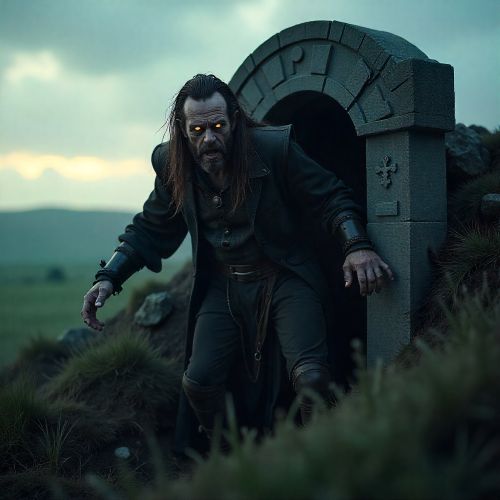
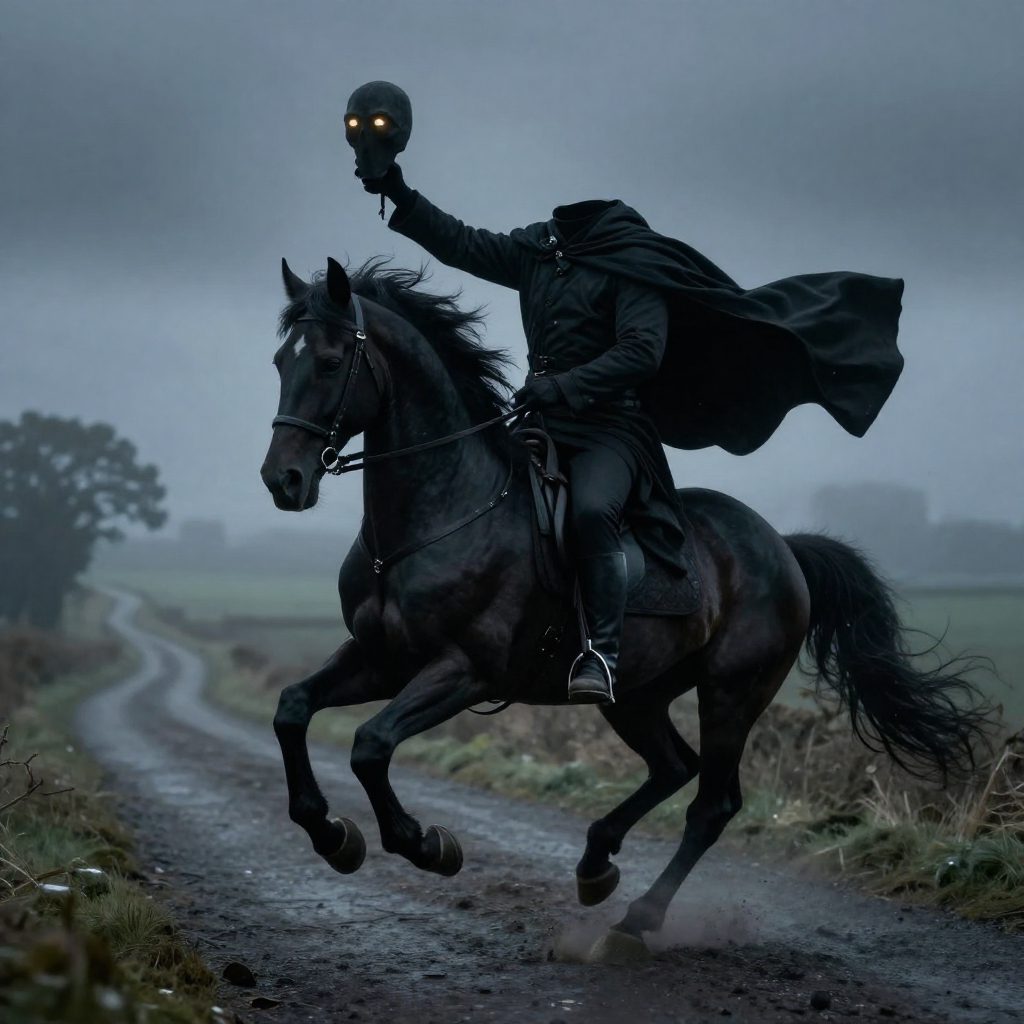
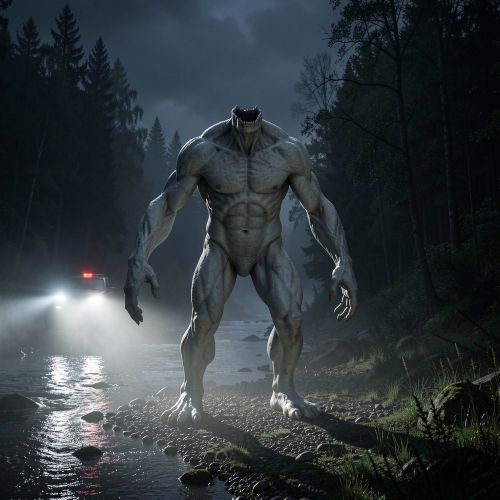
The Dullahan’s appearance is designed to disturb on every possible level. Its defining feature is, of course, its missing head, which it carries casually under one arm while riding a powerful black horse through rural roads and burial grounds. The severed head is far from lifeless. Folklore consistently describes it as grotesquely animated, with eyes that dart restlessly and a mouth stretched into a corpse-like grin that exposes sharp, predatory teeth.
Descriptions often emphasize decay rather than blood. The skin of the head is said to resemble moldy or curdled cheese in both texture and color, giving it a sickly, unnatural pallor. The eyes glow or flicker as if lit from within, suggesting an intelligence that sees far more than mortal sight allows. In some regional traditions, the Dullahan’s body is cloaked in black, its garments whipping violently in the wind as it rides.
In certain tellings, the Dullahan does not ride alone but drives the Cóiste Bodhar, a death coach assembled from coffins, bones, and funerary remnants. This coach is soundless, its approach felt rather than heard, reinforcing the idea that death does not announce itself loudly but arrives with dreadful certainty.
Family
Unlike many figures in Irish tradition, the Dullahan exists without lineage. It has no parents, no offspring, and no clearly defined kinship ties. This absence of family separates it from mythological groups such as the Tuatha Dé Danann, whose identities are deeply rooted in genealogy and succession.
The Dullahan instead functions as a solitary agent of death, more force than individual. Some scholars have proposed that it may represent a degraded or folklorized remnant of earlier sacrificial deities, particularly Crom Dubh, a dark figure associated with harvest rites and decapitation. Whether or not this connection is direct, the Dullahan’s lack of family reinforces its symbolic role as death itself rather than a personality with relationships or loyalties.
Other names
The name Dullahan originates from the Irish Dubhlachan, a term associated with darkness, anger, and malicious intent. Variations such as Dulachan and Durrachan appear across regions, reflecting dialect shifts rather than separate beings. Another common designation is Colainn Gan Cheann, meaning “body without a head,” a blunt description that leaves little to the imagination.
In English retellings, the Dullahan is frequently labeled the Headless Horseman, a title that has helped the figure migrate beyond Ireland into global folklore. In some later traditions, advanced or especially powerful Dullahans are associated with the Death Coach itself, blurring the line between rider and vehicle as a single manifestation of doom.
Powers and Abilities
The Dullahan’s power lies not in battle or magic spells, but in inevitability. It rides out at night, often on specific feast days, stopping only once during its journey. When it halts, it speaks a single name aloud. That utterance alone is enough to seal the fate of the person named. There is no escape, no intervention, and no reversal.
Despite its headless body, the Dullahan sees perfectly by holding its severed head aloft, scanning the countryside for those whose time has come. Those who dare to look upon it risk immediate punishment. Folklore warns that witnesses may be struck blind, either by a whip fashioned from a human spine or by a splash of blood hurled directly into their eyes.
One rare weakness offers slight protection. Gold, even in small amounts, is said to repel the Dullahan temporarily. A single coin dropped in its path can cause it to recoil, though this defense works only if the individual is not the intended victim. The implication is clear: gold may distract death, but it cannot deny destiny.
Modern Day Influence
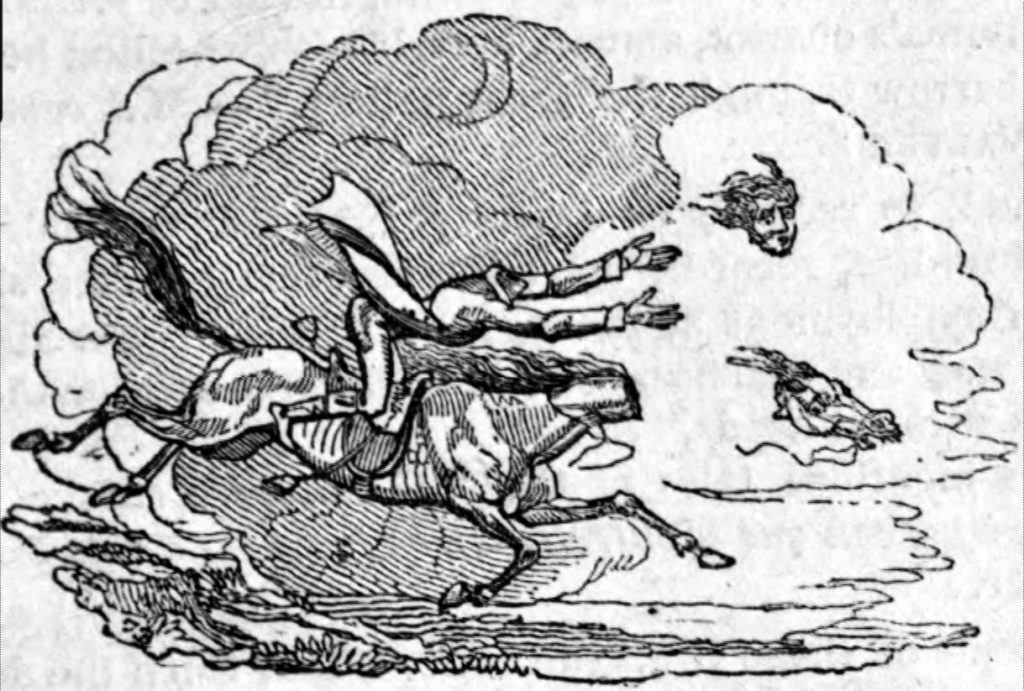
The Dullahan’s legacy extends far beyond Ireland. Its most famous descendant appears in The Legend of Sleepy Hollow by Washington Irving, where the headless horseman becomes an American folk icon. While Irving relocated the story to New York and altered its themes, the core imagery remains unmistakably Celtic.
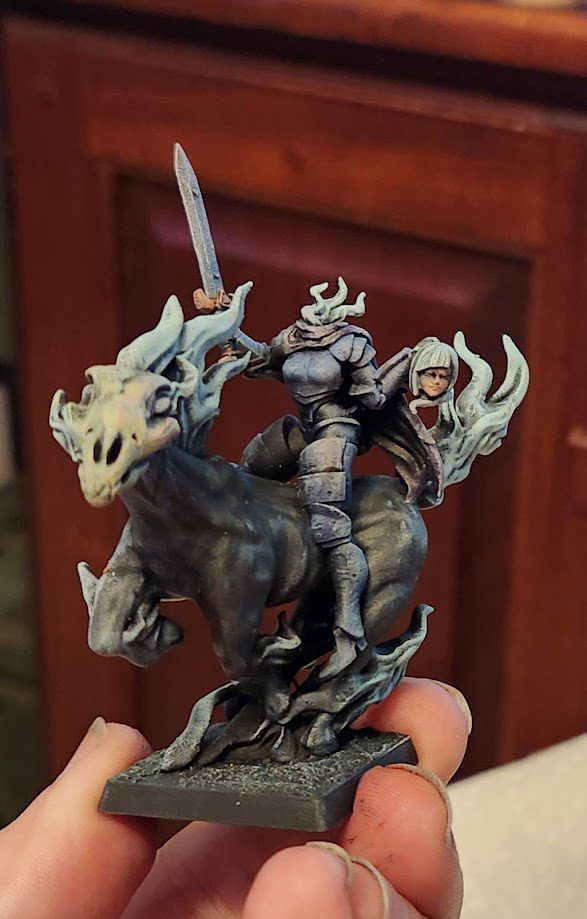
German folklore also preserves headless riders who announce death with horns or spectral hunts, suggesting shared Indo-European roots. In modern media, the Dullahan frequently appears in fantasy novels, anime, and video games, often reimagined as an undead knight or grim enforcer. Despite these adaptations, its original function remains intact: a reminder that death is impartial, silent, and unstoppable.
Related Images
Source
Croker, T. C. (1828). Fairy legends and traditions of the South of Ireland. Project Gutenberg.
https://www.gutenberg.org/files/39752/39752-h/39752-h.htm
Ó hÓgáin, D. (2006). The lore of Ireland: An encyclopaedia of myth, legend & art. University of Oklahoma Press.
Yeats, W. B. (1888). Fairy and folk tales of the Irish peasantry. Walter Scott.
Monsters Anthology. (2024). Dullahan. https://mythosanthology.com/dullahan/
Powerlisting Fandom. (2025). Dullahan physiology. https://powerlisting.fandom.com/wiki/Dullahan_Physiology
The Irish Place. (2019). The Dullahan of Celtic mythology. https://www.theirishplace.com/heritage/the-dullahan/
Wikipedia. (2026). Dullahan. https://en.wikipedia.org/wiki/Dullahan
Irish Myths. (2021). Did the Dullahan, the Irish Headless Horseman, really exist https://irishmyths.com/2021/09/22/headless-horseman-history/
Frequently Asked Questions
Is the Dullahan evil or just a death messenger?
The Dullahan is not purely evil but functions as a merciless harbinger of death, carrying out fate rather than personal malice.
Can the Dullahan be stopped?
Folklore suggests it cannot be stopped, though gold may temporarily repel it if the observer is not its chosen victim.
Is the Dullahan a ghost or a fairy?
The Dullahan is traditionally classified as an unseelie fairy rather than a ghost or undead spirit.
Why is the Dullahan headless?
This reflects ancient Irish beliefs that the soul resided in the head, making decapitation a powerful symbol of death.
Did the Dullahan inspire the Headless Horseman?
Yes, scholars widely agree the Irish Dullahan influenced later headless horseman legends, especially in American literature.