
Alcyoneus : The Immortal Giant
Listen
At a glance
| Description | |
|---|---|
| Origin | Greek Mythology |
| Classification | Gods |
| Family Members | Gaia (Mother) |
| Region | Greece |
| Associated With | Strength, Immortality |
Alcyoneus
Introduction
Alcyoneus (Ancient Greek: Ἀλκυονεύς, Alkyoneús) occupies a central role in the myths of the Gigantomachy, the great battle between the Olympian gods and the race of giants known as the Gigantes. Born of Gaia, the primordial Earth goddess, Alcyoneus was among the mightiest of his kin and stood as a symbol of defiance against the Olympian order. Unlike many giants whose roles are overshadowed by collective depictions, Alcyoneus emerges as an individual adversary, particularly through his legendary conflict with Heracles. Ancient sources describe him not only as a champion of the giants but also as a figure whose existence was tied to his homeland, making his myth a story of strength, vulnerability, and connection to the earth itself. His presence in both literary accounts and visual art underscores the importance of his legend in shaping Greek cultural and religious imagination.
Physical Traits
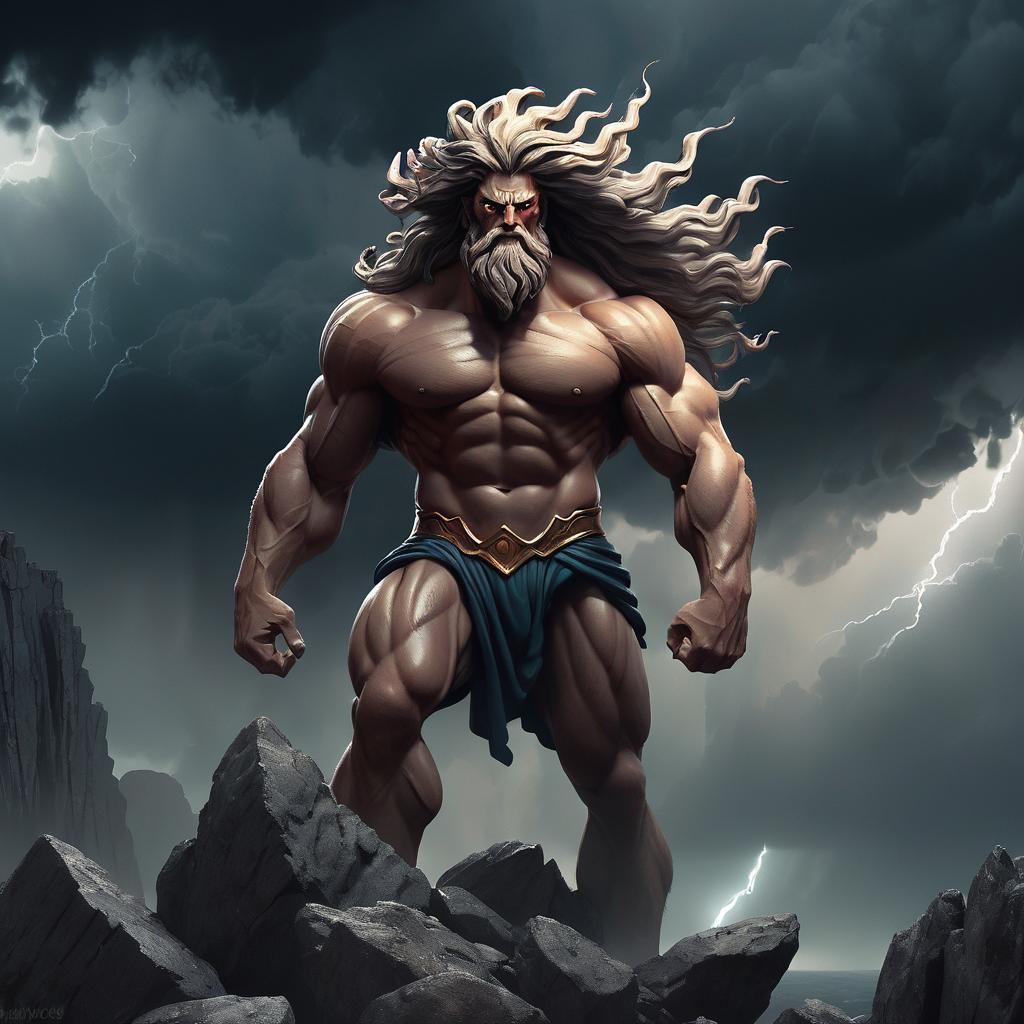
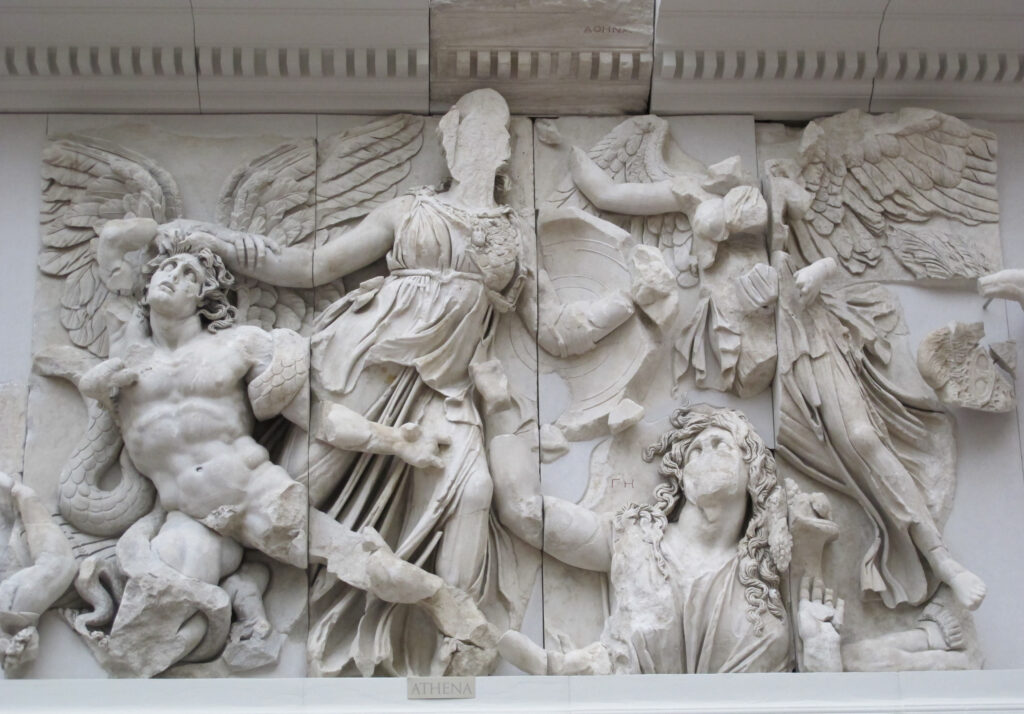
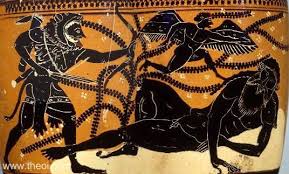
Descriptions of Alcyoneus highlight his status as a giant of truly staggering proportions. He was often imagined as towering above mortals and gods alike, his body reflecting the raw might of the earth from which he sprang. Ancient vase paintings and sculptural reliefs portray him with exaggerated musculature and features that amplify his role as a primordial force—untamed, unshaven, and radiating a rugged wildness. The famed Pergamon Altar frieze offers one of the most vivid depictions of Alcyoneus in battle, where Athena seizes him by the hair while his mother Gaia rises from the earth, imploring mercy. The intensity of this imagery reveals not only his colossal size but also his connection to the earth goddess herself. At times, Alcyoneus is shown reclining or struck down, yet even in moments of defeat, his scale and presence dominate the scene. His physical form functions less as a literal description and more as a symbol of chaotic, earth-born strength opposing divine order.
Family
Alcyoneus belongs to the primordial family of the Gigantes, born from Gaia after the blood of the sky god Ouranos fell to earth during his castration by Cronus. This origin ties Alcyoneus directly to the earth’s creative yet destructive power. Some traditions extend his lineage by naming Tartarus, the deep abyss of punishment, as his father, making him the offspring of both Earth and the underworld. His own family is remembered through his seven daughters, the Alkyonides. When Heracles slew their father, grief drove these sisters to leap into the sea, where the gods transformed them into kingfishers, preserving their memory through nature itself. This episode of metamorphosis reinforces a recurring theme in Greek mythology: that death and despair often lead to renewal and continuity in another form. The family narrative of Alcyoneus, therefore, intertwines tragedy, transformation, and enduring connection between human grief and the natural world.
Other names
The name Alcyoneus, transliterated also as Alkyoneus, carries layers of meaning. Scholars often link it to “alkyôn,” the Greek word for kingfisher, which recalls the fate of his daughters and possibly suggests a symbolic connection between his myth and the sea or air. Another interpretation connects the name to the root “alk-,” meaning strength, aligning perfectly with his role as the most powerful of the giants. Pindar referred to him as the “Thracian shepherd,” an epithet that situates him geographically and poetically in the northern lands associated with the giants. Some later authors have suggested a connection or even identity with Eurymedon, another giant mentioned in Homeric tradition, though the two figures are usually treated separately. These variations in name and epithet reflect how mythological figures could shift across regions and literary traditions, with each retelling emphasizing different facets of their identity.
Powers and Abilities
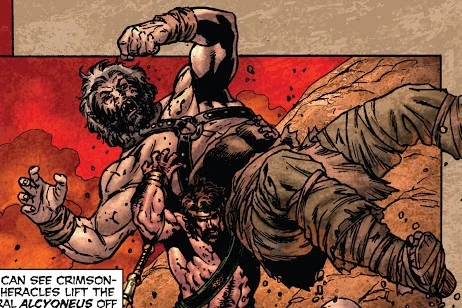
Alcyoneus was renowned not only for his strength but also for his unique gift of immortality. Unlike gods whose immortality was absolute, his life was bound to the land of Pallene, a peninsula in Thrace. As long as he remained on his homeland, no weapon could destroy him. This conditional immortality illustrates a profound mythological theme: the bond between a being and its native soil. In battle, Alcyoneus’s strength was unmatched; ancient sources describe him hurling massive stones and overpowering entire groups of warriors with ease. During the Gigantomachy, he resisted even Heracles, whose divine lineage and heroic power were legendary. It was only through Athena’s counsel that Heracles discovered Alcyoneus’s vulnerability. After striking him with an arrow, Heracles dragged the giant away from Pallene, where his immortality no longer held, and slew him. This tale underscores how cunning and strategy, guided by divine wisdom, triumphed over brute force. Beyond the Gigantomachy, traditions describe him as destructive and lawless, plundering travelers and spreading terror—behaviors that marked him as a chaotic adversary to civilization and divine order alike.
Modern Day Influence
The myth of Alcyoneus has not faded into obscurity but continues to inspire art, literature, and even scientific naming. In late antiquity, the poet Nonnus included him in the Dionysiaca, extending his role beyond the Gigantomachy to battles against Dionysus. In Renaissance art, his combat with Heracles and Athena became a favored subject, reflecting the era’s fascination with heroic struggle and divine justice. Paintings and sculptures across Europe reimagined his downfall, blending classical myth with contemporary artistic ideals. In modern literature, Alcyoneus gained renewed life in Rick Riordan’s The Son of Neptune (2011), where he appears as a villainous figure reinterpreted for young readers in the Heroes of Olympus series. Even astronomy has paid tribute to his name: in 2022, scientists identified the largest known radio galaxy and christened it “Alcyoneus,” an homage to the giant’s immense scale in myth. In gaming and digital culture, Alcyoneus frequently emerges as a boss character or symbolic adversary, embodying themes of territorial defense, overwhelming strength, and the necessity of strategy over raw power. These reinterpretations ensure that the story of Alcyoneus continues to resonate, bridging the gap between ancient myth and contemporary imagination.
Related Images


Source
Apollodorus. (1921). The Library (J. G. Frazer, Trans.). Harvard University Press. Retrieved from https://www.theoi.com/Gigante/GiganteAlkyoneus.html
Pindar. (1997). Nemean Odes & Isthmian Odes (C. M. Bowra, Trans.). Penguin Classics.
Smith, W. (1870). Dictionary of Greek and Roman Biography and Mythology. London: John Murray. Retrieved from https://www.theoi.com/Gigante/GiganteAlkyoneus.html
Wikipedia contributors. (2025). Alcyoneus. Wikipedia. Retrieved from https://en.wikipedia.org/wiki/Alcyoneus
GreekMythology.com. (2025). Alcyoneus. Retrieved from https://www.greekmythology.com/Myths/Gigantes/Alcyoneus/alcyoneus.html
Riordan, R. (2011). The son of Neptune. Disney Hyperion.
Smith, W. (1870). Dictionary of Greek and Roman biography and mythology.
Theoi Greek Mythology. (n.d.). Alkyoneus. Retrieved from https://www.theoi.com/Gigante/GiganteAlkyoneus.html
Buxton, R. (2005). The complete world of Greek mythology.
Frequently Asked Questions
What is lorem Ipsum?
I am text block. Click edit button to change this text. Lorem ipsum dolor sit amet, consectetur adipiscing elit. Ut elit tellus, luctus nec ullamcorper mattis, pulvinar dapibus leo.
What is lorem Ipsum?
I am text block. Click edit button to change this text. Lorem ipsum dolor sit amet, consectetur adipiscing elit. Ut elit tellus, luctus nec ullamcorper mattis, pulvinar dapibus leo.
What is lorem Ipsum?
I am text block. Click edit button to change this text. Lorem ipsum dolor sit amet, consectetur adipiscing elit. Ut elit tellus, luctus nec ullamcorper mattis, pulvinar dapibus leo.
What is lorem Ipsum?
I am text block. Click edit button to change this text. Lorem ipsum dolor sit amet, consectetur adipiscing elit. Ut elit tellus, luctus nec ullamcorper mattis, pulvinar dapibus leo.
What is lorem Ipsum?
I am text block. Click edit button to change this text. Lorem ipsum dolor sit amet, consectetur adipiscing elit. Ut elit tellus, luctus nec ullamcorper mattis, pulvinar dapibus leo.