


Esege Malan : The Supreme Sky Father of the Buryat People
Listen
At a glance
| Description | |
|---|---|
| Origin | Buryat Mythology |
| Classification | Gods |
| Family Members | Ehe Yuuren Iibii (Wife), Solobung Yubin, Buha Noyon (Children) |
| Region | Russia |
| Associated With | Creation, Sky |
Esege Malan
Introduction
Esege Malan is one of the most important figures in Buryat and Mongolian mythology, revered as the supreme sky deity and the creator of the cosmos. In traditional Buryat belief, he stands at the very beginning of existence, shaping the sun, moon, and stars, sculpting the earth from primordial soil, and establishing the order that governs the universe. Central to epics such as the Hesariad, Esege Malan is both a cosmic architect and the paternal figure who oversees the great heavenly triad alongside Zayan Sagan Tengri and Huhedey Mergen Tengri. His presence reflects the deep shamanistic roots of Buryat spirituality, where the sky is not merely a physical space but a sacred realm tied to ancestry, balance, and divine authority. Through rituals, chants, and genealogical myths, Esege Malan remains the symbolic father of the Buryat people, a deity who embodies clarity, wisdom, and the vastness of the western sky.
Physical Traits
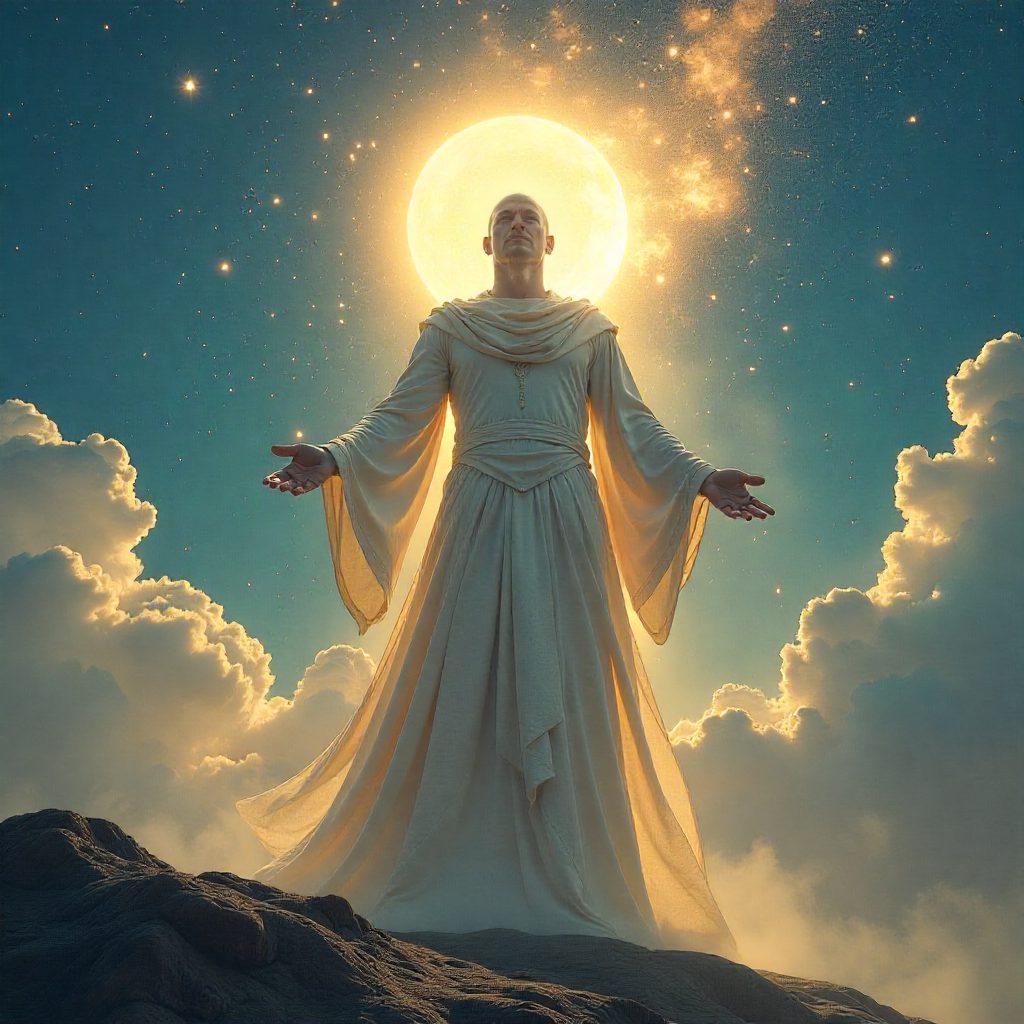
Descriptions of Esege Malan focus less on human features and more on symbolic meaning. His name is often translated as “Father Bald Sky” or “Clear Sky Ancestor,” a metaphor for the cloudless, open heavens ruled by him. This idea of baldness represents purity and unobstructed celestial space rather than a literal appearance. In myths where he interacts with shamans or spirits, he displays a luminous, commanding presence that reflects his position as the highest of the sky-spirits. Some tales even portray him in a physical form—such as when a shaman stings him on the forehead—suggesting he can manifest tangibly when divine order is challenged. Yet overall, Esege Malan remains an abstract, radiant force whose form mirrors the infinite sky he governs.
Family
Esege Malan’s lineage forms the backbone of the Buryat cosmic structure. His principal consort is Ehe Yuuren Iibii (also known as Ehe Ureng Ibi), a primordial mother figure who joins him in shaping the world from darkness. Together, they give rise to powerful beings who govern various natural and spiritual domains. Their most widely recognized offspring include Solobung Yubin, the spirit of the morning star, who is closely associated with fertility, seasonal cycles, and agricultural blessings. Through offerings made to Solobung Yubin, communities sought Esege Malan’s favor for abundant harvests. Myths also name Buha Noyon, a legendary ancestor of the Buryats, as one of his sons, reinforcing the belief that the Buryat people descend from the sky father himself. Other lineages link him to earth deities, mountain patrons, and cosmological figures, reflecting a world where divine kinship mirrors the hierarchical structure of ancient Buryat society.
Other names
Esege Malan is known under multiple names that highlight his status across different Mongolic traditions. He appears as Esege Malaan in Mongolian, Eség Malan in Buryat, and under similar transliterations in Russian sources. In sacred chants he is addressed as Esege Malan baabai, meaning “Father Esege Malan,” blending celestial sovereignty with the warmth of an ancestral elder. Some traditions also link him to Huhe Munhe Tengri, the Eternal Blue Sky, describing Esege Malan as its son or manifestation within the Buryat pantheon. These shifting titles emphasize how his identity evolved across regions while maintaining his core role as the supreme sky creator.
Powers and Abilities
Esege Malan wields authority over creation, balance, and celestial governance. One of his primary acts is the formation of the universe from a handful of soil, dividing the world into eastern and western domains for other deities to oversee. He creates the sun, moon, stars, and living beings, establishing the cycles that sustain life. As ruler of the sky-spirits, he presides over divine councils said to be held in the Pleiades or upon the moon, where cosmic order is discussed and maintained. His power extends into the earthly realm through deities like Solobung Yubin, who ensures prosperity and agricultural fertility on his behalf. While he embodies immense authority, some epics portray him as an ancient contemplative figure occasionally challenged by cunning shamans—an important narrative theme in Buryat shamanism, where spiritual negotiation plays a central role. Nonetheless, his dominion over creation and cosmic harmony remains absolute.
Modern Day Influence
Although Buryat society has undergone significant cultural transformation, the legacy of Esege Malan remains deeply embedded in spiritual practices and cultural identity. Shamanic traditions around Lake Baikal, especially on Olkhon Island, still invoke him as a guardian of balance and ancestral memory. Post-Soviet cultural revival movements have renewed interest in Tengrist beliefs, and Esege Malan often appears in rituals performed by modern shamans seeking healing, protection, or guidance. His myths are studied in ethnographic works, preserved in oral traditions, and retold through digital media, documentaries, and contemporary literature that reintroduce Buryat cosmology to global audiences. As environmental stewardship becomes more central in modern discourse, Esege Malan’s role as a sky father who maintains cosmic equilibrium increasingly resonates with ecological narratives. He symbolizes not only the origins of creation but also the responsibility humans hold toward the natural world.
Related Images


Source
Dugarov, B. S. (2019). Buryat Hesariad: Tengrist mythology and the epic interpretation. Philosophy Journal SPbU. https://philosophyjournal.spbu.ru/article/download/6691/5158
Sharakshinova, N. O. (1980). Mythology of the Buryats. Novosibirsk: Nauka. https://cyberleninka.ru/article/n/buryat-hesariad-tengrist-mythology-and-the-epic-interpretation
Wikipedia contributors. (2024). Esege Malan. Wikipedia. https://en.wikipedia.org/wiki/Esege_Malan
Zorbas, A. (2001). Image of Esege Malan Tengri in the context of religious and mythological tradition of Buryats. eLibrary.org.uk. https://elibrary.org.uk/blogs/entry/IMAGE-OF-ESEGE-MALAN-TENGRI-IN-THE-CONTEXT-OF-RELIGIOUS-AND-MYTHOLOGICAL-TRADITION-OF-BURYAT
Buyandelger, N. (2015). Trance, Custom, and the Soul: The Poetics of Shamanic Healing in Contemporary Buryatia. University of Chicago Press.
Humphrey, C. (1996). Marx Went Away—But Karl Stayed Behind: Culture and Society in Inner Asia. University of Michigan Press.
Jakobson, R. (1945). The Paleosiberian Languages. American Anthropologist, 47(4), 600-602.
Manzhigeev, I. A. (1978). Buryatskie mify i legendy [Buryat Myths and Legends]. Buryat Book Publishing House.
Frequently Asked Questions
Who is Esege Malan in Buryat mythology?
Esege Malan is the supreme sky deity and creator god in Buryat mythology, responsible for forming the universe, celestial bodies, and natural order.
What powers does Esege Malan have?
He commands creation, oversees sky-spirits, controls celestial cycles, and influences prosperity through deities like his son Solobung Yubin.
Who is the wife of Esege Malan?
His primary consort is Ehe Yuuren Iibii, a primordial mother deity who helps him bring forth cosmic order and divine offspring.
Why is Esege Malan important in shamanic practices?
Shamans invoke him as the ancestral sky father who maintains balance, provides guidance, and safeguards communities.
How is Esege Malan honored today?
He is remembered in modern Buryat shamanism, cultural festivals, mythology studies, and digital storytelling that preserve indigenous Siberian beliefs.
