
Kaumodaki : Vishnu’s Mace of Cosmic Order
At a glance
| Description | |
|---|---|
| Mythology | Indian Mythology |
| Type | Carried |
| Power | 08/10 |
Mythlok Perspective
Kaumodaki reflects an idea of power that does not rush to act but cannot be resisted once it moves. Unlike bladed weapons that symbolize speed or ambition, the mace represents inevitability. Across cultures, instruments of blunt force often appear where moral imbalance has hardened beyond negotiation. In Kaumodaki, Indian tradition preserves a truth modern systems still struggle with: when disorder becomes structural, restoration requires weight, not persuasion.
Kaumodaki
Introduction
Kaumodaki is the sacred gada carried by Vishnu, the preserver of cosmic order in Indian tradition. Unlike bladed weapons associated with speed or spectacle, Kaumodaki represents certainty, restraint, and decisive force. Its presence in Vishnu’s iconography signals not aggression but authority, the kind that restores balance when chaos becomes entrenched. The name Kaumodaki is traditionally interpreted as “that which delights or enlightens the mind,” suggesting that its purpose extends beyond physical destruction into the realm of moral and intellectual clarity.
In temple sculptures and classical art, Vishnu is often shown resting his hand gently upon the mace rather than raising it. This visual language communicates a central idea in Indian cosmology: power exists to preserve harmony, not to dominate for its own sake. Kaumodaki thus functions as a philosophical instrument as much as a divine weapon, embodying controlled strength that intervenes only when dharma is threatened.
Origins
The origins of Kaumodaki emerge gradually across epic and Purāṇic literature, reaching prominence during the composition of the Mahabharata. Early references associate the mace with Krishna, identifying it as one of the divine weapons granted to him during pivotal cosmic events. One well-known tradition recounts how Varuna entrusted celestial arms to Krishna during the burning of the Khandava forest, a moment that elevated Kaumodaki from symbolic attribute to active force in epic narrative.
Etymologically, scholars link the name Kaumodaki to Sanskrit roots associated with joy, moonlight, or mental illumination. Some texts interpret it as “stupefier of the mind,” not in a negative sense, but as a force that overwhelms ignorance and ego. Over time, iconographic traditions expanded this idea by personifying the mace as Gadadevi, a feminine manifestation of divine power. Gupta-period sculptures depict this figure standing beside Vishnu, reinforcing the belief that Kaumodaki is not an inert object but a living extension of cosmic energy.
Another strand of myth describes the mace as emerging during cycles of creation alongside Vishnu’s other attributes, indicating that Kaumodaki is not forged but manifested, arising whenever preservation requires decisive intervention.
Think you know your myths and legends? Dive into the world of ancient stories and test your knowledge with our engaging quizzes on Mythlok!
Powers
Kaumodaki’s power lies in its finality. Unlike weapons that wound or intimidate, the mace resolves conflict by crushing the root of disorder. Texts describe its strikes as thunderous, capable of shattering demonic forces and dispersing illusions that sustain adharma. Its force is portrayed as selective rather than indiscriminate, striking only those who actively destabilize cosmic balance while leaving the righteous untouched.
Philosophically, Kaumodaki represents the destruction of anarthas, inner obstacles such as arrogance, confusion, and moral inertia. Its weight symbolizes the accumulated burden of unrighteousness that can no longer be tolerated. Several traditions associate the mace with time itself, emphasizing inevitability rather than rage. When Kaumodaki is raised, it signifies that a moral threshold has been crossed.
Some Purāṇic descriptions attribute transformative qualities to the weapon, including the ability to expand in size, emit fire, or disrupt perception. These qualities reinforce its role as a corrective force capable of adapting to different manifestations of chaos, whether physical, psychological, or cosmic.
Owners/Users
Kaumodaki belongs exclusively to Vishnu and his avatars, reinforcing its status as a weapon of preservation rather than conquest. Vishnu is frequently addressed as Gadādhara, the bearer of the mace, a title that emphasizes responsibility over dominance. In iconography, Kaumodaki is consistently placed in the lower left hand, symbolizing its grounding role in individual existence and moral discipline.
Krishna’s use of Kaumodaki during epic conflicts reflects this continuity of purpose across incarnations. While other figures in Indian epics wield maces of great power, Kaumodaki itself remains distinct. It does not circulate among heroes or gods, nor does it change allegiance. Even in narratives where divine weapons appear personified or temporarily manifest independently, Kaumodaki ultimately returns to Vishnu, underscoring its singular alignment with cosmic preservation.
The personified Gadadevi is sometimes described as its guardian spirit, reinforcing the idea that Kaumodaki operates with awareness rather than blind force.
Instances used
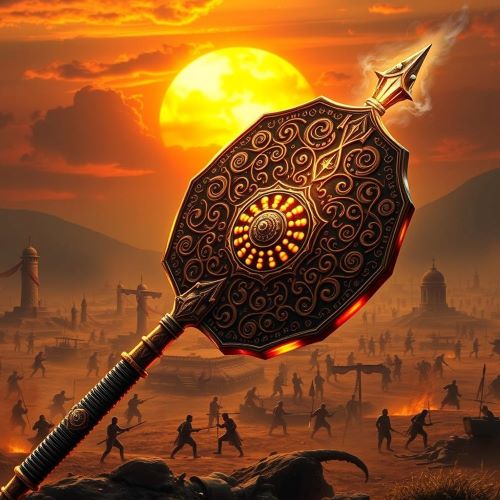
Kaumodaki’s most prominent narrative appearance occurs during the Khandava forest episode of the Mahabharata, where Krishna employs it to counter celestial opposition and ensure the fulfillment of cosmic necessity. Its thunderous presence neutralizes resistance, allowing Agni to complete the destruction required for cosmic rebalancing. This event establishes Kaumodaki as a tool of inevitability rather than violence.
Other traditions describe Vishnu using the mace during his incarnations to subdue forces that threaten cosmic stability. In Varaha’s battle against Hiranyaksha, the mace symbolizes the crushing of primordial chaos. In accounts involving Andhaka and other asuric figures, Kaumodaki appears as the decisive end to prolonged imbalance rather than the opening strike of conflict.
In classical literature and drama, Kaumodaki is occasionally depicted descending alongside Vishnu’s other weapons, assuming semi-anthropomorphic forms that observe or intervene in cosmic events. These portrayals reinforce the belief that divine weapons are conscious extensions of cosmic will, not passive instruments.
Source
Devi Bhagavata Purana. (n.d.). In Wisdom Library. Retrieved January 11, 2026, from https://www.wisdomlib.org/concept/kaumodaki-gada
Mahabharata. (n.d.). Mahabharata (English). In Wisdom Library. Retrieved January 11, 2026, from
https://www.wisdomlib.org/concept/kaumodaki-mace
Sreevidyatantram. (2017, February 6). Gada (weapon) in Hindu mythology. Retrieved January 11, 2026, from http://sreevidyatantram.blogspot.com/2017/02/gadaweapon-in-hindu-mythology.html
Wikipedia contributors. (2005, November 25). Kaumodaki. Wikipedia. Retrieved January 11, 2026, from
https://en.wikipedia.org/wiki/Kaumodaki
Just Kalinga. (2024, November 13). Kaumodaki Gada: Vishnu’s Mace and its Cosmic Power (Ch. 30). Just Kalinga. Retrieved from https://justkalinga.com/kaumodaki-gada-vishnus-mace-and-its-cosmic-power-ch-30/?srsltid=AfmBOorxPp7GnWjx97OPha-t-FL2HiVzyCY5RB4QGnEALZXoGxVtayoa
Mudigere Temple. (2013, August 23). THE STORY OF KAUMODAKI. Mudigere Temple. Retrieved from http://mudigeretemple.weebly.com/stories-and-legends/the-story-of-kaumodaki
Frequently Asked Questions
What is Kaumodaki in Indian tradition?
Kaumodaki is the sacred mace of Vishnu, representing divine authority, moral discipline, and the power to restore cosmic balance.
What does Kaumodaki symbolize?
It symbolizes controlled strength, the destruction of ignorance, and the inevitability of justice when dharma is threatened.
Who wields Kaumodaki?
Kaumodaki is wielded by Vishnu and his avatars, most notably Krishna, and does not permanently belong to any other figure.
Is Kaumodaki a living entity?
Some traditions personify Kaumodaki as Gadadevi, suggesting it possesses awareness and functions as a conscious extension of divine power.
How is Kaumodaki different from other divine weapons?
Unlike weapons that emphasize speed or aggression, Kaumodaki represents finality, restraint, and corrective force rather than continuous warfare.