

Wahieloa : The Hawaiian Ancestral Voyager and Chiefly Hero
Listen
At a glance
| Description | |
|---|---|
| Origin | Hawaiian Mythology |
| Classification | Demigods |
| Family Members | Kaha‘i (Father), Hina (Mother), Laka (son) |
| Region | Hawaii |
| Associated With | Voyaging, Fishing rites, Ocean mastery |
The Mythlok Perspective
From the Mythlok perspective, Wahieloa represents a form of heroism grounded in continuity rather than conquest. His strength lies in preserving balance between land, sea, and lineage, a theme echoed across Polynesian traditions. Comparable figures such as the Māori Wahieroa and Tahitian Vahieroa reveal a shared archetype of the ancestral voyager, while parallels can also be drawn with Norse culture heroes who transmit skill and authority across generations. Through Wahieloa, Hawaiian tradition emphasizes that legacy, not dominance, is the truest measure of power.
Wahieloa
Introduction
Wahieloa occupies a quiet but important place within Hawaiian sacred tradition, remembered less as a distant god and more as a living ancestor whose deeds shaped lineage, land, and ritual practice. His story belongs to the wider body of mo‘olelo, the oral histories that preserve genealogies, migrations, and moments of transformation across generations. Wahieloa is most often identified as the son of Kaha‘i, a culture hero associated with fishing mastery and long-distance voyaging, and as the father of Laka, whose own journeys echo ancestral returns to Kahiki. Through this lineage, Wahieloa becomes a connective figure linking divine favor with human responsibility.
Unlike figures defined purely by cosmic power, Wahieloa’s importance lies in how his life reinforces mo‘okū‘auhau, the sacred continuity of ancestry. His name appears in genealogical chants from Kaua‘i to Maui, situating him as both a chief and a cultural transmitter. The Wahieloa–Laka cycle emphasizes that authority in Hawaiian society was not granted by conquest alone, but by inherited mana tied to land, sea, and ritual knowledge. In this way, Wahieloa stands as a bridge between the akua and the ali‘i, embodying a worldview where history, myth, and identity remain inseparable.
Physical Traits
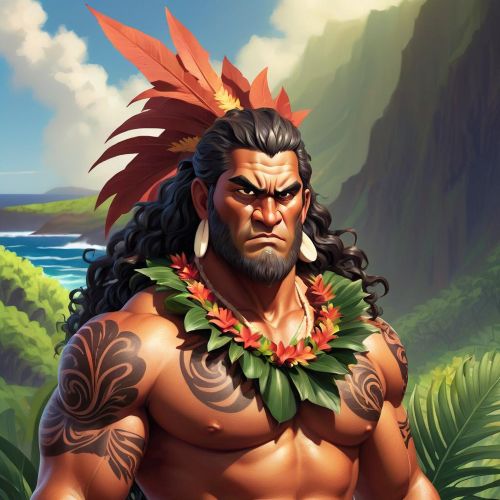
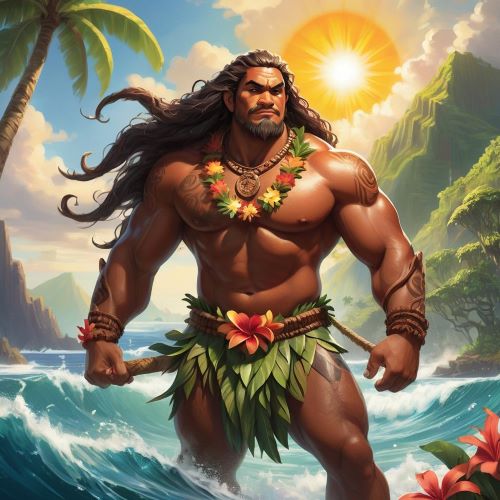
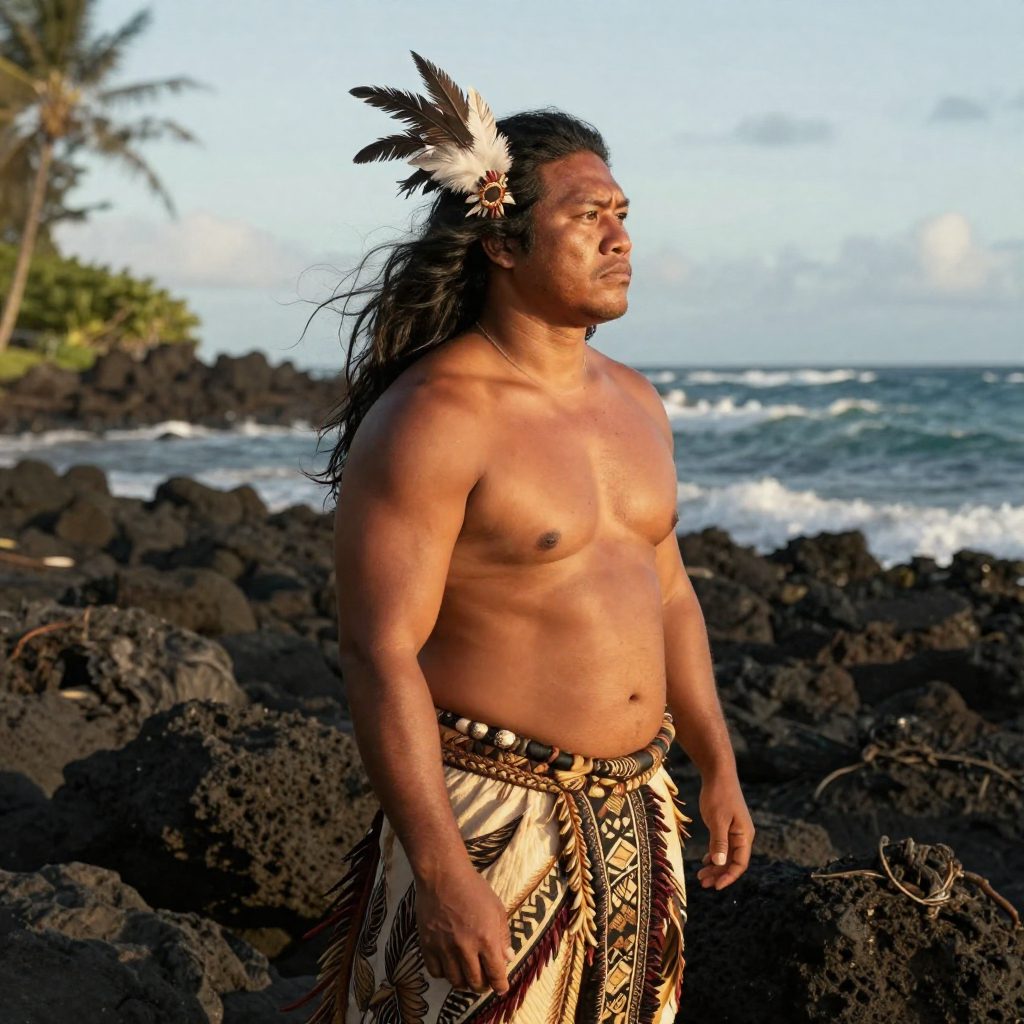
Traditional Hawaiian narratives rarely linger on decorative description, yet Wahieloa is consistently portrayed as physically formidable, reflecting his role as a warrior and seafarer. He is imagined with a powerful frame shaped by ocean travel, broad shoulders suited to paddling and combat, and the endurance required to survive storms, battles, and long voyages between islands. His appearance aligns with Polynesian ideals of strength born from labor rather than ornamentation, where the body itself becomes evidence of mana.
Chants and later retellings describe his presence as commanding rather than monstrous. His height and bearing signal chiefly status, while references to sun-darkened skin and flowing hair adorned with feathers associate him with ali‘i nobility. In some variants, his arms are likened to koa trunks, an image that emphasizes natural strength and sacred wood symbolism rather than exaggerated fantasy. These traits do not exist in isolation but reinforce his cultural role, presenting Wahieloa as a man shaped by sea winds, ritual duty, and inherited authority.
Family
Genealogy forms the backbone of Wahieloa’s identity. He is widely recognized as the son of Kaha‘i, whose own myths stretch across Polynesia under names such as Tawhaki, linking Wahieloa to a transoceanic heroic tradition. His mother is usually identified as Hinahina or a related Hina figure, placing him within the expansive lunar and fertility lineage that permeates Hawaiian sacred narratives. This maternal connection reinforces themes of rhythm, tide, and renewal that follow Wahieloa throughout his story.
Wahieloa is best known as the father of Laka, a figure celebrated for voyaging skill, ritual authority, and in some traditions, associations with hula and forest sanctity. Through Laka, Wahieloa’s legacy becomes generational rather than episodic. His descendants are said to have settled and protected regions of Maui, particularly Hana, where sacred sites and family heiau preserve ancestral memory. Some localized traditions also suggest early encounters with Pele’s lineage, though these remain secondary to the dominant Kaha‘i line. Collectively, these relationships position Wahieloa not merely as an individual hero, but as a vital link in the sacred chain of Hawaiian ancestry.
Other names
Wahieloa’s name appears in multiple forms across Polynesia, reflecting both linguistic evolution and shared mythic memory. In Māori traditions, he is remembered as Wahieroa, while Tahitian and Tuamotuan sources preserve the form Vahieroa. Variants such as Va‘ieroa and Uhi-loa appear in Cook Islands and Rarotongan chants, each shaped by local phonetics while retaining the same narrative core. These names often carry meanings related to distance, reach, or enduring mark, emphasizing long journeys and lasting impact.
Within Hawaii itself, historical spellings such as Waihieloa and Wahioloa surface in nineteenth-century texts and genealogical records. Rather than indicating confusion, these variations highlight the oral nature of the tradition, where sound and rhythm mattered more than fixed orthography. The persistence of the name across islands and centuries underscores Wahieloa’s role as part of a shared Polynesian heritage rooted in voyaging and ancestral continuity.
Powers and Abilities
Wahieloa’s abilities emerge through action rather than explicit declaration. He is consistently associated with mastery of the sea, particularly fishing knowledge inherited from Kaha‘i. Stories describe his use of ku‘ula stones and ritual offerings to summon fish schools, ensuring abundance for his people. These acts blend practical skill with spiritual authority, reflecting a worldview where success at sea depended on proper relationship with unseen forces.
In battle narratives, Wahieloa displays exceptional endurance and strength, overcoming rival chiefs and monstrous adversaries that threaten social balance. His victories are rarely framed as personal glory; instead, they restore order and reaffirm rightful lineage. Some traditions describe allies who respond to his mana, such as turtles or winds that aid his voyages, suggesting a harmonious alignment with natural forces rather than domination over them. His power ultimately lies in balance, combining physical capability, ritual knowledge, and inherited spiritual favor.
Modern Day Influence
In contemporary Hawaii, Wahieloa’s presence survives through cultural memory rather than popular spectacle. His name appears in genealogical study, chant reconstruction, and educational programs that emphasize ancestral knowledge. Hula practitioners draw upon narratives from the Wahieloa–Laka cycle to frame performances that honor forest, sea, and lineage, especially within hula kahiko traditions.
Wahieloa also resonates within the modern Polynesian voyaging revival. Navigation societies and cultural educators reference his lineage when teaching the continuity of ocean knowledge across generations. Sacred sites associated with his descendants contribute to community-led heritage tourism, encouraging respectful engagement with land and history. In digital platforms and scholarly discourse, Wahieloa increasingly represents the quieter heroes of Hawaiian tradition, those whose influence is measured not by spectacle, but by continuity.
Related Images

Source
Beckwith, M. W. (1970). Hawaiian mythology. University of Hawaii Press.
Fornander, A. (1916–1920). Fornander collection of Hawaiian antiquities and folk-lore (Vol. 3). Bishop Museum Press.
Kalākaua, D. (1888). The legends and myths of Hawaii. C. E. Tuttle Co.
Nogelmeier, M. P. (2003). The epic tale of Hi’iakaikapoliopele: A celebration of Hawaii’s vibrant legacy. University of Hawaii at Mānoa, ScholarSpace.
Pukui, M. K., & Elbert, S. H. (1986). Hawaiian dictionary (Rev. ed.). University of Hawaii Press.
Thrum, E. M. (1907). Hawaiian folk tales: A collection of native legends. A. C. McClurg & Co.
Westervelt, W. D. (1910). Legends of Maui: A demigod of Polynesia. George H. Ellis Co.
Wikipedia contributors. (2023). Wahieloa. Wikipedia, The Free Encyclopedia. https://en.wikipedia.org/wiki/Wahieloa
Frequently Asked Questions
Who was Wahieloa in Hawaiian tradition?
Wahieloa was a legendary Hawaiian chief and ancestral hero, remembered for his lineage, voyaging heritage, and connection to sacred fishing practices.
Is Wahieloa a god or a human?
Wahieloa is best understood as a demigod or heroic ancestor, bridging human and divine realms through genealogy rather than ruling as a full god
How is Wahieloa connected to Laka?
Wahieloa is the father of Laka, whose own myths continue the family’s legacy of voyaging, ritual authority, and cultural transmission.
Does Wahieloa appear in other Polynesian cultures?
Yes, variants of Wahieloa appear across Polynesia under names such as Wahieroa and Vahieroa, reflecting shared ancestral traditions.
Why is Wahieloa important today?
Wahieloa remains important as a symbol of genealogy, ancestral responsibility, and the continuity of Hawaiian cultural knowledge.