
Nyaminyambi : The Supreme Creator in Chokwe Belief
Listen
At a glance
| Description | |
|---|---|
| Origin | Chokwe Mythology |
| Classification | Gods |
| Family Members | N/A |
| Region | Angola, Zambia, Democratic Republic of the Congo |
| Associated With | Creation |
Nyaminyambi
Introduction
Nyaminyambi stands at the apex of Chokwe cosmology as the supreme creator and ultimate source of existence. Among the Chokwe people, whose cultural presence spans Angola, Zambia, and the Democratic Republic of the Congo, Nyaminyambi represents the origin of the universe, life, and cosmic order itself. Oral traditions describe him as existing before land, sky, or humanity, bringing creation into being from nothingness. In some narratives, he descends from the heavens to the world below using a spider’s web, a powerful metaphor that communicates interconnectedness, balance, and the fragile bonds linking all forms of life.
Unlike deities who walk among humans or interfere frequently in daily affairs, Nyaminyambi is understood as distant yet omnipresent. His remoteness does not imply absence but authority. The Chokwe worldview emphasizes that the supreme being establishes the laws of nature and morality, while ancestral spirits and ritual specialists manage human concerns. Through initiation rites such as Mukanda, sculptural traditions, and oral storytelling, Nyaminyambi’s creative acts are retold to reinforce humility, respect for ancestors, and harmony with the natural environment. As a keyword within African religious studies, Nyaminyambi illustrates how Central African belief systems articulate a sophisticated concept of a singular creator without centralized temples or rigid dogma.
Physical Traits
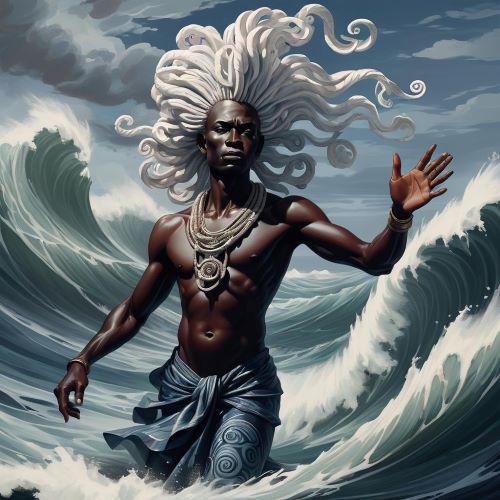
Nyaminyambi has no fixed physical form within Chokwe tradition. He is not imagined as a human-like god with limbs, facial features, or gendered traits. This absence of anthropomorphic description is deliberate and theologically significant. Nyaminyambi is conceived as a sky-bound, formless presence whose essence transcends material shape. To describe him physically would be to limit him, and limitation contradicts his role as the source of all existence.
When visual symbolism is employed, it is indirect and abstract. The sun may represent his generative power, the sky his vastness, and the spider’s web his role as the architect of cosmic connections. In ritual art and carvings associated with Chokwe spiritual life, Nyaminyambi is rarely depicted directly. Instead, artists focus on masks, figures, and patterns that express fertility, authority, and continuity. These symbolic references allow the divine to be felt without being seen. The lack of a bodily image reinforces the belief that Nyaminyambi exists everywhere at once, embedded in natural cycles rather than confined to a single form.
Family
Within Chokwe mythology, Nyaminyambi does not possess a family in the conventional sense of spouses, siblings, or divine offspring. He stands alone as the uncreated creator, occupying a position above all other spiritual beings. This structure places him closer to a monotheistic supreme principle than to a relational pantheon. Rather than family members, Nyaminyambi is surrounded by a hierarchy of spiritual forces that operate under his authority.
Ancestral spirits, often referred to collectively as mahamba, function as intermediaries between humans and the cosmic order established by Nyaminyambi. These spirits are not his children but manifestations of his creative breath continuing through human lineage. Cultural figures such as Pwo and Cihongo, celebrated in masks and ceremonies, embody ideals of femininity, masculinity, fertility, and social harmony. They are not divine relatives of Nyaminyambi but expressions of values rooted in the world he created. In this way, all humanity can be understood as indirectly related to Nyaminyambi, not through bloodlines, but through creation itself.
Other names
Nyaminyambi is known by several names across Central and Southern Africa, reflecting linguistic variation among Bantu-speaking communities. Nyambe is a common alternative, particularly in neighboring traditions, while Nzambi and Nzambi Mpungu appear prominently in Kongo-influenced cosmologies. Variants such as Nzambi, Njambi, Nyambi, and Njambe retain the core meaning of a supreme creator associated with the sky and origin of life.
These names do not indicate separate deities but regional expressions of a shared theological concept. Among the Chokwe, Nyaminyambi remains the preferred and culturally specific name, anchoring the deity within their artistic and ritual heritage. The multiplicity of names demonstrates how African cosmologies adapt to language and geography while preserving core beliefs. For comparative mythology, Nyaminyambi serves as a unifying figure linking diverse traditions without erasing local identity.
Powers and Abilities
Nyaminyambi’s powers are absolute yet subtle. He is credited with the creation of the universe, the formation of the first humans from clay, and the animation of all living beings through breath or vital force. Once creation is complete, he withdraws from direct involvement, allowing natural laws and spiritual intermediaries to govern daily existence. This withdrawal emphasizes order rather than abandonment, suggesting a cosmos designed to sustain itself through balance.
As the ultimate moral authority, Nyaminyambi oversees justice, harmony, and the rhythm of life and death. Natural phenomena such as rain, drought, fertility, and disease are understood as expressions of cosmic balance rather than acts of personal intervention. Divination practices and ritual healing do not summon Nyaminyambi directly but appeal to ancestral forces that operate within his established order. His omniscience and immortality ensure that nothing escapes the structure he created, even when his presence is not actively invoked.
Modern Day Influence
In contemporary contexts, Nyaminyambi continues to shape cultural identity and spiritual thought among Chokwe communities and the wider African diaspora. Traditional ceremonies still acknowledge him as the ultimate source of life, even when practical worship centers on ancestors. During colonial and missionary encounters, Nyaminyambi was often equated with the Christian God, enabling forms of religious syncretism that preserved indigenous cosmology beneath new frameworks.
Today, Nyaminyambi appears in academic studies, museum exhibitions, and discussions about African philosophy and theology. His symbolism is increasingly referenced in environmental discourse, where the spider’s web metaphor is used to express ecological interconnectedness. Artists and storytellers draw upon his image to assert cultural continuity and challenge outdated notions that African religions lack complexity. As a concept, Nyaminyambi endures as both a sacred presence and a symbol of intellectual and spiritual depth.
Related Images
Source
Chokwe people. (2005). Wikipedia. https://en.wikipedia.org/wiki/Chokwe_people
Honwana, L. (n.d.). Chokwe tribes [PDF]. 101lasttribes.com. https://www.101lasttribes.com/tribes/Chokwe2.pdf
Nyambe. (2009). Wikipedia. https://en.wikipedia.org/wiki/Nyambe
Ranger, T. O. (1989). African Traditional Religion and Modern Identity. African Affairs, 88(351), 243–261.
Vansina, J. (1990). Paths in the Rainforests: Toward a History of Political Tradition in Equatorial Africa. Madison: University of Wisconsin Press.
Thornton, J. (2004). Africa and Africans in the Making of the Atlantic World, 1400–1800. Cambridge: Cambridge University Press.
Turner, V. (1967). The Forest of Symbols: Aspects of Ndembu Ritual. Ithaca: Cornell University Press.
Frequently Asked Questions
Who is Nyaminyambi in Chokwe belief?
Nyaminyambi is the supreme creator deity in Chokwe cosmology, responsible for the creation of the universe and the establishment of cosmic order.
Does Nyaminyambi have a physical form?
Nyaminyambi is considered formless and transcendent, represented symbolically rather than as a human-like figure.
Is Nyaminyambi the same as Nzambi?
Nyaminyambi and Nzambi are closely related names used across Bantu traditions, often referring to the same supreme creator concept with regional variations.
Is Nyaminyambi actively worshipped today?
While direct worship is rare, Nyaminyambi remains acknowledged as the ultimate source of life, with rituals focusing more on ancestors.
What does the spider web symbolize in Nyaminyambi myths?
The spider web represents interconnectedness, creation, and the delicate balance linking all existence.