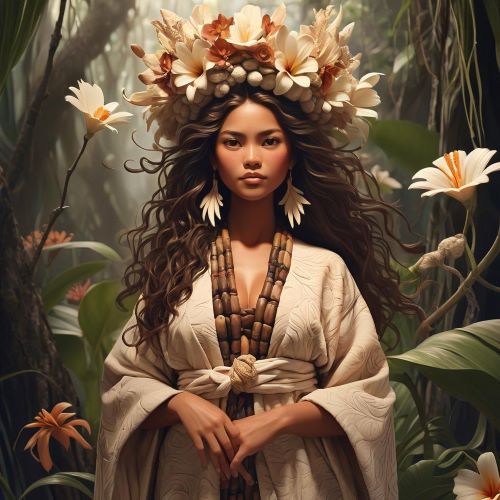

Lilinoe : The Hawaiian Goddess of Mist and Sacred Mountains
Listen
At a glance
| Description | |
|---|---|
| Origin | Hawaiian Mythology |
| Classification | Gods |
| Family Members | Poliʻahu, Waiau, Kahoupokāne (Siblings) |
| Region | Hawaii |
| Associated With | Mist, Fog, Cold, Mountain protection |
The Mythlok Perspective
Lilinoe is not a goddess of command but of correction. She does not conquer fire; she cools it. In the Mythlok view, Lilinoe represents an elemental truth seen across cultures, where mist, snow, and fog serve as nature’s restraint mechanisms. Like alpine spirits in Andean or Himalayan traditions, she reminds humanity that survival depends not on dominance, but on respecting limits set by the land itself.
Lilinoe
Introduction
Lilinoe is a revered figure in Hawaiian belief, most often understood as the goddess or spiritual embodiment of mist. Her presence belongs to the high, cold landscapes of Mauna Kea and Haleakalā, where drifting fog moves slowly across lava fields and alpine slopes. In Hawaiian thought, mist is never an empty weather event. It is moisture, concealment, transition, and warning, and Lilinoe personifies all of these at once.
She is traditionally described as the younger sister of Poliʻahu, the snow goddess of Mauna Kea, and belongs to a wider family of mountain and water deities who govern snow, lakes, streams, and fog. Lilinoe’s stories are rooted in the Hawaiian understanding that land, climate, and divinity are inseparable. Mountains are not backdrops to myth; they are living participants. Through Lilinoe, mist becomes a conscious force that cools volcanic fury, protects sacred spaces, and marks the boundary between the human world and the realm of the gods.
Unlike deities associated with thunder, war, or fire, Lilinoe operates quietly. Her mythology teaches restraint rather than spectacle, and balance rather than dominance. In this way, she stands as a counterforce to the volcanic power of Pele, not as an enemy, but as a necessary natural response that restores equilibrium to the islands.
Physical Traits
Lilinoe’s physical form is intentionally elusive, reflecting the nature of mist itself. Hawaiian oral traditions do not describe her with heavy ornamentation or dramatic features. Instead, she is envisioned as graceful and pale, moving softly across mountain slopes like fog carried by wind. Her presence is often felt before it is seen, as air cools and visibility fades.
She is sometimes portrayed as a beautiful young woman whose body appears and dissolves with changing weather. Her skin is described as cool and light, her movements slow and unthreatening. Rather than commanding attention, Lilinoe invites quiet awareness. Encountering her is less like meeting a person and more like stepping into a living atmosphere.
This subtle portrayal reinforces an important theme in Hawaiian belief. Not all power announces itself. Some forces operate through gentleness, endurance, and persistence. Lilinoe’s beauty lies in transience, and her form mirrors the way mist arrives without warning and departs without trace.
Family
Lilinoe belongs to a closely connected family of mountain deities who collectively govern the upper realms of Mauna Kea. Her most prominent familial bond is with Poliʻahu, the elder sister and snow goddess who rules the icy summit. Together, they represent cold, moisture, and restraint, forces that limit volcanic destruction and sustain long-term balance.
She is also associated with Waiau, the spirit linked to Lake Waiau, one of the highest alpine lakes in the Pacific, and Kahoupokāne, a figure tied to mountain resources and water flow. These siblings are not merely relatives but expressions of a single ecological system, encompassing snow, mist, lakes, and streams.
Some traditions connect Lilinoe to human figures as well. She is sometimes said to have married Nuʻu, a mortal associated with a great flood narrative, blending divine and human survival myths. Other accounts link her to Kūkahauʻula, a high chief of Waimea. These relationships place Lilinoe at the intersection of akua and humanity, reinforcing her role as a bridge rather than a distant cosmic power.
Other names
Lilinoe’s name itself carries her identity. Derived from Hawaiian linguistic roots that suggest gentle movement and mist, the name is often translated as “fine mist” or “soft drifting fog.” Unlike many deities, she does not possess a long list of alternative titles. This simplicity reflects the clarity of her domain.
In chants and poetic references, she may be described indirectly as the woman who dwells with Poliʻahu or as the mist of Mauna Kea. Certain geographic features, such as Puʻu Lilinoe, preserve her name in the landscape, reinforcing the idea that her identity is inseparable from place rather than personality.
The continued use of Lilinoe as a personal name in modern Hawaii also functions as a living extension of her mythology, keeping her presence active through language rather than ritual alone.
Powers and Abilities
Lilinoe’s powers center on mist, cold, and atmospheric balance. She is believed to summon and disperse fog across mountain regions, cloaking sacred spaces and limiting human intrusion into areas considered dangerous or spiritually charged. This mist is not merely visual but physical, capable of cooling lava, extinguishing fire, and slowing volcanic activity.
In traditional narratives, Lilinoe counters Pele’s volcanic eruptions by releasing freezing mist that suppresses flames and halts advancing lava. This interaction represents the natural opposition between heat and cold rather than moral conflict. Each force acts according to its nature, preserving equilibrium across the islands.
Mist in Hawaiian belief also marks transitions. Lilinoe’s presence signals entry into the wao akua, the realm of the gods. Those who wander into her fog risk disorientation, exposure, and death, not through malice, but through misunderstanding nature’s limits. In this sense, her power includes spiritual warning, reminding humans that not all spaces are meant to be crossed casually.
Modern Day Influence
Lilinoe remains culturally relevant in contemporary Hawaii as a symbol of environmental awareness and sacred geography. Her mythology is frequently referenced in discussions surrounding Mauna Kea, particularly in debates over conservation, development, and astronomical observatories. She represents the voice of the mountain itself, quiet yet persistent.
In cultural practice, Lilinoe appears in chants, storytelling, and hula that emphasize respect for weather patterns and highland ecosystems. Her name continues to be given to children, reflecting ideals of grace, calm strength, and connection to land.
Modern interpretations often frame Lilinoe as a reminder of ecological fragility. Mist-fed alpine environments are among the most vulnerable to climate change, and her mythology now carries renewed significance as a symbol of balance threatened by human excess.
Related Images

Source
Beckwith, M. W. (1919). The Hawaiian romance of Laieikawai. Project Gutenberg. https://www.gutenberg.org/files/18450/18450-h/18450-h.htm
Illes, J. (2009). Encyclopedia of spirits. In Lilinoe entry. Occult World. https://occult-world.com/lilinoe/
Pukui, M. K., & Elbert, E. M. (1986). Hawaiian dictionary. University of Hawai’i Press. (Referenced in multiple etymological sources)
Westervelt, W. D. (1916). Hawaiian legends of ghosts and ghost-gods. Sacred Texts. https://sacred-texts.com/pac/hlov/hlov14.htm
Yuen, L. (2023). Deities of Maunakea. Kaʻahele Hawaiʻi. https://www.kaahelehawaii.com/deities-of-maunakea/
Kamakau, S. M. (1961). Ka mo’olelo o ke aupuni. Bishop Museum.
Green Global Travel. (2022). Hawaiian mythology gods. https://greenglobaltravel.com/hawaiian-mythology-gods-goddesses-legends/
Mauna Kea Info. (2021). Lilinoe and Nuu. https://www.mkea.info/mauna-kea-moolelo/2021/10/25/lilinoe-and-nuu
Frequently Asked Questions
Who is Lilinoe in Hawaiian belief?
Lilinoe is a mountain-associated deity or spirit who embodies mist and fog, particularly around Mauna Kea and Haleakalā. She represents balance, protection, and the quiet power of cold and moisture.
Is Lilinoe related to Poliʻahu?
Yes, Lilinoe is traditionally described as the younger sister of Poliʻahu, the snow goddess of Mauna Kea, and belongs to a family of mountain and water deities.
What does Lilinoe control?
Lilinoe governs mist, fog, and cooling forces that counter volcanic heat. She is also associated with spiritual boundaries and the protection of sacred highland spaces.
How is Lilinoe different from Pele?
While Pele represents volcanic fire and creation through destruction, Lilinoe represents restraint, cooling, and preservation. Together they reflect opposing but necessary natural forces.
Why is Lilinoe important today?
Lilinoe remains important as a cultural and environmental symbol, especially in discussions about protecting sacred mountains and fragile ecosystems in modern Hawaii.