
Kihawahine : The Hawaiian Moʻo Goddess of Water and Power
Listen
At a glance
| Description | |
|---|---|
| Origin | Hawaiian Mythology |
| Classification | Gods |
| Family Members | Piʻilani (Father), Lāʻieloheloheikawai (Mother) |
| Region | Hawaii |
| Associated With | Shapeshifting, Water guardianship, Fishpond fertility, Ancestral protection, Political legitimacy |
The Mythlok Perspective
Kihawahine is best understood not as a goddess who rules water but as water remembering itself. Within the Mythlok framework, she represents authority that flows rather than commands, power rooted in continuity rather than force. Unlike sky or fire deities who transform through disruption, Kihawahine endures through presence. Comparable to water guardians across Oceania, she reveals how leadership grounded in land and ancestry remains resilient even when political structures change.
Kihawahine
Introduction
Kihawahine stands among the most complex and politically significant figures in Hawaiian sacred tradition. Remembered as a powerful moʻo akua, a lizard or dragon-like water deity, her story begins not as a god but as an aliʻi woman of exceptional rank. Born as Kalāʻaiheana, daughter of the sixteenth-century Maui ruler Piʻilani and his sacred wife Lāʻieloheloheikawai, she belonged to a lineage where political authority and spiritual potency were inseparable. After her death, her remains were ritually transformed through kakuʻai, a process of deification reserved for the highest chiefly bloodlines. Her bones were wrapped in yellow kapa, immersed in the sacred waters of Mokuhinia at Mokuʻula in Lāhainā, and elevated into a living divine presence.
From this transformation emerged Kihawahine, no longer solely ancestral memory but an active guardian spirit. She became the ʻaumakua of Keōpūolani and the Kamehameha line, intertwining her mana with the unification of the Hawaiian Islands. Oral traditions describe her presence accompanying Kamehameha’s forces during the Battle of Nuʻuanu, where her image was carried as a symbol of spiritual legitimacy. Through these accounts, Kihawahine is not portrayed as a distant goddess but as a force embedded in governance, land, and water, shaping history through spiritual authority rather than overt rule.
Physical Traits
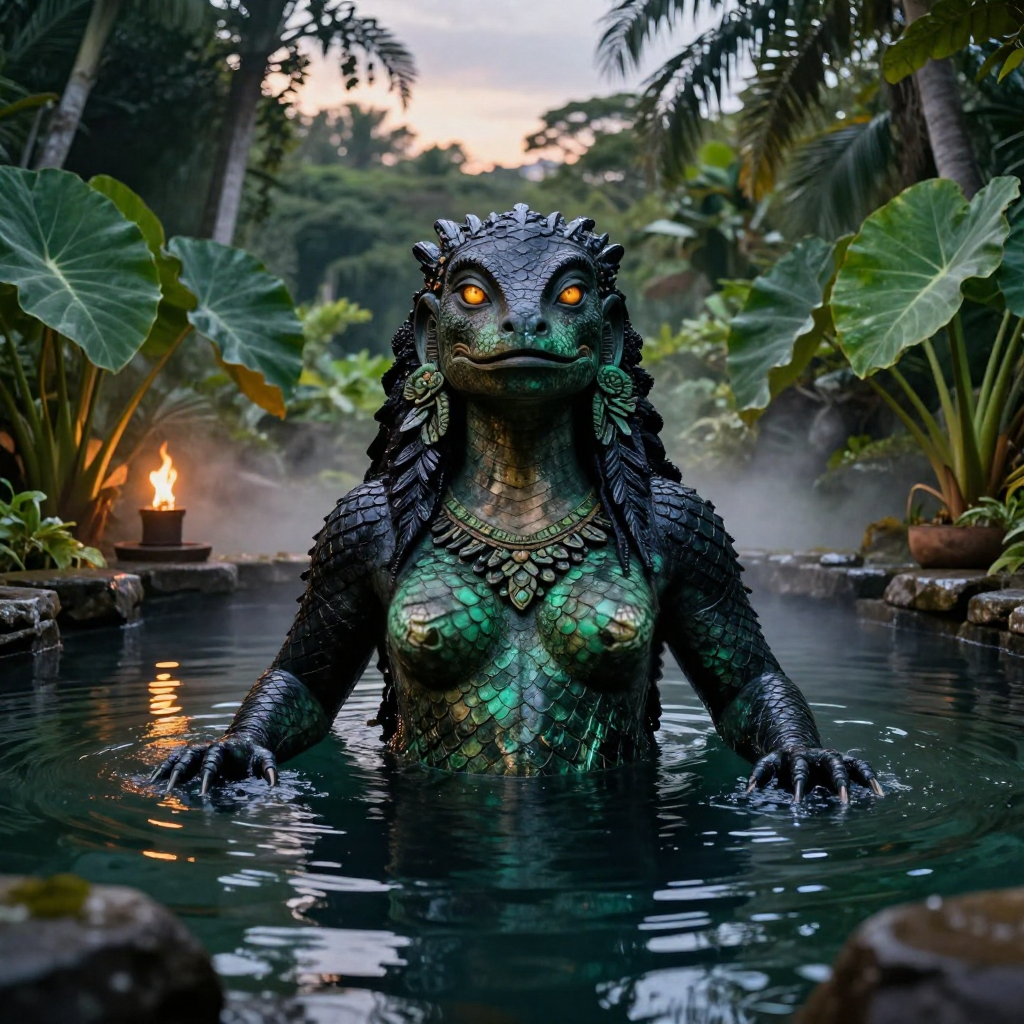
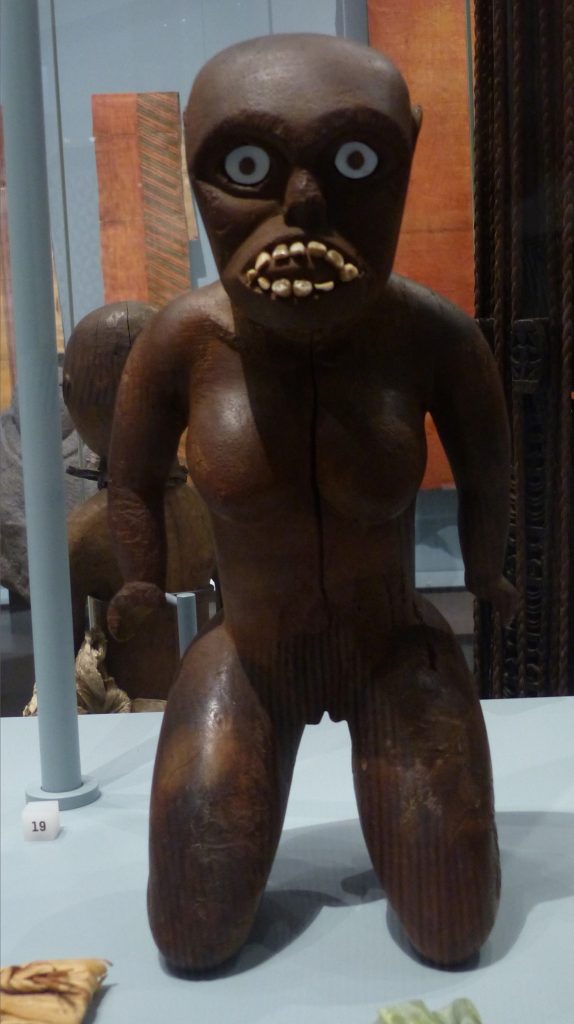
As a moʻo, Kihawahine’s physical form resists a single fixed description. In her most fearsome manifestation, she appears as a colossal water-dwelling lizard with a serpentine body, powerful jaws, and scales said to shimmer like wet stone under sunlight. These forms place her within a wider class of Hawaiian moʻo beings believed to inhabit fishponds, wetlands, and freshwater systems, guarding resources essential to survival. Her size and appearance shift according to context, reinforcing the belief that kino lau are expressions rather than limitations.
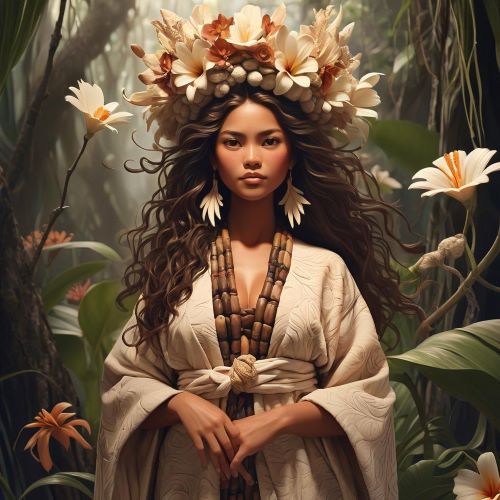
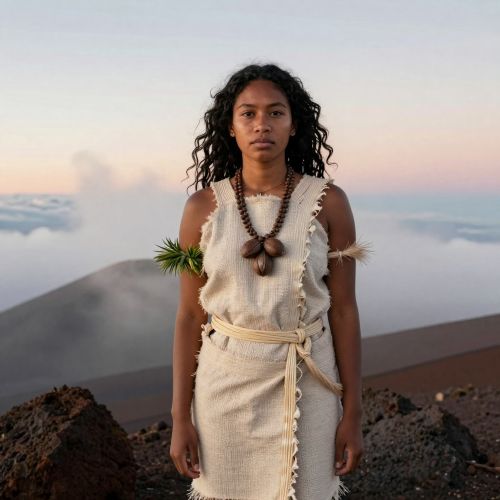
Equally important is her ability to appear in human form. Many moʻolelo describe Kihawahine emerging from ponds as a woman of striking beauty, only revealing her reptilian nature when boundaries are crossed or loyalty tested. This dual appearance reinforces her role as both protector and judge. In visual tradition, her presence is often symbolised rather than illustrated directly, appearing as flowing water lines, wave motifs, and dotted patterns in kapa and tattoo designs. These abstractions reflect her elemental nature, tying her body not to flesh alone but to movement, water, and place.
Family
Kihawahine’s power is inseparable from her genealogy. As the daughter of Piʻilani, a ruler credited with consolidating Maui through infrastructure, law, and sacred order, she inherited not only rank but responsibility. Her mother, Lāʻieloheloheikawai, was a piʻo wife, intensifying the sacred nature of her lineage and ensuring that Kalāʻaiheana’s transformation would carry enduring mana.
Following her deification, Kihawahine’s role expanded beyond her immediate family to encompass the ruling house of Kamehameha. As ʻaumakua to Keōpūolani, she became a spiritual anchor for a dynasty navigating unprecedented political change. Through chants and ritual remembrance, she is invoked as an ancestral presence who legitimised rule by aligning it with land, water, and continuity rather than conquest alone.
Other names
Kihawahine is known by several names that reflect her forms, locations, and phases of existence. Kalāʻaiheana refers to her human identity before deification, anchoring her divinity in lived history. Mokuhinia associates her with the sacred pond at Lāhainā, reinforcing her role as a guardian of freshwater systems. In some traditions she is referred to simply as Moʻo Kihawahine, emphasising her classification within the moʻo lineage rather than individual biography.
Regional variations preserve additional names that reflect local encounters and functions, highlighting the fluidity of Hawaiian sacred identity. Rather than fragmenting her mythology, these names collectively reinforce the idea that Kihawahine is not confined to one narrative but exists as a network of remembered presences tied to land and water across islands.
Powers and Abilities
Kihawahine’s powers emerge organically from her nature as a moʻo akua. Her association with freshwater grants her authority over fertility, abundance, and survival itself. Oral accounts describe her blessing fishponds with extraordinary yields or withdrawing her protection when kapu are violated. Water, in her mythology, is not passive but responsive, capable of nourishment or destruction depending on human conduct.
Her ability to shapeshift allows her to interact directly with people, often testing humility, hospitality, and respect for sacred space. As an ʻaumakua, she offers guidance through dreams, omens, and visions rather than direct speech. Politically, her presence functioned as spiritual endorsement. Carrying her image into battle was not an act of superstition but a declaration that leadership aligned with ancestral order. Through this role, Kihawahine bridges the human and divine, demonstrating how power in Hawaiian tradition is validated through balance rather than domination.
Modern Day Influence
Kihawahine remains a living presence in contemporary Hawaiian cultural memory. Her most visible modern appearance is as the figurehead of Hōkūleʻa, launched in 1975 by the Polynesian Voyaging Society. Placing her at the prow symbolised protection, navigation, and continuity with ancestral knowledge as Hawaiians reclaimed traditional wayfinding across the Pacific.
Sites associated with her, particularly Mokuʻula and Mokuhinia in Lāhainā, continue to hold cultural significance, especially amid restoration efforts following environmental and historical damage. Artists, tattoo practitioners, and cultural educators invoke Kihawahine as a symbol of female authority rooted in land stewardship. Rather than fading into folklore, she has become increasingly relevant within conversations on ecological protection, Indigenous governance, and cultural resurgence.
Related Images
Source
Beckwith, M. W. (1970). Hawaiian mythology. University of Hawaii Press.
Kamakau, S. M. (1991). Ka moʻolelo Hawaiʻi o Kīhāhāhine [Tales and traditions of the people of old]. Bishop Museum Press.
Pukui, M. K., & Elbert, S. H. (1986). Hawaiian dictionary (Rev. ed.). University of Hawaii Press.
Westervelt, W. D. (1915). Legends of Maui: A demigod. Honolulu Star-Bulletin.
Encounters with Kihawahine. In L. McDougall (Ed.), Sharks upon the land: Power and knowledge in Polynesia (pp. 1-20). Cambridge University Press. https://doi.org/10.23943/princeton/9780691211145.003.0001
Hawaiʻi Alive. (2020). Kihawahine. https://hawaiialive.org/kihawahine/
HILT. (2023). ʻO Kihawahine ka moʻo akua a Waiheʻe. https://www.hilt.org/blog/o-kihawahine-ka-moo-akua-a-waihee-kihawahinenbspthe-dragon-goddess-of-waihee
Wikipedia. (2020). Kihawahine. https://en.wikipedia.org/wiki/Kihawahine
Kanahele, G. S. (1992). Ku Kanaka: Stand Tall, A Search for Hawaiian Values. Honolulu: University of Hawaii Press.
Kirch, P. V. (2012). A Shark Going Inland Is My Chief: The Island Civilization of Ancient Hawai‘i. Berkeley: University of California Press.
Frequently Asked Questions
Who is Kihawahine in Hawaiian tradition?
Kihawahine is a deified aliʻi woman who became a powerful moʻo akua and guardian spirit associated with water, ancestry, and political authority.
Is Kihawahine a dragon goddess?
She is often described as dragon-like, but within Hawaiian belief she is classified as a moʻo, a sacred water-dwelling spirit.
What is Kihawahine associated with?
She is associated with freshwater ponds, fishpond fertility, shapeshifting, ancestral protection, and royal legitimacy.
How is Kihawahine connected to King Kamehameha?
She served as the ʻaumakua of Keōpūolani and the Kamehameha line, and her image was carried during key battles.
Is Kihawahine still important today?
Yes. She remains culturally significant through navigation traditions, site restoration, art, and Indigenous ecological philosophy.