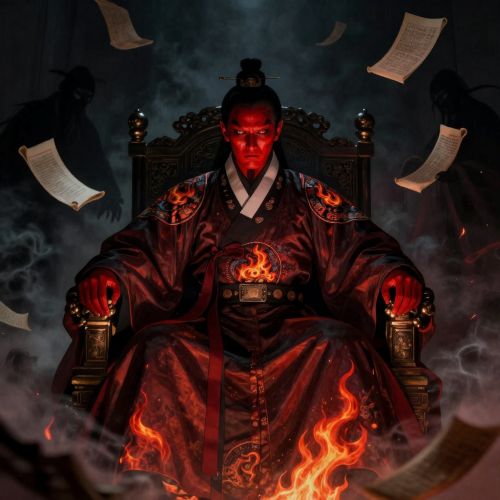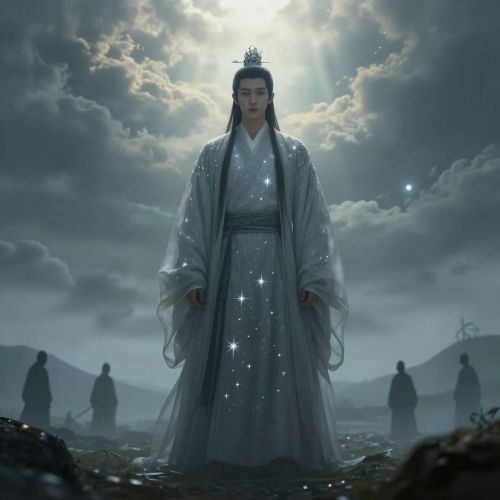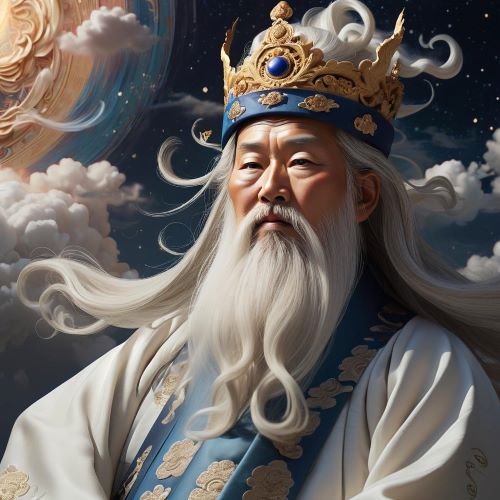


Daebyeol-wang : The Korean King of the Underworld
Listen
At a glance
| Description | |
|---|---|
| Origin | Korean Mythology |
| Classification | Gods |
| Family Members | Cheonji-wang (Father), Sobyeol-wang (Brother) |
| Region | Korean |
| Associated With | Underworld |
Daebyeol-wang
Introduction
Daebyeol-wang stands as one of the most important figures in Korean mythology, emerging from the shamanic creation traditions of Jeju Island. His story is preserved primarily through the Cheonji-wang bon-puri, a sacred narrative recited during ritual performances that explain the origins of cosmic order, death, and justice. Born as one of twin sons to the heavenly deity Cheonji-wang and a mortal woman, Daebyeol-wang represents the principle of moral balance that governs existence beyond human life. While his brother Sobyeol-wang becomes the ruler of the living world, Daebyeol-wang assumes authority over the realm of the dead, transforming death into a structured and meaningful continuation of cosmic law.
The myth unfolds through a series of divine trials that reveal the contrasting natures of the twins. Though Daebyeol-wang demonstrates wisdom, fairness, and restraint, he ultimately yields dominion over the human world to his more cunning brother. This voluntary surrender is not a loss but a deliberate choice, rooted in the understanding that the flawed realm of the living requires harsher rule, while the afterlife must remain a place of impartial judgment. Through this decision, Daebyeol-wang becomes the guardian of ethical order, ensuring that justice denied in life is restored in death. His myth reflects a deeply Korean worldview in which imbalance in the mortal realm is corrected beyond it.
Physical Traits
Korean shamanic mythology rarely emphasizes detailed physical descriptions, and Daebyeol-wang is no exception. His identity is conveyed more through action, authority, and symbolic presence than through fixed bodily form. Nevertheless, contextual elements within the myths imply a figure of immense strength and commanding stature. Daebyeol-wang and his twin are described as capable of forging and wielding iron arrows weighing hundreds of catties, a feat that suggests superhuman power far beyond mortal limits.
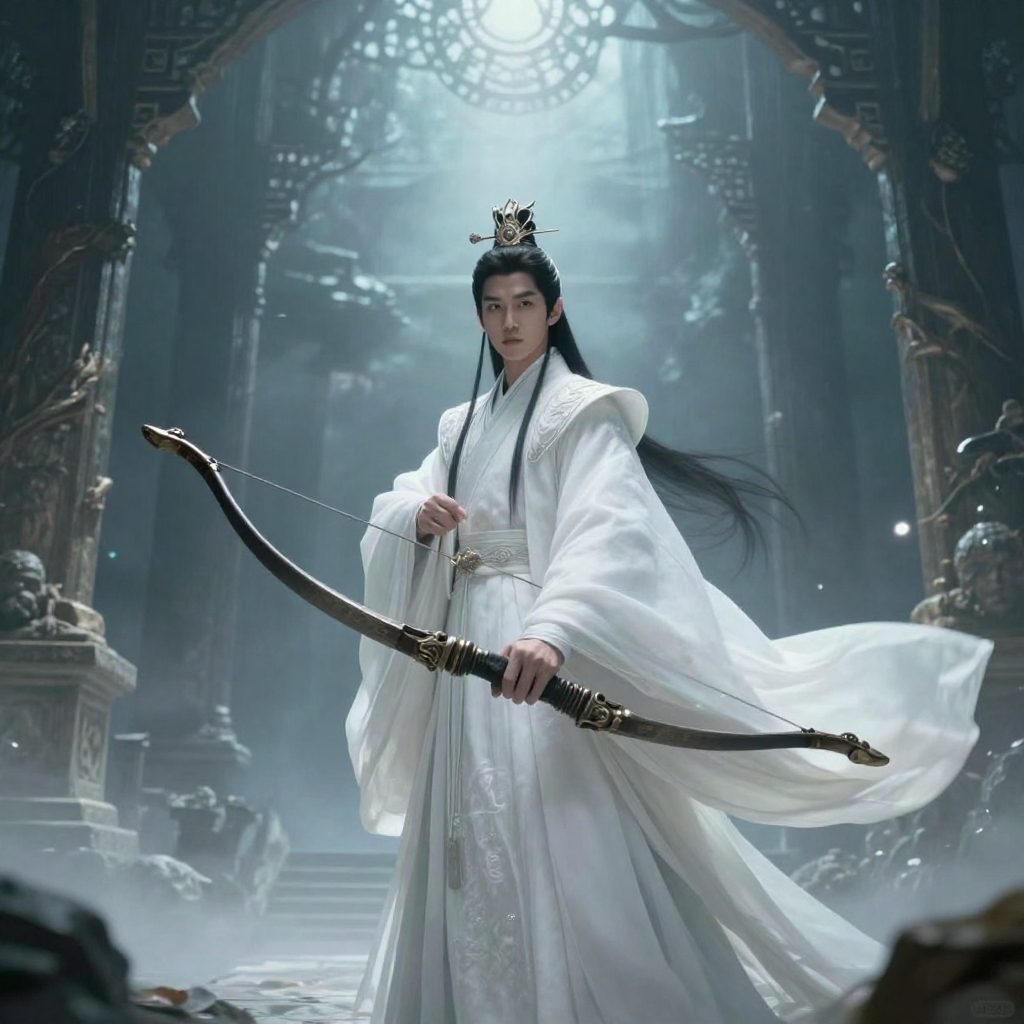
In ritual performances, Daebyeol-wang is envisioned as a dignified and solemn king, often associated with purity and moral clarity rather than terror. He is commonly portrayed in white or pale ceremonial robes, colors that symbolize justice, transcendence, and separation from earthly corruption. Archery motifs appear frequently, referencing his role in shooting down the duplicated suns and moons that once threatened cosmic stability. Rather than a fearsome god of death, Daebyeol-wang’s presence evokes calm authority, reinforcing the idea that the underworld is not chaos, but structured order.
Family
Daebyeol-wang’s lineage lies at the heart of his mythological significance. He is the son of Cheonji-wang, the primordial sky deity who descends to the human world after creation. His mother is a mortal woman whose union with Cheonji-wang symbolizes the fusion of heaven and earth, a recurring theme in Korean shamanic cosmology. This divine–human origin establishes Daebyeol-wang as a liminal figure, uniquely suited to govern the boundary between life and death.
His twin brother Sobyeol-wang forms the central relational tension of the myth. Though born together and assigned complementary roles, their moral paths diverge sharply. Sobyeol-wang’s rule over the living world is marked by deception and disorder, while Daebyeol-wang’s authority in the afterlife is defined by fairness and restraint. The absence of spouses or descendants in Daebyeol-wang’s narrative further reinforces his function as an eternal judge rather than a dynastic ruler. His loyalty is not to lineage, but to cosmic law.
Other names
The name Daebyeol-wang literally translates to “Great Star King,” a title that emphasizes celestial authority and hierarchical balance. This stands in deliberate contrast to Sobyeol-wang, whose name means “Small Star King,” reinforcing the twin motif of paired opposites. In Jeju shamanic chants, Daebyeol-wang may be invoked simply as “Daebyeol” or referred to through honorific titles emphasizing his role as ruler of the underworld.
Variations in Romanization appear in academic texts, including forms such as Taebyeol-wang, but the identity remains consistent across versions of the Cheonji-wang bon-puri. Unlike many mythological figures who acquire numerous regional aliases, Daebyeol-wang’s name remains stable, reflecting the clarity and constancy of his moral role. His title is less about personal identity and more about function within the cosmic order.
Powers and Abilities
Daebyeol-wang’s powers center on regulation, judgment, and restoration of balance. One of his earliest recorded feats is participating in the destruction of the duplicated suns and moons, an act that stabilizes time, climate, and natural rhythm. This event establishes him as a force capable of correcting cosmic excess. His skill with archery symbolizes precision and discernment rather than brute force.
As ruler of the underworld, Daebyeol-wang governs the fate of human souls after death. He is responsible for sorting, judging, and assigning consequences based on moral conduct in life. Unlike punitive figures driven by vengeance, Daebyeol-wang embodies impartial justice. Shamanic traditions credit him with silencing chaotic forces, regulating natural sounds, and removing disorderly elements from existence. His power lies not in domination, but in enforcement of fairness where it was previously denied.
Modern Day Influence
Daebyeol-wang continues to shape cultural and spiritual life on Jeju Island, where the Cheonji-wang bon-puri is still performed in ritual contexts. These performances are not symbolic reenactments but living religious acts that connect communities to ancestral cosmology. Annual village rites commemorate the ascent of the twin kings, reinforcing the myth’s relevance in everyday life.
Beyond ritual, Daebyeol-wang influences modern Korean storytelling, particularly in narratives exploring moral duality, justice, and the afterlife. His archetype appears indirectly in fantasy literature, webtoons, and games that draw upon Korean mythological frameworks. As global interest in indigenous Korean spirituality grows, Daebyeol-wang increasingly represents a distinctly Korean vision of death—not as annihilation, but as ethical reckoning.
Related Images
Source
Hwang, S. (1980). A study on Korean creation myths. Seoul National University Press.
Kim, H. (2015). Korean shamanism: Myths and rituals. University of Hawaii Press.
Korean Encyclopedia of National Culture. (2022). Daebyeol-wang. https://encykorea.aks.ac.kr
Lee, Y. (2005). Myths of Jeju Island. Dolbegae Publishers.
Namu Wiki. (2024). Daebyeolwang and Sobyeolwang. https://en.namu.wiki/w/%EB%8C%80%EB%B3%84%EC%99%95%EA%B3%BC%20%EC%86%8C%EB%B3%84%EC%99%95
Seo, D. (1980). Framework of Korean cosmogonies. Seoul National University.
Wikipedia contributors. (2024). Korean mythology. https://en.wikipedia.org/wiki/Korean_mythology
Choi, G.-H. (2000). Korean mythology: An oral tradition. Seoul: Jimoondang Publishing.
Kim, T.-Y. (2011). Myths of Korea: Shamanic narratives and cultural identity. Seoul: Ewha Womans University Press.
Lee, P.-H. (1984). Sourcebook of Korean civilization: Volume I. New York: Columbia University Press.
Seo, D.-S. (1996). Korean shamanism: The cultural heritage of Jeju Island. Honolulu: University of Hawai‘i Press.
Kendall, L. (1985). Shamans, housewives, and other restless spirits: Women in Korean ritual life. Honolulu: University of Hawai‘i Press.
Frequently Asked Questions
Who is Daebyeol-wang in Korean mythology?
Daebyeol-wang is the ruler of the underworld in Jeju shamanic mythology, responsible for justice and moral order after death.
Is Daebyeol-wang a god of death?
He is not a god of death itself, but a divine judge who governs the realm where souls are judged after death.
What is the difference between Daebyeol-wang and Sobyeol-wang?
Daebyeol-wang rules the afterlife with fairness, while Sobyeol-wang governs the human world through cunning and imbalance.
Where does the myth of Daebyeol-wang originate?
His story originates from Jeju Island’s Cheonji-wang bon-puri, a foundational shamanic creation narrative.
Is Daebyeol-wang still worshipped today?
He is invoked in traditional Jeju shamanic rituals and remains a vital figure in Korean spiritual heritage.