


Chauta : The Supreme Creator of the Chewa Tradition
Listen
At a glance
| Description | |
|---|---|
| Origin | Chewa Mythology |
| Classification | Gods |
| Family Members | N/A |
| Region | Malawi, Zambia, Mozambique |
| Associated With | Creation, Rain, Fertility |
Chauta
Introduction
Among the Chewa people of southern Africa, spiritual understanding is inseparable from the rhythms of nature, ancestry, and moral order. At the heart of this worldview stands Chauta, the supreme creator deity revered across present-day Malawi, Zambia, and Mozambique. Chauta is understood not merely as a distant creator but as the sustaining intelligence behind rain, fertility, and cosmic balance. His presence governs the cycles that allow life to flourish, making him both a universal force and an intimate guardian of everyday survival.
Chewa oral tradition describes a time before humanity when the earth lay barren beneath an endless blue sky. When storms first broke this silence, Chauta descended from the heavens, bringing life itself into being. This foundational myth places him at the origin of humanity, animals, vegetation, and moral law. Through storytelling, ritual performance, and seasonal observance, Chauta remains woven into Chewa identity as the divine authority who established harmony and withdrew only after humans violated sacred trust.
Physical Traits
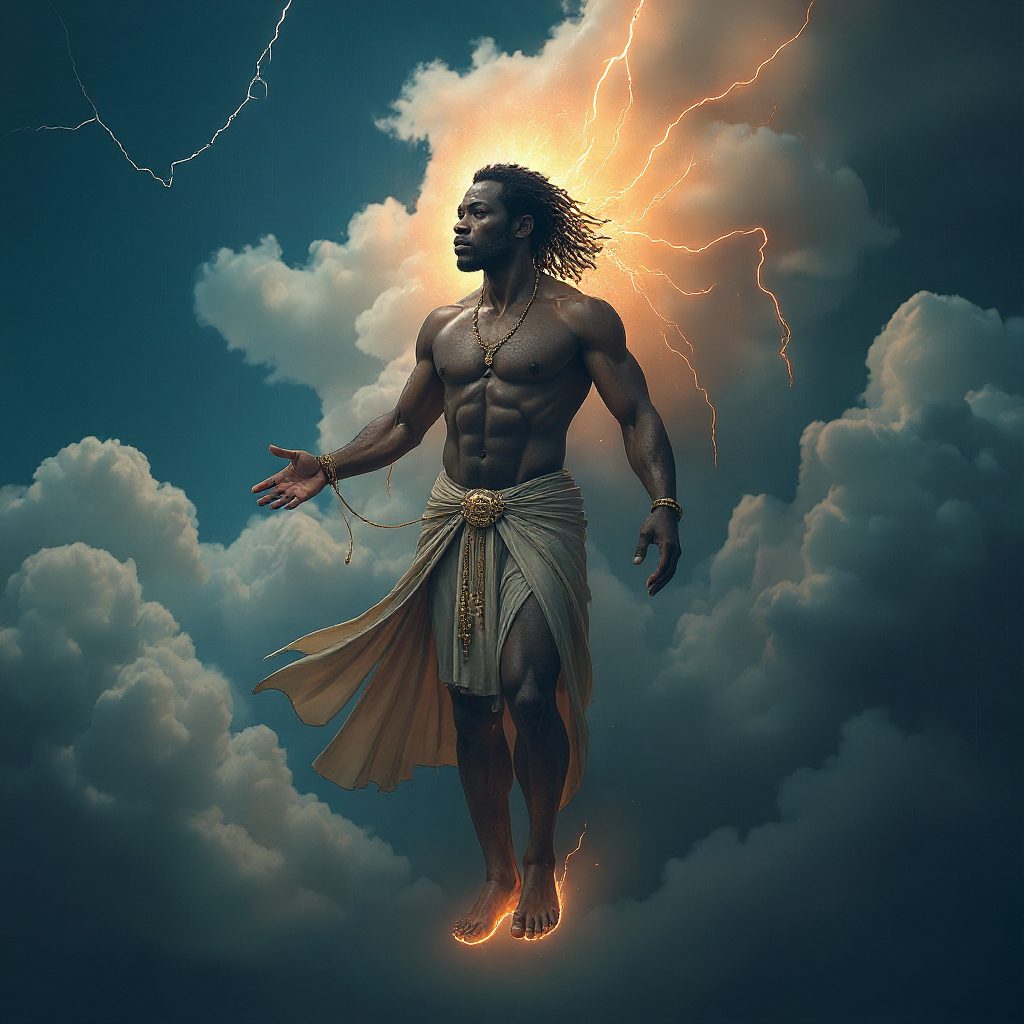
Chauta is not imagined in human form, nor confined to statues or icons. His appearance is conveyed through symbolism rooted in nature and mythic action. Most famously, Chauta manifests as a spider during his descent from the sky, lowering himself to earth on a silken thread amid thunder, lightning, and rain. This form reflects intelligence, creative precision, and the ability to connect distant realms, with the spider’s thread serving as a bridge between heaven and earth.
Beyond this mythic moment, Chauta is perceived through elemental forces rather than physical shape. Storm clouds gathering, lightning splitting the sky, and rainbows arching across the horizon all signal his presence. These phenomena are not metaphors but expressions of divine reality within Chewa cosmology. By avoiding anthropomorphic imagery, Chewa belief emphasizes that Chauta transcends human limitation, existing as an omnipresent force embedded within the natural world itself.
Family
Unlike deities embedded in elaborate genealogies, Chauta stands alone as the original source of existence. He has no consort, parents, or divine offspring described in Chewa tradition. Instead, his relationship to humanity is framed through creation rather than lineage. When Chauta descended to earth, he brought with him the first man and woman, animals, and plants, establishing the foundations of life rather than forming a divine household.
In this framework, ancestors occupy a crucial intermediary role. While not family members of Chauta, ancestral spirits derive their authority from him and act as custodians of moral order. They maintain communication between the living community and the divine realm, especially during rituals connected to rain, fertility, and social harmony. This structure reinforces the idea that Chauta’s “family” is creation itself, bound together through responsibility rather than blood.
Other names
Chauta is closely associated with the name Chiuta, a term widely used among neighboring Bantu-speaking communities, particularly the Tumbuka. Linguistically, Chiuta is often interpreted as “Great Bow,” a reference to the rainbow that appears after rain. This symbolism highlights the deity’s role as rain-giver and cosmic mediator, linking sky and earth through visible signs.
While Chauta emphasizes supreme creative authority within Chewa tradition, Chiuta foregrounds meteorological power and renewal. These names are not competing identities but complementary expressions shaped by regional language and oral transmission. Their coexistence illustrates the fluid nature of African spiritual systems, where divine names adapt without altering core meaning.
Powers and Abilities
Chauta’s abilities encompass the full scope of existence, beginning with creation itself. He is credited with transforming a lifeless world into a fertile landscape by introducing humans, animals, and vegetation simultaneously. Rain is central to this creative power, as it activates growth and sustains agricultural life, making Chauta indispensable to survival.
Equally important is his role as regulator of moral and ecological order. The well-known myth of fire recounts how humans disobeyed Chauta’s warning against careless use of sticks, resulting in wildfire that shattered harmony between people and wild animals. This act did not diminish Chauta’s authority but revealed it, as natural consequences enforced divine law. Thunder and lightning serve as reminders of this power, reinforcing balance through awe rather than constant intervention.
Modern Day Influence
Chauta’s influence continues to shape Chewa cultural life despite centuries of social change. Ritual traditions associated with the Nyau secret society, particularly masked performances known as Gule Wamkulu, preserve ancestral knowledge and reinforce cosmological values linked to Chauta’s authority. These performances, recognized internationally for their cultural significance, encode lessons about respect for nature, community order, and spiritual accountability.
Agricultural communities still associate rainfall with divine favor, and prayers for rain often implicitly invoke Chauta’s role as life-giver. Even within Christian contexts, many Chewa people interpret Chauta as compatible with monotheistic belief, viewing him as the supreme creator acknowledged before missionary influence. In contemporary scholarship, environmental discourse, and cultural revitalization efforts, Chauta is increasingly recognized as a symbol of indigenous ecological wisdom and spiritual resilience.
Related Images


Source
Banda, D. (n.d.). Folklore as an instrument of education among the Chewa. http://www.zambiancu.org/1zRead/BandaD-FolkloreAndEducation.pdf
Chewa story of creation. (2012, March 17). Explore Malawi. http://exploremalawi.blogspot.com/2012/03/chewa-story-of-creation.html
Chiuta. (n.d.). In Chewa.pdf. University of Missouri.
https://dice.missouri.edu/assets/docs/niger-congo/Chewa.pdf
Comboni Missionaries. (2020, June 25). African tradition and religion: The sacredness of nature.
https://combonimissionaries.ie/2020/06/25/african-tradition-and-religion-the-sacredness-of-nature/
Scott, C., Myers, C., & Orr, G. J. (n.d.). Le-ling Chichewa: Book 2, lessons 11-20. Peace Corps. https://www.academia.edu/85676214/Scottcn_Carol_Myers_Orr_Gregory_John_TITLE_Le_ling_Chichewa_Book_2_Lessons_11_20_Peace_Corps_L
The Chewa creation myth. (2008, May 28). Arntz Grays. http://arntzgrays.blogspot.com/2008/05/chewa-creation-myth.html
The Malawi’s legends and faith. (2024, February 15). ACU MWK. https://www.acumwk.com/the-malawis-legends-and-faith/
TalkAfricana. (2024, November 19). Chiuta’s gift: The Tumbuka creation story and the origins of life and death. Retrieved December 21, 2025, from https://talkafricana.com/chiutas-gift-the-tumbuka-creation-story-and-the-origins-of-life-and-death/
Wikipedia contributors. (n.d.). Nyau. In Wikipedia. Retrieved December 21, 2025, from https://en.wikipedia.org/wiki/Nyau
Brown, L. (2001). Myths and legends of Africa. New York: Rosen Publishing Group.
Frequently Asked Questions
Who is Chauta in Chewa belief?
Chauta is the supreme creator deity of the Chewa people, responsible for creation, rain, fertility, and moral order.
Why is Chauta associated with a spider?
The spider symbolizes Chauta’s descent from the sky and his role as a cosmic connector between heaven and earth.
Is Chauta the same as Chiuta?
Yes, Chiuta is a regional name emphasizing Chauta’s role as rain-giver and cosmic mediator.
What lesson does the fire myth of Chauta teach?
The myth warns against environmental irresponsibility and disobedience to divine order.
Is Chauta still worshipped today?
Chauta remains influential through ritual, oral tradition, ancestral rites, and cultural identity.
