Áine : The Irish Goddess of Summer, Fertility, and Sovereignty
Listen
At a glance
| Description | |
|---|---|
| Origin | Irish Mythology |
| Classification | Gods |
| Family Members | Egobail, Manannán mac Lir, the Dagda (Parents), Aillen, Fennen, Fer Fí (Siblings) |
| Region | Ireland |
| Associated With | Fertility, Summer, Love, Sovereignty, Light, Healing |
The Mythlok Perspective
From the Mythlok perspective, Áine represents a form of power that is conditional rather than absolute. Her authority flows from harmony with land and consent, not conquest. Unlike solar goddesses who dominate through command, Áine governs through reciprocity, rewarding respect and withdrawing favor when boundaries are crossed. This places her closer to figures like Amaterasu of Japan, who sustains order through presence, and Demeter of Greece, whose fertility responds directly to human action. Áine reminds us that prosperity, ancient or modern, is never automatic; it is earned through balance with the forces that sustain life.
Aine
Introduction
Aine stands among the most luminous figures of Irish sacred tradition, embodying summer’s fullness, fertile land, love, and the ancient idea of kingship bound to place. Her stories emerge from early oral tradition and later medieval sources such as Cormac’s Glossary from around the ninth century, where her name is directly linked with brightness and radiance. Áine is not merely a seasonal goddess; she represents the living contract between ruler, people, and land, where prosperity depends on respect, balance, and moral authority.
Her cult was strongest in Munster, particularly around Cnoc Áine, now known as Knockainey Hill in County Limerick. Midsummer rites held there involved fire rituals meant to bless crops, cattle, and communities, customs that survived into the nineteenth century. Through these practices, Áine became woven into everyday rural life, not as a distant deity but as an ever-present force whose favor shaped harvests, lineage, and legitimacy. Across myth and folklore, she also appears as a fairy queen, bridging divine tradition and later sídhe beliefs, which allowed her worship to persist even as Ireland’s spiritual landscape changed.
Physical Traits
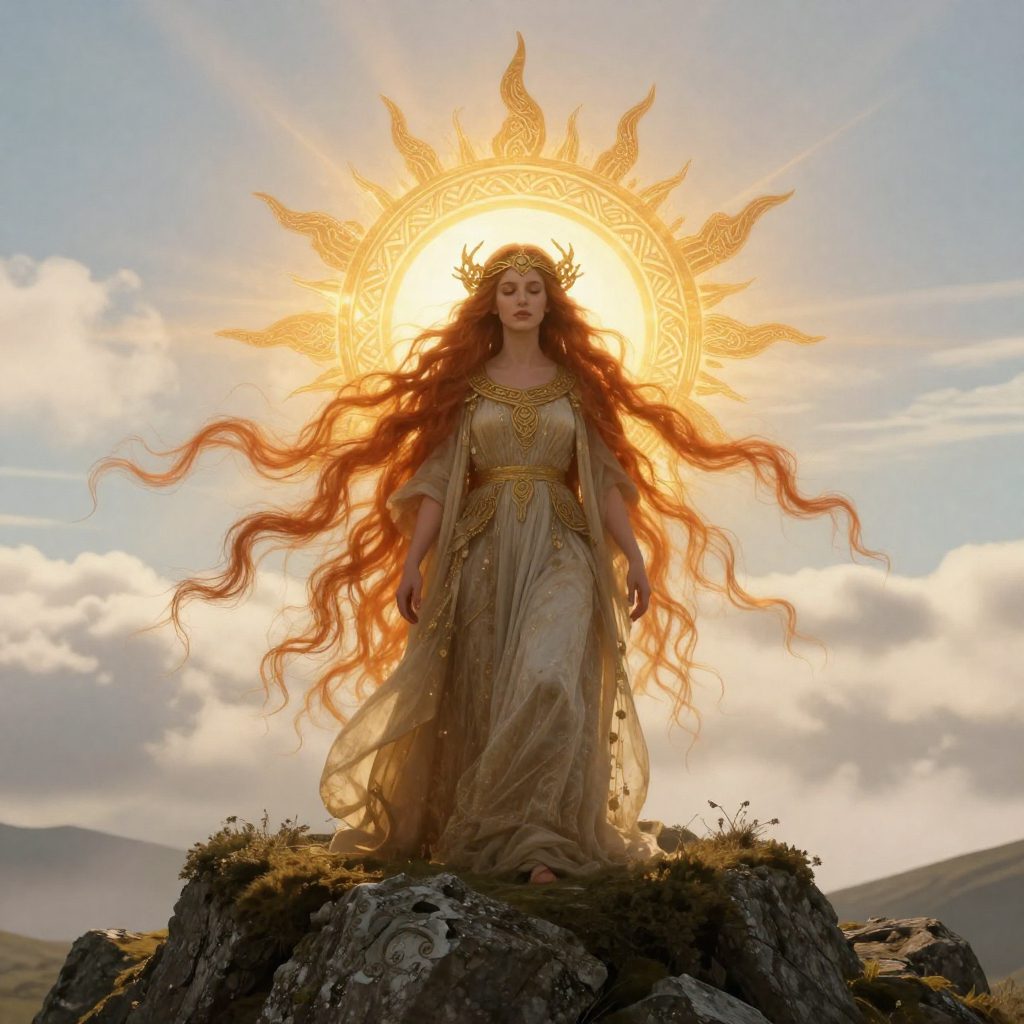
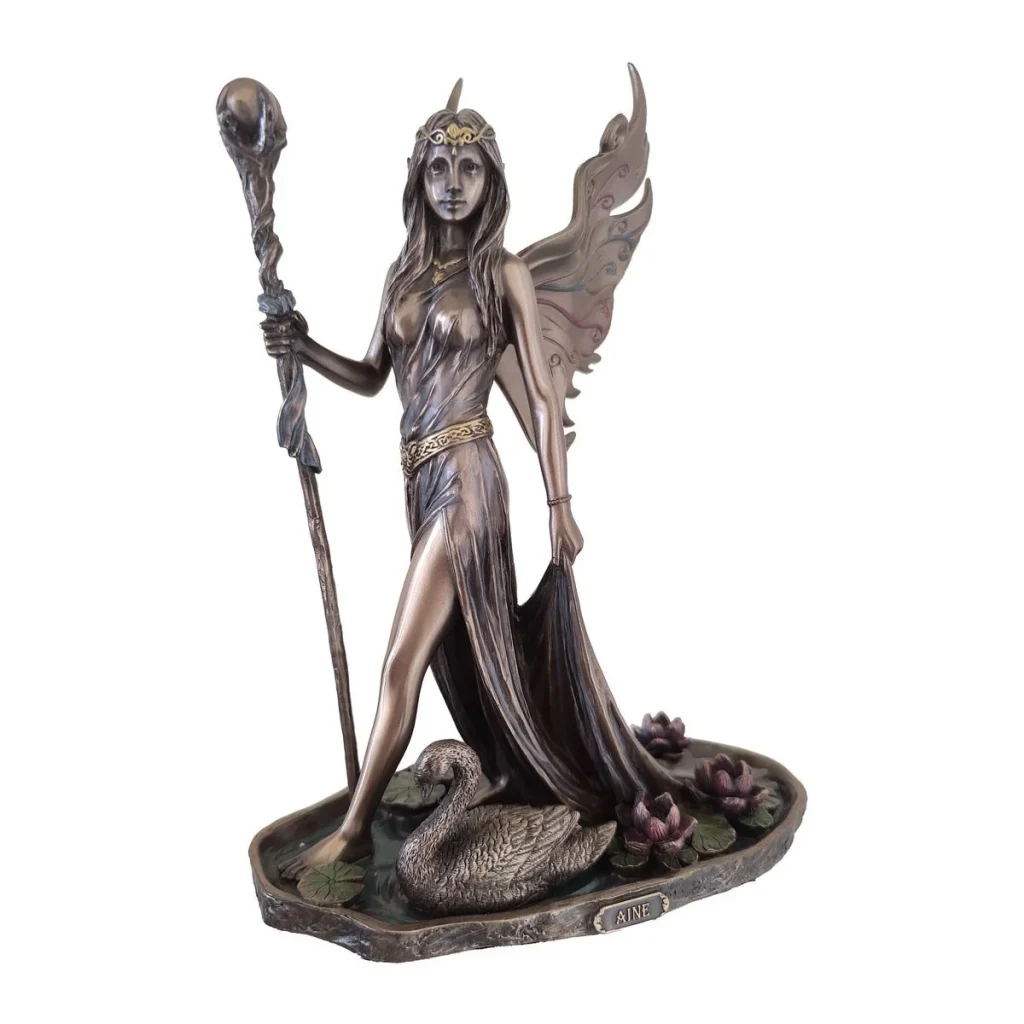
Áine is consistently described as a woman of striking beauty whose appearance reflects the season she governs. Folklore paints her with long golden or reddish hair that shines like sunlight on water, often seen combing it beside lakes or rivers. This imagery reinforces her association with vitality, warmth, and abundance, while also emphasizing her liminal nature as a being who moves easily between worlds.
Her radiance is not purely gentle. In several traditions, Áine can appear as a red mare, a powerful symbol in Irish culture associated with fertility, sovereignty, and the testing of kings. This equine form underscores her authority over land and rulership, as horses were deeply tied to territorial power. Other accounts hint at fiery or even draconic aspects, suggesting that beneath her beauty lies a formidable elemental force capable of protection and punishment alike. These shifting forms present Áine as both nurturing and dangerous, a goddess whose allure commands reverence rather than possession.
Family
Áine’s genealogy varies depending on region and source, reflecting the fluid nature of Irish myth. She is most commonly named as the daughter of Egobail, a figure associated with the Tuatha Dé Danann, the divine race of early Ireland. In other traditions, she is linked to Manannán mac Lir or even the Dagda, sometimes as daughter, sometimes as consort or fostered kin. Rather than contradictions, these variations highlight her importance across multiple mythic lineages.
She is often described as the sister of figures such as Aillen or Fennen and is occasionally tied to royal families of Munster as an ancestral goddess. These claims reinforced her role as a sovereignty figure, grounding political authority in sacred descent. A lesser-known but evocative figure in her mythos is her brother Fer Fí, a dwarf harpist whose music could soothe the dying. Through these familial connections, Áine occupies a central place within the divine network of Irish tradition, linking land, lineage, and legitimacy.
Other names
Áine’s many titles reflect her wide reach and enduring local devotion. She is frequently called Áine Chlair, meaning Bright Áine, emphasizing her solar aspect. As Áine of Knockainey, she becomes inseparable from the landscape itself, transforming a hill into a sacred presence. Folklore also refers to her as Queen of the Fair Folk, placing her at the head of the sídhe and blurring the boundary between goddess and fairy ruler.
Other epithets associate her with protection and generosity, such as references to her mantle, Brat Áine, believed to shield those under her care. While she is sometimes confused with figures like Anu or Danu due to overlapping fertility themes and phonetic similarity, Áine remains distinct in her strong connection to midsummer, sovereignty, and personal autonomy. Her names, embedded in wells, hills, and placenames, preserve her memory long after formal worship faded.
Powers and Abilities
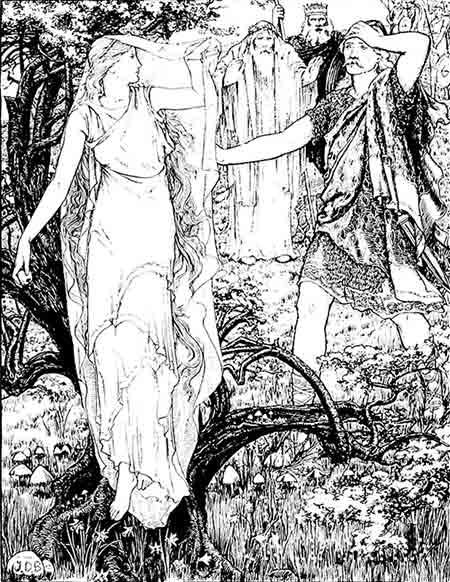
Áine’s powers center on fertility in all its forms, extending from crops and cattle to human love and lineage. She was invoked to ensure rich harvests, healthy livestock, and successful unions, making her essential to agrarian life. Her sovereignty role is one of her most defining traits. Myths describe how kings required her favor to rule, and how those who violated her autonomy were punished. The tale of Ailill Aulom, whom she maimed for assaulting her, illustrates how moral failure rendered a king unfit to rule.
Beyond fertility and kingship, Áine commands healing, protection, and enchantment. Sacred wells associated with her were believed to cure illness, while her fairy authority allowed her to shape landscapes and fortunes overnight. Her shapeshifting abilities, particularly into a red mare, reinforce her dominion over land and instinctual power. Solar symbolism links her to light itself, carried through midsummer bonfires whose ashes were spread on fields for blessing. These abilities together present Áine as a guardian of balance, rewarding respect and punishing transgression.
Modern Day Influence
Áine’s presence remains strong in modern Ireland and beyond. Midsummer celebrations at Knockainey, though now largely symbolic, continue to echo ancient fire rites. In contemporary spirituality, especially within Neo-Pagan and Celtic reconstructionist traditions, she is honored as a goddess of love, fertility, and sovereignty, often invoked during solstices and seasonal rites.
In literature, music, and visual art, Áine appears as a symbol of Irish identity and empowered femininity. Her stories resonate with modern environmental thought, framing land not as a resource to be exploited but as a living partner demanding respect. She also influences fantasy portrayals of fairy queens and solar goddesses, shaping popular imagination far beyond Ireland. Even her name, meaning radiance or delight, continues to be chosen for children, reflecting her lasting cultural warmth.
Related Images
Source
Byrne, F. J. (2001). Irish kings and high-kings (2nd ed.). Four Courts Press.
Ellis, P. B. (1994). Dictionary of Celtic mythology. Oxford University Press.
MacKillop, J. (1998). Dictionary of Celtic mythology. Oxford University Press.
Ó hÓgáin, D. (1991). Myth, legend and romance: An encyclopaedia of the Irish folk tradition. Prentice Hall Press.
Wood, J. (2002). The Celts: Life, myth, and art. Thorsons.
Irish Mythology Stories. (2024, June 26). Áine: The goddess of love, light, and sovereignty.
https://irishmythologystories.substack.com/p/aine-the-goddess-of-love-light-and
Wikipedia. (n.d.). Áine. Retrieved January 23, 2026, from https://en.wikipedia.org/wiki/%C3%81ine
Celtic Creatives. (2024, June 24). Goddess & fairy queen Áine, bringer of destiny. https://celticcreatives.substack.com/p/goddess-and-fairy-queen-aine-bringer
Frequently Asked Questions
Who is Áine in Irish tradition?
Áine is a revered Irish goddess associated with summer, fertility, love, and the sacred authority of kingship.
What is Áine the goddess of?
She governs midsummer, agricultural abundance, romantic love, healing, and sovereignty over the land.
Where was Áine worshipped?
Her primary cult center was Cnoc Áine, or Knockainey Hill, in County Limerick, Ireland.
Is Áine a fairy or a goddess?
Áine is originally a goddess of the Tuatha Dé Danann who later appears in folklore as a fairy queen.
What does the name Áine mean?
Áine derives from Old Irish meaning brightness, radiance, or delight.