

Akongo : The Supreme Originator in Ngombe Traditions
Listen
At a glance
| Description | |
|---|---|
| Origin | Ngombe Mythology |
| Classification | Gods |
| Family Members | Mbokomu (Daughter) |
| Region | Democratic Republic of the Congo |
| Associated With | Creation |
Akongo
Introduction
Akongo is recognised as the supreme creator god in the mythology of the Ngombe people, a Bantu-speaking community living along the Congo River basin in what is today the Democratic Republic of the Congo. In Ngombe belief, Akongo is responsible for the formation of the universe and everything within it—from the land and rivers to the earliest ancestors who shaped human society. His mythology expresses the deep connection the Ngombe maintain between the spiritual and material worlds, where divine presence influences moral order, social harmony, and the rhythms of nature.
Although Akongo is central to creation, he is not a god who remains constantly involved in daily life. Early myths recount a time when he lived among humans, guiding them and ensuring balance. However, repeated conflict and disobedience drove him to retreat to the heavens. This act of withdrawal forms the foundation of the Ngombe worldview: while the creator watches over existence, the responsibility for maintaining harmony lies with humanity and the ancestral spirits. Akongo’s myth is therefore not simply a creation narrative but a reflection of the Ngombe understanding of accountability, cosmic order, and the fragile relationship between humans and the divine.
Physical Traits
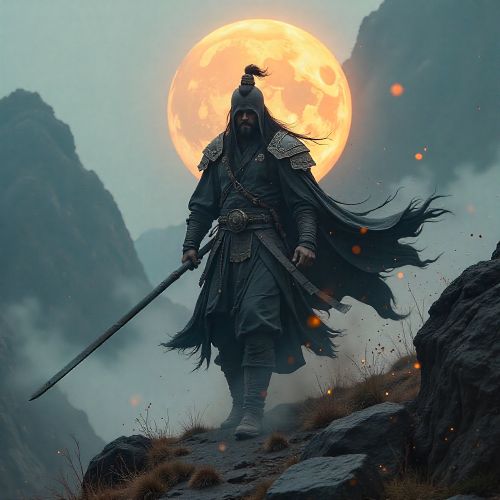
Akongo is not described with specific physical features in Ngombe tradition, a characteristic that sets him apart from many deities across world mythologies. His presence is spiritual rather than corporeal, suggesting a being whose essence cannot be contained in human imagination. The absence of physical imagery also reinforces his elevated status; gods who shape reality and govern cosmic forces often remain beyond anthropomorphic limits.
Nevertheless, oral storytellers often speak of Akongo as a presence that once felt close and approachable. The famous tale of his departure—climbing a rope to heaven and removing it afterward—evokes a vivid sense of motion and intention without defining what he looked like. In artistic reinterpretations, modern illustrators and scholars sometimes imagine him as a radiant elder or a sky-bound figure symbolising wisdom, authority, and separation from earthly imperfection. These depictions, however, are interpretations rather than traditional descriptions, serving to visualise a deity whose true form remains purposefully undefined.
Family
Family plays a crucial role in Akongo’s myth, particularly through his daughter Mbokomu, a foundational figure in Ngombe cosmology. According to legend, life in the heavens was disrupted by Mbokomu’s actions, prompting Akongo to send her to Earth in a large basket together with her two children. Once on Earth, she became the ancestor of all humankind, shaping agricultural practices, social customs, and the beginnings of civilisation. Her descendants populate the world, making Akongo the ultimate patriarch of humanity.
This story mirrors broader Bantu themes where divine beings withdraw but leave behind intermediaries who influence the human realm. Mbokomu’s presence bridges that gap, embodying both divine origin and human imperfection. Through her lineage, Akongo remains linked to humanity, even though he no longer intervenes directly. The myth also underscores the idea that creation is not only an act of divine power but a continuing legacy carried forward through families, communities, and ancestral spirits.
Other names
Among the Ngombe, the name Akongo is consistent and widely used, reflecting his singular status as the supreme creator. Unlike gods from more expansive pantheons who gather multiple titles or epithets, Akongo’s identity remains stable across storytelling traditions. In some neighbouring Bantu cultures, creator gods may share similar roles and linguistic roots. Names such as Nzambi, Nzambe, or Nyambe appear in the wider Congo basin, and though sometimes compared to Akongo by researchers, they belong to distinct traditions with their own mythologies.
The simplicity of his naming reflects his uniqueness: Akongo is not one deity among many but the single origin point of all creation. His consistent designation strengthens his position in Ngombe spirituality and ensures that his identity remains easily recognisable within the community and across generations.
Powers and Abilities
Akongo’s powers align with his position as a creator deity who shaped everything that exists. He is believed to have formed the first humans, the natural landscape, the animals, and the cosmic order governing the world. This creative authority places him at the top of the Ngombe spiritual hierarchy. Yet Akongo’s powers extend beyond creation into the realm of moral judgment and cosmic regulation.
His withdrawal from Earth serves as a significant display of his power. By removing himself from human reach, Akongo demonstrates his ability to reshape the divine–human relationship. He remains aware of human actions, but his influence is exerted indirectly through the ancestral spirits who watch over families and communities. The decision to send Mbokomu to Earth reflects his capacity to guide humanity even from a distance, ensuring the continuation of life while emphasising human responsibility.
Akongo’s nature is not purely benevolent or punitive. Instead, he embodies the complexities of creation itself—a god who nurtures but also withdraws, who grants life but demands harmony. This duality makes him an especially compelling figure in African mythological studies, standing apart from more interventionist creator gods in other world traditions.
Modern Day Influence
Akongo’s mythology continues to shape Ngombe identity in the modern era. Oral traditions remain vital, with elders recounting creation stories during community gatherings and rituals. While Christianity has become widespread in the Congo region, many Ngombe communities incorporate elements of Akongo’s myth into their spiritual worldview, blending indigenous beliefs with Christian teachings. In such syncretic interpretations, Akongo is sometimes aligned with the Christian God, though the cultural nuances of his story remain uniquely rooted in Ngombe heritage.
In academic contexts, Akongo features prominently in studies of Central African cosmology, helping scholars understand how Bantu societies conceptualise creation, morality, and divine distance. His story also appears in contemporary digital storytelling platforms like Mythlok, which introduce global audiences to African mythologies often overshadowed by Greek, Norse, or East Asian traditions. Through these modern interpretations, Akongo becomes not only a cultural figure but a symbol of African heritage preservation.
Artists, writers, and educators continue to draw inspiration from Akongo’s narrative, using it to explore themes of abandonment, resilience, and the enduring power of ancestral memory. As interest in African mythology grows worldwide, Akongo’s relevance expands beyond the Congo basin, enriching global mythological discourse.
Related Images


Source
Asante, M. K., & Mazama, A. (Eds.). (2009). Encyclopedia of African religion (Vol. 1). Sage Publications.
Knappert, J. (1971). Myths and legends of the Congo. Heinemann Educational Books.
Leiris, M. (1958). The Christian faith and non-Christian religions. In discussions of Ngombe beliefs.
Wikipedia contributors. (2022, February 8). Mbokomu (deity). Wikipedia. https://en.wikipedia.org/wiki/Mbokomu_(deity)[5]
Wikipedia contributors. (2011, December 6). Akongo. Wikipedia. https://en.wikipedia.org/wiki/Akongo
Willis, R. (2010). African mythology A to Z (2nd ed.). Chelsea House Publications.
Yai, O. J. (1994). History and mythology of the Bantu-Kongo. In African cosmologies.
Frequently Asked Questions
Who is Akongo in Ngombe mythology?
Akongo is the supreme creator god of the Ngombe people, credited with forming the universe, humanity, and the natural world.
Why did Akongo withdraw from Earth?
Myths say Akongo left Earth due to human conflict and disobedience, retreating to heaven to separate himself from chaos.
Who is Mbokomu in relation to Akongo?
Mbokomu is Akongo’s daughter and the ancestral mother of humanity, sent to Earth with her children to populate the world.
Does Akongo have a physical form?
Akongo is not depicted with physical traits and is considered a transcendent spiritual being beyond human form.
How is Akongo viewed today?
Akongo remains culturally significant among the Ngombe and appears in modern studies, artworks, and discussions on African spirituality.
