

Dalnim : The Moon Goddess of Korean Lore
Listen
At a glance
| Description | |
|---|---|
| Origin | Korean Mythology |
| Classification | Gods |
| Family Members | Haenim (Brother) |
| Region | South Korea |
| Associated With | Moon |
Dalnim
Introduction
Dalnim occupies a cherished place in Korean mythology as the goddess of the moon, embodying calmness, protection, and the natural rhythm of night. Her name blends “dal,” meaning moon, with the honorific “nim,” giving her a title that expresses both affection and reverence. Unlike figures rooted in formal scripture, Dalnim belongs to Korea’s shamanic and oral traditions, where her stories evolve across regions and generations. She is often portrayed as a symbol of equilibrium, guiding humanity through cycles of darkness and renewal. Many of her narratives pair her with a solar sibling, reflecting Korea’s deep cultural understanding of cosmic duality. During important festivals such as Chuseok, she remains an unseen but honored presence, associated with gratitude, harvest, and the moonlit sky that connects the living with their ancestors.
Physical Traits
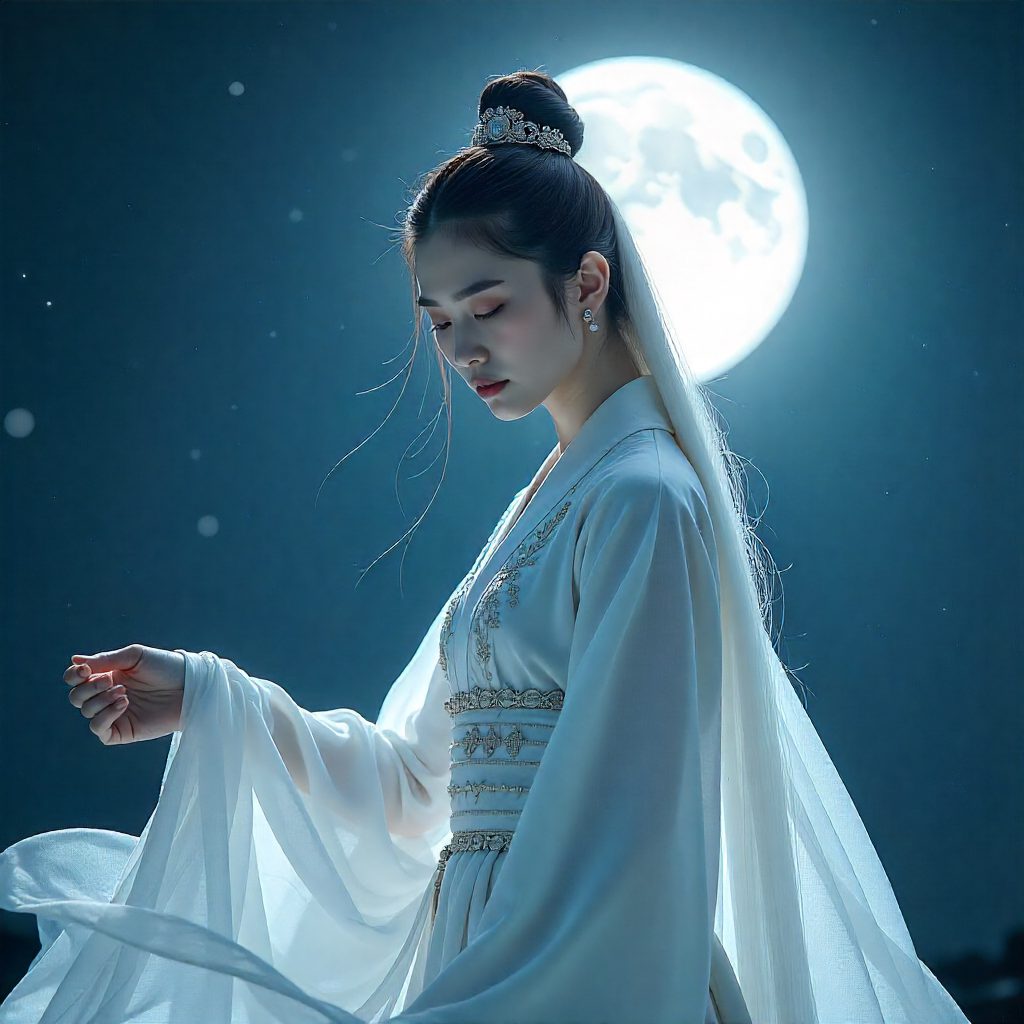
Depictions of Dalnim consistently highlight her soft radiance, mirroring the gentle glow of the moon that governs the night. She is envisioned as a graceful woman with pale, luminous skin that seems to hold the cool shimmer of moonlight. Artists and storytellers describe her robes as flowing and weightless, often white or silver, moving like mist across the sky. These garments traditionally show delicate crescent motifs or faint celestial patterns that shift with the moon’s phases. Her long, silken hair—sometimes imagined as silver, sometimes as deep black—adds to her ethereal presence, while her serene expression conveys compassion rather than awe or fear. Through these traits, Dalnim represents beauty that comforts rather than overwhelms, aligning with her role as a protector of the night.
Family
Dalnim’s familial origins are rooted in folktales explaining the balance between day and night. One of the most widespread narratives recounts how she and her brother, Haenim or Haemosu depending on the tradition, were once mortals fleeing a tiger after the death of their mother. Their desperate prayer for escape allowed them to ascend to the heavens, where the sister became the moon and the brother the sun. This story, still taught in Korean homes and schools, underscores the idea of sibling harmony and shared cosmic duty. Their transformation reflects the yin-yang concept of complementing forces, portraying Dalnim as the gentle counterbalance to her brother’s solar brilliance. In some regional myths she is linked with broader pantheons, but her core identity remains that of a devoted sister whose ascension shaped the natural world.
Other names
Although “Dalnim” remains her most recognized name, oral traditions sometimes use poetic or ceremonial titles that reflect her role. In shamanic chants, she may appear as the “Lady of Night Light” or the “Serene Moon Mother,” emphasizing her nurturing qualities. Within folk stories featuring both sun and moon deities, she appears in the paired expression “Haenim Dalnim,” which celebrates their dual guardianship over time. These alternative references are not separate identities but affectionate expressions that highlight different aspects of her lunar presence. Across Korea’s diverse regions, the nuances of her titles shift, yet the respect conveyed through “nim” remains constant, reaffirming her revered status.
Powers and Abilities
Dalnim governs a range of natural and spiritual forces tied to the moon’s symbolism. Her foremost power is illumination—she guides travelers, protects villages, and brings clarity to those who navigate emotional or literal darkness. She is also associated with balance, ensuring that light and shadow move in steady cycles that sustain life on earth. Many agricultural communities historically relied on lunar calendars, and Dalnim’s waxing and waning were seen as signals for planting, harvesting, and seasonal rituals. Folklore also credits her with influencing tides and human intuition, linking her presence to dreams, foresight, and emotional healing. Her power is restorative rather than destructive, emphasizing renewal, protection, and gentle guidance. Through phases of brightness and dimness, Dalnim embodies the certainty that every dark moment eventually gives way to light.
Modern Day Influence
Dalnim continues to resonate in contemporary Korean culture, even as mythology shifts into artistic and symbolic expressions. During Chuseok, families perform moon-viewing customs and offer gratitude for the year’s harvest, quietly acknowledging the goddess who watches over the full moon. In Korean shamanism (Muism), she remains an invoked presence in rituals calling for wellness, fertility, and household protection. Modern writers, poets, and visual artists frequently draw on her themes of calmness and resilience, using Dalnim as a metaphor for inner strength or emotional clarity. Digital creators reinterpret her in web novels, illustrations, and animations, presenting her as a timeless figure who adapts easily to futuristic and fantasy settings. Global audiences encountering Korean culture through K-dramas, storytelling channels, and digital art increasingly recognize Dalnim as part of Korea’s distinctive mythological identity. Her symbolism—peace, feminine energy, and cyclical renewal—continues to influence mindfulness practices and spiritual aesthetics worldwide.
Related Images


Source
Avid Archer. (2025, November 25). Dalnim: Korean moon goddess of light and balance. https://avid-archer.com/dalnim-korean-moon-goddess/
Storytelling Database. (2025, October 7). Korean mythology 101: The ultimate guide. https://storytellingdb.com/korean-mythology-101/
Wikipedia. (2003, September 26). Korean mythology. https://en.wikipedia.org/wiki/Korean_mythology
Everything About Shell. (2018, September 20). The story behind Dalnim story. https://everythingaboutshell.wordpress.com/2018/09/21/the-story-behind-dalnim-story/
Hanna-One. (2023, December 31). Korean mythology – A rich tapestry of deities, spirits. https://www.hanna-one.com/fan-mythology.html
Grayson, J. H. (2002). Korea: A Religious History. Routledge.
Kendall, L. (1985). Shamans, Housewives, and Other Restless Spirits: Women in Korean Ritual Life. University of Hawaii Press.
Choi, G. H. (2014). Korean Shamanism: The Cultural Paradox. Seoul National University Press.
Lee, P. H. (1989). Sourcebook of Korean Civilization: Volume One. Columbia University Press.
Kim, T. H. (2018). Myths and Legends of Korea. Seoul: Hollym International.
Frequently Asked Questions
Who is Dalnim in Korean mythology?
Dalnim is the Korean Moon Goddess, revered for her calm, protective nature and her role in maintaining cosmic balance between night and day.
What powers does Dalnim have?
She controls moonlight, influences tides and agricultural cycles, protects travelers at night, and embodies intuition, healing, and emotional clarity.
Is Dalnim related to the Sun God?
Yes, in many Korean folktales Dalnim and the Sun God (Haenim or Haemosu) are siblings who ascended to the heavens to become lunar and solar deities.
How is Dalnim celebrated today?
She is honored indirectly during Chuseok moon-viewing traditions, and her symbolism appears in Korean art, literature, and shamanic rituals.
What does Dalnim represent in modern culture?
Dalnim symbolizes feminine strength, serenity, renewal, and the quiet resilience reflected in lunar cycles.