

Zamba : Creator God of the Beti-Pahuin People
Listen
At a glance
| Description | |
|---|---|
| Origin | Beti-Pahuin Mythology |
| Classification | Gods |
| Family Members | Mingon (Wife) |
| Region | Cameroon |
| Associated With | Creation |
Zamba
Introduction
In the mythological traditions of the Beti-Pahuin peoples of Central Africa—including the Ewondo, Fang, and Bulu—few figures hold as much spiritual weight as Zamba, often also called Nzame. As the supreme creator god, Zamba represents the foundation upon which the universe, humanity, and moral order rest. His presence in Beti-Pahuin cosmology reflects a worldview deeply rooted in the harmony between humans, nature, and the spirit world. Storytellers across generations describe him as the architect of existence, the one who sets the laws that sustain life, and the divine force whose withdrawal from the world explains why suffering and mortality exist. Through these narratives, Zamba becomes both a symbol of ancestral guidance and a reminder of the fragile balance between divine law and human responsibility.
Physical Traits
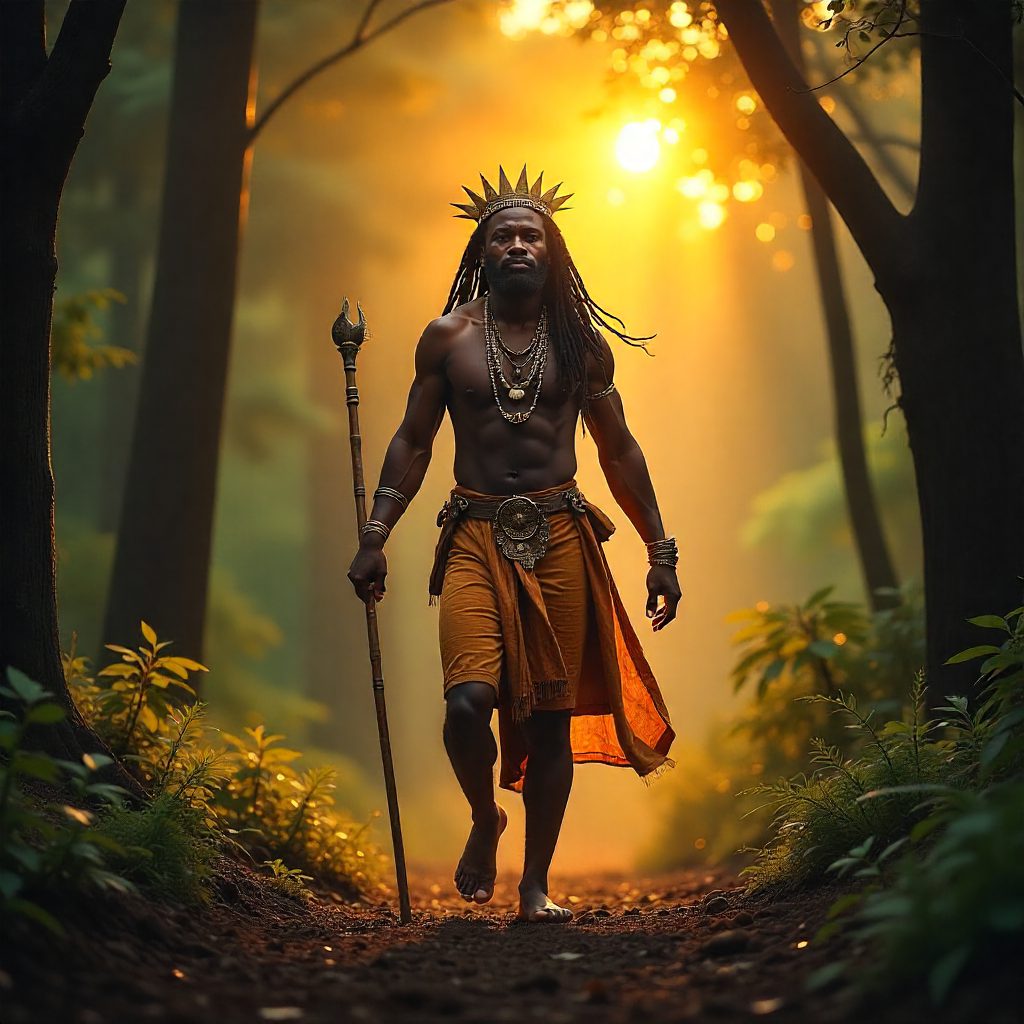
Zamba’s physical form is described differently depending on the region and the tradition, but all share the idea that he is not bound to a single appearance. In many Beti-Pahuin stories, he takes on a human-like form when he lives among people during the era often referred to as the golden age. This form allows him to interact directly with humanity, teach them sacred laws, and nurture their early society. Yet other versions emphasize that Zamba transcends physical definition, presenting him as an immaterial cosmic force whose true nature cannot be perceived by the human eye. These interpretations coexist because both emphasize his divinity—whether he appears as a fatherly figure walking among humans or as an unseen presence shaping the universe with infinite authority.
Family
Zamba exists above all creation, yet his mythological family plays an essential role in the story of humanity’s early fate. His wife, Mingon, described as exceptionally beautiful, shares life on earth with him during the golden age. Together, they have a daughter, whose death becomes one of the most significant turning points in Beti-Pahuin mythology. When Zamba instructs that his daughter should not be buried in the sacred forest, the people violate this divine command. This act, along with the growing influence of the malevolent spirit Evu, breaks the original harmony between humans and the divine. In many traditions, Zamba’s heartbreak over humanity’s disobedience leads him to withdraw permanently from the earthly world. Mingon, left behind, ultimately faces her own tragic end, further illustrating how the fate of the divine family mirrors humanity’s transition from innocence to struggle.
Other names
Across the Beti-Pahuin region, Zamba is known by several names, reflecting the linguistic variety within the broader cultural group. The name Nzame, commonly used among Fang communities, is interchangeable with Zamba and shares the meaning of “God” or “the Supreme One.” Variants such as Nzeme, Zama, and Ntondobe appear in other dialects and storytelling traditions, each expressing reverence for the creator. These names highlight how oral traditions adapt across neighboring clans while still maintaining a unified belief in a singular divine being who shaped the world and established the rules that govern life. Despite regional differences, all names point back to the same powerful creator whose authority defines the moral and cosmic order.
Powers and Abilities
Zamba’s abilities are described as limitless, shaping the world at both physical and spiritual levels. As the creator of the universe, he forms the earth, brings life into existence, and establishes the foundational laws that allow humanity to thrive. During the golden age, he ensures that no one suffers from hunger or illness by providing sustenance each day and reviving those nearing death. His power extends beyond creation to moral governance, as he sets down rules about sacred spaces, proper burial customs, and the behavior expected of humans living under divine protection.
The arrival of death (Awu) and suffering is directly tied to the breaking of Zamba’s laws and the influence of Evu, the spirit of disorder and malevolence. After humanity violates the sacred burial instructions, Zamba withdraws his life-giving powers, marking the end of an era where death could be reversed. His departure to the sky creates the distance between humans and the divine that persists in Beti-Pahuin belief. Though he no longer intervenes directly, Zamba remains the ultimate source of authority, the one whose original laws continue to shape human conduct and cultural memory.
Modern Day Influence
Zamba’s legacy continues to influence Beti-Pahuin communities even as modern life transforms cultural landscapes. With the spread of Christianity in Central Africa, many believers identified Zamba with the Christian God, allowing traditional spiritual concepts to blend with new religious frameworks without erasing indigenous heritage. Among storytellers, elders, and cultural preservationists, Zamba remains a central figure in explaining the relationship between humans and spiritual forces, especially concerning life, death, and moral boundaries.
The myth of Zamba’s departure from earth reflects a philosophical understanding shared across many African traditions—that human suffering arises from moral rupture and separation from the divine. These stories continue to serve as educational tools, teaching respect for sacred spaces, the importance of obedience to moral law, and the consequences of disrupting natural balance. In contemporary literature, visual art, and cultural revitalization movements, Zamba is often invoked as a symbol of ancestral wisdom and the resilience of Central African identity. His mythology bridges generations, reminding communities of their shared origins and the spiritual truths embedded in their history.
Related Images

Source
S. (2021). Origin of EVU (Evil Spirit) and AWU (Death) Amongst the Beti-Pahuin. University of Warsaw. http://omc.obta.al.uw.edu.pl/myth-survey/item/187
Beti-Pahuin peoples. (2005, February 3). Wikipedia. https://en.wikipedia.org/wiki/Beti-Pahuin_peoples
Bantu Mythology: Traditional Beliefs And Legends. (2025, September 25). Consult Ifa. https://consultifa.com/blog/bantu-mythology-traditional-beliefs-and-legends/
Beti-Pahuin peoples. (n.d.). Grokipedia. https://grokipedia.com/page/Beti-Pahuin_peoples
African Mythology: A to Z. (n.d.). Calibre. https://calibre.thecartwrights.nz/download/4782/pdf/4782.pdf
Laburthe-Tolra, P. (1985). Les seigneurs de la forêt: Essai sur le passé historique, l’organisation sociale et les normes religieuses des anciens Beti du Cameroun. Paris: Publications de la Sorbonne.
Mbiti, J. S. (1990). African religions and philosophy (2nd ed.). Oxford: Heinemann.
Neba, A. S. (1999). Modern geography of Cameroon. Bamenda: Neba Publishers.
Nkwi, P. N., & Warnier, J.-P. (1982). Elements for a history of the Western Grassfields. Yaoundé: University of Yaoundé Press.
Tardits, C. (1980). Le royaume Bamoun. Paris: Armand Colin.
Frequently Asked Questions
Who is Zamba in Beti-Pahuin mythology?
Zamba is the supreme creator god of the Beti-Pahuin peoples, responsible for forming the world, establishing moral laws, and shaping the earliest human society.
What powers is Zamba known for?
Zamba possesses the power to create life, sustain humanity, restore the dying, and uphold the cosmic laws that maintain balance in the world.
Why did Zamba leave the earth?
He withdrew after humans disobeyed his sacred laws, an act that introduced death and suffering into the world and ended the golden age.
What other names is Zamba known by?
Zamba is also called Nzame, Nzeme, Zama, and other local variations across Beti-Pahuin communities.
How is Zamba viewed in modern Central African culture?
Many equate Zamba with the Christian God, and his mythology continues to influence moral teachings, storytelling, art, and cultural identity.
