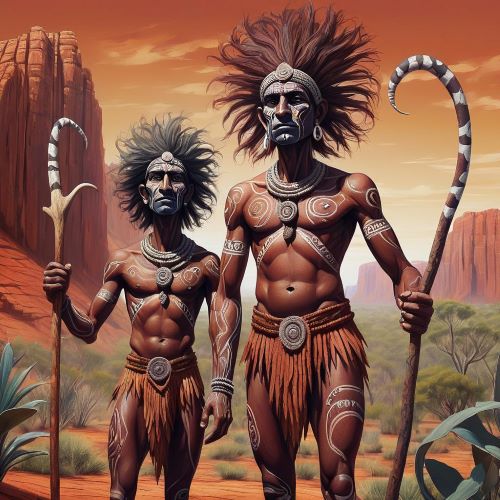


Anangu (Pitjantjatjara, Yankunytjatjara & Pintupi) Mythology
Anangu mythology reflects the spiritual traditions of the Pitjantjatjara, Yankunytjatjara, and Pintupi peoples of Central Australia, whose cultural heritage is rooted in the vast desert landscapes surrounding Uluru, Kata Tjuta, and the Western Desert. Known collectively as Tjukurpa (often translated as the Dreaming or Dreamtime), this spiritual framework describes the creation of the world, the laws of life, and the responsibilities each person holds toward their community and Country.
Tjukurpa is not a distant mythological era — it is a living system guiding social conduct, ecological knowledge, ceremony, and identity. According to Tjukurpa, ancestral beings travelled across the land, forming hills, rock formations, waterholes, sand dunes, animals, and plants. Their journeys established the laws that govern kinship, resource sharing, and cultural responsibilities. These beings left their presence in the landscape, making Country itself a sacred testimony to ancestral action.
Among the most famous places connected to Anangu mythology is Uluru, one of the world’s most significant cultural landscapes. Its caves, ridges, and rock features correspond to specific Tjukurpa stories involving ancestral beings such as the Mala people, Kuniya the python, and the Lungkata blue-tongue lizard. Each feature of Uluru is tied to ceremonial knowledge, moral teachings, and cultural law. Nearby Kata Tjuta (the Olgas) is equally significant, associated with senior men’s law and deeply embedded in Anangu storytelling.
For the Pintupi people of the Western Desert, Tjukurpa maps ancestral journeys across vast sand dunes and hidden water sources. Songlines — pathways created by ancestral beings — connect these places across thousands of kilometres, forming spiritual and geographic networks that guide travel, storytelling, and ceremony.
Anangu mythology also emphasizes correct behaviour and responsibilities. Every story teaches a lesson: how to share food, how to care for Country, how to maintain kinship ties, and how to respect sacred places. Elders are custodians of this knowledge and ensure that cultural law is preserved through ceremony, dance, body painting, and oral storytelling.
Despite colonisation, missions, and displacement, Anangu mythology remains strong. Land rights movements, cultural education programs, and community-led tourism initiatives have helped sustain Tjukurpa and protect sacred landscapes. Art centres across Central Australia continue to share Tjukurpa stories through painting, weaving, and sculpture, strengthening cultural identity across generations.
Anangu mythology stands as a powerful living tradition — a system of law, spirituality, and environmental understanding that shapes the heart of Central Australia.