

Golden Axe of Hephaestus : The Legendary Greek Divine Weapon
Golden Axe of Hephaestus
Introduction
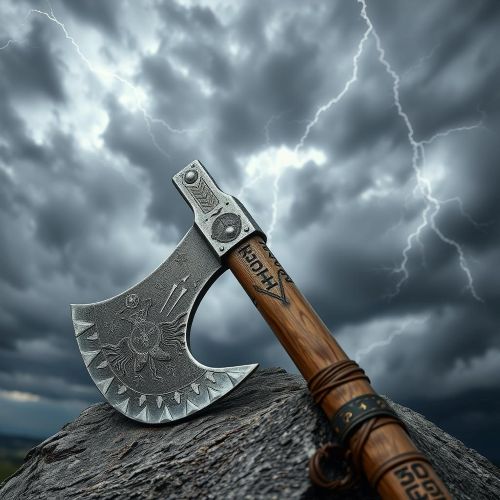
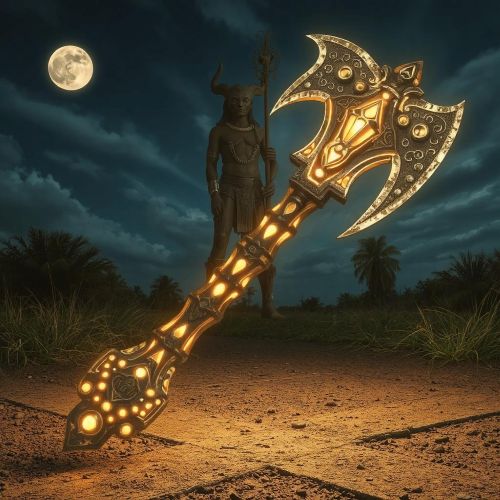
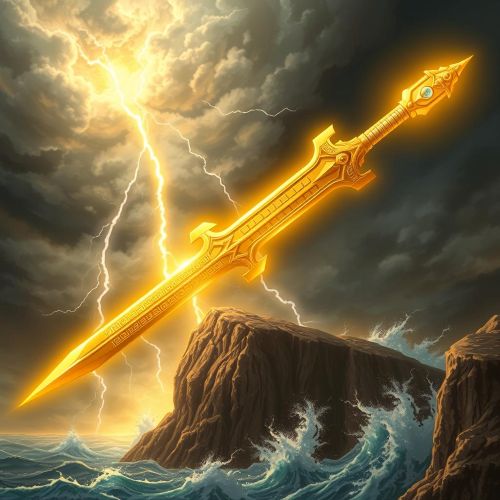
In the intricate world of Greek mythology, divine weapons often shape the balance of power among gods, heroes, and mortals. Among these fabled creations, the Golden Axe of Hephaestus remains one of the most intriguing artifacts, even though it is not as widely referenced as Zeus’s thunderbolt or Athena’s spear. Its legacy survives through the mythic reputation of its maker: Hephaestus, the Olympian god of fire, metallurgy, artisans, and invention. More than a mere weapon, the Golden Axe symbolizes the god’s mastery over fire and metal, his identity as both a creator and protector, and the duality of destruction and craftsmanship that defines his mythic persona. While surviving texts mention the axe only indirectly, its significance emerges through archaeology, symbolism, and the broader traditions surrounding divine tools forged by the god of the forge.
Origins
The origins of the Golden Axe are closely tied to Hephaestus’s identity as the supreme smith of the Greek world. Ancient authors such as Homer and Hesiod describe his workshops—either beneath Mount Olympus or deep within volcanic regions like Mount Etna—where anvils rang and sparks flew day and night. It is within these fiery forges that the Golden Axe is believed to have been crafted, shaped from divine metals associated with the radiance of gold and the unyielding strength of celestial ore.
Although Greek literature provides no detailed narrative of the axe’s creation, the concept is reinforced by the symbolic connection between the axe and the labrys, the double-headed sacred axe found prominently in Minoan and Lydian cultures. Ancient historian Plutarch noted that “labrys” was the Lydian term for axe, and Arthur Evans famously linked the word to “labyrinth,” or “the house of the double axe.” These archaeological and linguistic contexts place the Golden Axe within an ancient tradition of ceremonial axes that represented divine authority, earth power, and religious ritual. The axe’s golden nature also reflects Hephaestus’s mastery of metallurgy, transforming raw materials into objects of cosmic significance.
Think you know your myths and legends? Dive into the world of ancient stories and test your knowledge with our engaging quizzes on Mythlok!
Powers
The Golden Axe of Hephaestus is traditionally associated with abilities that mirror the god’s dominion over fire and craftsmanship. Its foremost attribute was its indestructible composition, forged from metals unavailable to mortals and tempered in divine flame. No earthly force could break, dull, or tarnish it, making it a perfect instrument of both precision and power.
The axe also possessed a deep affinity with elemental fire, capable of channeling volcanic heat and molten energy. Myths involving Hephaestus often describe his tools glowing with inner flame, a trait that naturally extends to the Golden Axe. Some interpretations propose that the axe was able to split stone, metal, and magical barriers with equal ease, reflecting the god’s ability to open mountains and shape the physical world.
Its symbolic attributes were equally powerful. As both a builder’s tool and a warrior’s weapon, the Golden Axe represented creation and destruction in perfect balance, a theme deeply rooted in Hephaestus’s mythological character. In some scholarly readings, especially those linking it to Minoan ceremonial axes inscribed with undeciphered Linear A symbols, the weapon may also carry ritualistic, invocative, or protective powers.
Owners/Users
The Golden Axe was chiefly associated with Hephaestus himself, who used his tools not only for war but for shaping the divine order. Unlike Ares or Athena, Hephaestus was seldom portrayed in battle, yet he wielded his weapons with authority when defending Olympus or establishing new divine strongholds.
There are also traditions suggesting the axe was temporarily entrusted to mortals or demigods chosen by the god. Heroes who received divine weapons—such as Achilles, who bore armor forged by Hephaestus—demonstrate the god’s willingness to support those he deemed worthy. Although no canonical text names a specific human wielder of the Golden Axe, later mythographers and modern retellings frequently place the weapon in the hands of select champions to overcome otherwise insurmountable tasks.
Some archaeological studies of golden votive axes found in Crete, Anatolia, and Greek sanctuaries propose that priestly custodians may have symbolically represented Hephaestus or invoked him through rituals involving ceremonial axes. This association reinforces the idea that the Golden Axe held a religious significance beyond simple warfare.
Instances used
Surviving Greek literature does not offer explicit accounts of the Golden Axe in major battles, yet its presence is felt through episodes that involve axes used by Hephaestus or divine tools with similar attributes.
One of the most famous scenes in mythology involving an axe—though not explicitly labeled the golden one—is the birth of Athena, where Hephaestus splits open Zeus’s head to release the fully formed goddess. Some modern scholars suggest the Golden Axe may have been the symbolic or artistic descendant of this mythic tool.
The broader tradition of Hephaestus assisting gods and heroes with powerful creations also supports the axe’s implied participation in mythic constructions, such as carving out the first divine forges, shaping landforms, or assisting in battles during the Titanomachy and Gigantomachy.
In Minoan and later Greek religious contexts, golden axes discovered in palatial sanctuaries appear to have served ritual and ceremonial purposes, possibly linking them to agricultural blessings, divine protection, or initiatory rites. These objects echo the mythical Golden Axe as an emblem of both spiritual and elemental power.


Source
Centre of Excellence. (2023, April 3). Hephaestus in Greek mythology: Myths, powers, and symbols. Retrieved from https://www.centreofexcellence.com/hephaestus-in-greek-mythology/
Plutarch. (n.d.). Quaestiones Graecae (302a). In Labrys. Wikipedia. Retrieved from https://en.wikipedia.org/wiki/Labrys
Theoi Project. (n.d.). Hephaestus myths 1 general. Retrieved from https://www.theoi.com/Olympios/HephaistosMyths.html
Evans, A. (1921). The Palace of Minos. London: Macmillan.
Burkert, W. (1985). Greek religion. Harvard University Press.
Nilsson, M. P. (1950). The Minoan-Mycenaean religion and its survival in Greek religion. Lund: Gleerup.
Frequently Asked Questions
What is the Golden Axe of Hephaestus in Greek mythology?
It is a mythical golden weapon forged by Hephaestus, symbolizing divine craftsmanship, fire, and authority.
Did Hephaestus use the Golden Axe in battles?
While not widely documented in battle myths, it is believed he used it to shape divine forges, split rock, and perform cosmic feats.
Is the Golden Axe connected to the Minoan labrys?
Yes, its concept is rooted in the sacred double-axe tradition found in Minoan and Lydian cultures.
Could mortals wield the Golden Axe?
Some traditions suggest Hephaestus occasionally lent divine tools to worthy heroes, though direct references are rare.
Why is the Golden Axe important in mythology?
It represents the dual power of creation and destruction, embodying Hephaestus’s role as master craftsman and elemental deity.